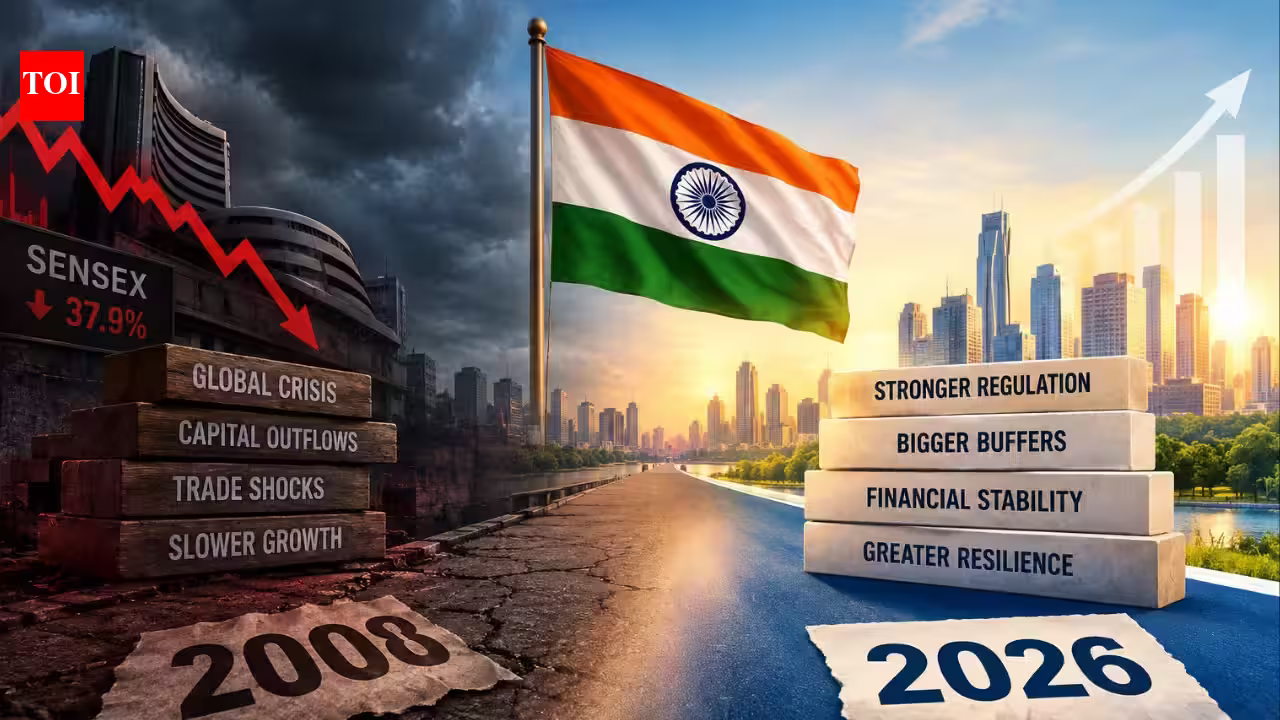







The global financial crisis of 2008 serves as a seminal case study in economic resilience and regulatory evolution. Emerging from the US housing market due to excessive credit expansion and opaque mortgage-linked securities, the crisis rapidly metastasized, leading to the collapse of Lehman Brothers and a subsequent freezing of global credit markets. For India, the period was a baptism by fire, testing the robustness of its financial institutions and the efficacy of its central banking policies against a massive external shock.
Assessing the Impact on the Indian Economy
India’s integration into the global economy by 2008 ensured that the country could not remain entirely insulated from the contagion. The primary transmission channels were threefold: plummeting market sentiment, a retreat of foreign institutional investors (FIIs), and tightening external financing conditions for Indian corporates. The BSE Sensex witnessed a sharp contraction of 37.9 percent in 2008, and GDP growth decelerated to 6.7 percent in 2008-09 from the robust 8.8 percent average recorded in the preceding five-year period.
Despite these headwinds, the Indian banking sector remained largely unscathed. This stability was primarily attributed to India’s cautious approach to financial liberalization. The rupee remained a partially convertible currency, limiting the exposure of domestic banks to complex, toxic global financial instruments. The Reserve Bank of India (RBI) acted with decisive speed, slashing the repo rate from 9 percent to 4.75 percent and significantly reducing the cash reserve ratio between late 2008 and early 2009. These liquidity-boosting measures injected approximately Rs 5.85 lakh crore into the system, effectively ring-fencing the economy from a full-scale banking collapse.
Evolution of the Too Big to Fail Framework
The 2008 crisis popularized the concept of “too big to fail,” highlighting how the insolvency of a single interconnected institution can trigger systemic risk. While India avoided a Lehman-like scenario, the crisis exposed a significant legislative gap: the absence of a comprehensive resolution framework for large financial institutions. While the Banking Regulation Act provided basic powers for reconstruction or amalgamation, it lacked the agility required for modern market crises.
In the years following 2008, India made significant strides in closing these regulatory loopholes. The enactment of the Insolvency and Bankruptcy Code (IBC) in 2016 provided a much-needed, time-bound mechanism for resolving corporate stress. Furthermore, the RBI’s introduction of the Domestic Systemically Important Banks (D-SIB) framework in 2014 formally acknowledged that the failure of lenders like SBI, HDFC Bank, or ICICI Bank would necessitate extraordinary scrutiny and higher capital requirements. Despite these advancements, legal experts note that while the framework is more robust today than it was nearly two decades ago, there remains a need for a specialized resolution law tailored specifically to systemic financial entities.
Proactive Regulatory Mindset
One of the most profound shifts post-2008 has been the change in the regulatory philosophy adopted by the RBI and the Securities and Exchange Board of India (SEBI). The historical reliance on post-facto intervention has been replaced by a proactive, risk-anticipatory approach. Regulators now prioritize identifying potential vulnerabilities before they scale into systemic threats.
This shift is evident in the regulatory handling of modern financial innovations. When the digital lending landscape began to expand rapidly, the RBI implemented guidelines on responsible lending and consumer protection early in the sector’s lifecycle. Similarly, SEBI has implemented stringent disclosure and governance requirements for newer investment structures like Real Estate Investment Trusts (REITs) and Alternative Investment Funds (AIFs). By embedding risk-mitigation measures into the structure of these products from their inception, Indian regulators are attempting to avoid the trap of innovation outpacing oversight.
Buffers and Resilience in a Modern Context
The recovery following 2008 was swift, underpinned by strong domestic demand and structural reforms. However, the most critical lesson learned was the necessity of maintaining substantial external buffers. India’s foreign exchange reserves, which hovered around $300 billion during the crisis, have surged to record levels, exceeding $785 billion by September 2026. This massive stockpile provides a critical shock absorber against currency volatility and capital flight.
The RBI’s recent policy actions—such as raising risk weights on unsecured consumer loans and credit-card exposures—demonstrate a continued commitment to preventing credit bubbles before they destabilize the macro-economy. This approach suggests that the modern Indian policy framework treats financial stability as a permanent, active concern rather than a secondary objective.
The AI Boom and Future Risks
As the global economy encounters the massive investment cycle driven by artificial intelligence, concerns regarding a new asset bubble have emerged. Comparisons to the 2008 housing bubble are inevitable given the sheer scale of capital expenditure—with global tech giants expected to invest trillions of dollars in data centers and computing infrastructure by 2030.
However, the structural differences are noteworthy. The 2008 crisis was driven by widespread leverage and the democratization of toxic mortgage assets across retail and institutional portfolios. Conversely, current AI investment is dominated by corporations with strong balance sheets and substantial cash reserves. The key indicator for future stability, according to market experts, is not the valuation multiple itself, but rather the extent to which future infrastructure expansion is funded through debt. Should this shift toward a debt-heavy model, the lessons of 2008—specifically regarding liquidity and interconnectedness—will become immediately relevant once more.
Strategic Takeaways for the Business Landscape
For Indian businesses and financial institutions, the 18-year trajectory from 2008 to the present underscores a vital realization: the stability of an economy is determined by the measures taken in times of calm, not during the crisis itself. The post-2008 era has taught market participants that cheap capital is not a permanent feature of the global landscape, and that excessive leverage remains the primary catalyst for systemic failure.
The contemporary Indian economy is deeper, more integrated, and significantly more resilient than it was in 2008. The regulatory architecture is more sophisticated, and the financial system is better equipped to monitor concentration risks. Yet, the challenge remains unchanged in its essence: preventing a single market disruption or a localized boom from spiraling into a systemic catastrophe. As India navigates the new frontiers of technology and global finance, the ability to discern the difference between legitimate growth and unsustainable bubble-driven expansion will remain the ultimate test of the country’s institutional maturity.
Disclaimer: This content is auto-generated for informational purposes only.
Source: Read Original News