





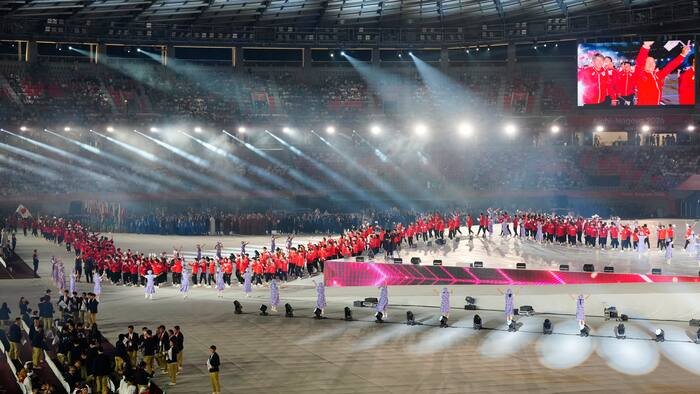
NAGOYA – The Asian Games officially kicked off with a flourish of pomp and ceremony on Saturday, but for the 11,000 athletes gathered in Japan, the reality of the competition has been underway for days.
While the opening ceremony—themed the “Harmonic Heart Beat”—saw Emperor Naruhito and Empress Masako preside over a vibrant celebration at Nagoya City Stadium, the sporting reality is far more frantic. To accommodate a staggering 43 sports, including modern additions like esports, mixed martial arts, padel, and teqball, organizers were forced to launch events like basketball and soccer as early as September 10. By the time the final flame was lit on Saturday, men’s basketball had already moved into the semifinal stage.
The sheer scale of the event rivals the global Summer Olympics. With an athlete count likely to match or exceed the 12,000 participants seen in Hangzhou three years ago, the Games are a logistical marathon. Beyond traditional Olympic staples like track and field, the event highlights unique regional disciplines such as kurash (an ancient form of wrestling), kabaddi, and sepaktakraw.
Host nation Japan boasts the largest delegation with 933 athletes, followed by China, which sent over 800. Observers expect a familiar leaderboard, with China—which dominated the last games with 201 gold medals—expected to once again set the pace for Japan and South Korea.
However, the road to this year’s opening has been anything but smooth. In a departure from typical host city infrastructure, Nagoya opted against building a dedicated athletes’ village. Instead, the 17,000 expected participants and staff are being housed across a mix of hotels, converted wooden containers, and a massive cruise ship. Reports of leaking roofs, cramped quarters, and complex transport logistics between venues have already surfaced, underscoring the budgetary constraints following the massive expenditures of the pandemic-delayed Tokyo Olympics.
Political tensions have also punctuated the lead-up. In a bizarre administrative blunder, organizers played the North Korean national anthem during a field hockey match between South Korea and Bangladesh, leaving South Korean players standing in confusion. Meanwhile, the Taiwanese sports minister, Lee Yang, faced a temporary, unexplained barring from a welcoming ceremony, reigniting focus on the delicate diplomatic status of Taiwan, which competes under the name “Chinese Taipei.”
Despite the friction, Sheikh Joaan bin Hamad Al Thani, president of the Olympic Council of Asia, struck a tone of unity during his address. “Tonight the eyes of Asia, and much of the world, turn to Japan,” he declared.
For organizers, the official start of the 16-day event offers a necessary reprieve. As the pageantry fades, the focus now shifts entirely to the venues, where the grueling task of managing one of the world’s largest sporting spectacles truly begins.
Disclaimer: This content is auto-generated for informational purposes only.
Source: Read Original News