







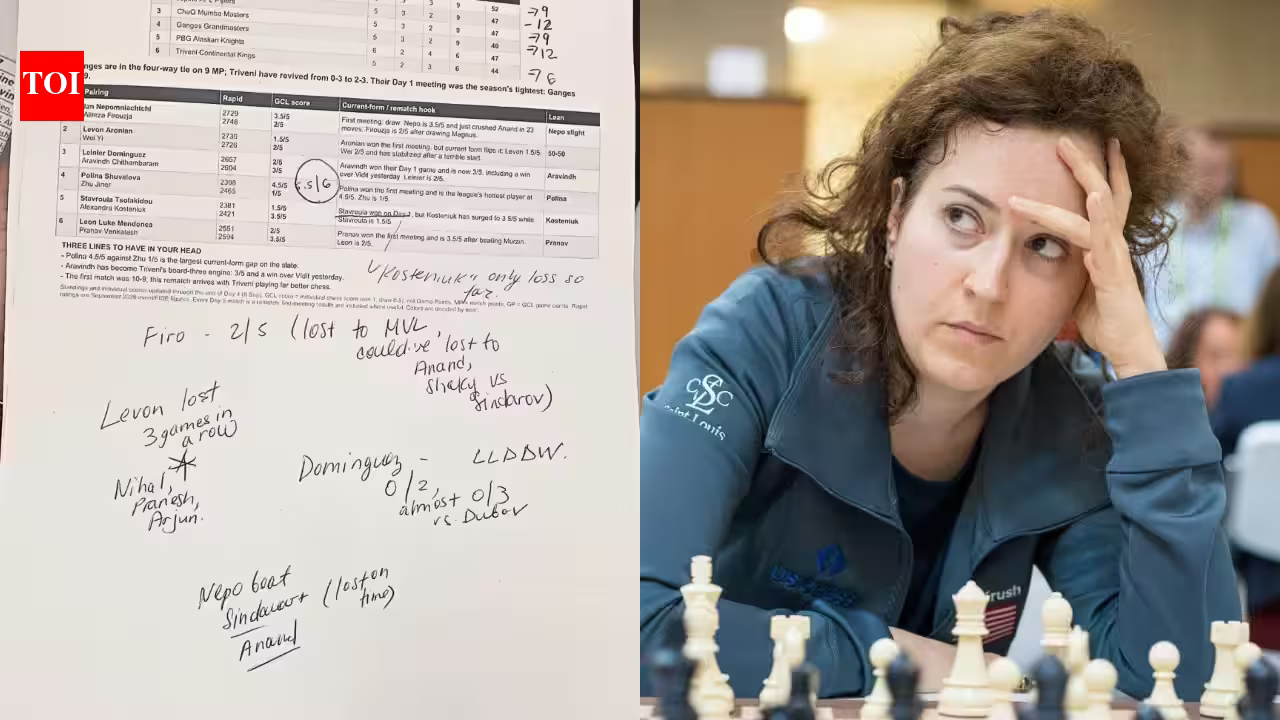
SAMARKAND — For over four decades, the American women’s chess team existed on the periphery of the Olympiad podium, searching for the elusive formula to break the stranglehold of European and Asian dominance. It wasn’t until the early 2000s, bolstered by the arrival of legend Susan Polgar, that the United States finally tasted hardware. Yet, amidst the shifting tides of rosters and the passing of generational eras, one constant has remained pinned to the scoresheet: Irina Krush.
As she competes in her record-extending 13th Chess Olympiad in Uzbekistan, the 42-year-old Grandmaster remains the standard-bearer for U.S. women’s chess. She is not just a competitor; she is a bridge between the sport’s quiet, analog past and its current, hyper-competitive, televised era.
A Legacy Forged in Brooklyn
Krush’s journey began thousands of miles from the American spotlight. Born in Odesa, Soviet Ukraine, she moved to Brooklyn with her parents at the age of five. Guided by her father, an amateur player with a keen eye for talent, she was identified early as a rare prodigy. By six, she was testing her wits against adults at the prestigious Manhattan Chess Club; by 14, she had captured the U.S. Women’s Championship title. Nearly three decades later, that victory remains a record, standing as a testament to the precocious brilliance that defined her youth.
Today, Krush occupies a unique space in the hierarchy of the game. She is the first, and currently the only, woman to earn the prestigious Grandmaster (GM) title while playing under the U.S. flag.
The Dual Life: Commentary and Competition
Krush’s recent professional evolution has seen her pivot to the other side of the glass. Her deep involvement with the Global Chess League (GCL), both as a player—famously joining a team centered around the indomitable Magnus Carlsen—and as a prominent commentator, has added a fresh dimension to her career.
“It was a chance to play in the same team as Magnus, and it was like a very special opportunity,” Krush reflected. “I definitely thought that was a highlight of my chess career.” However, she is quick to note the mental toll of playing alongside the world’s greatest. “You feel the pressure because you don’t want to look like the fool on the team with Magnus.”
Transitioning into the commentator’s booth has been an organic process for the veteran. Without formal training, she relies on her lifelong fluency in the language of the game. Her preparation is not about scripting lines, but about deep tactical immersion.
“I don’t have any training in commentary, but it comes naturally to talk about chess,” Krush said. “As the tournament continues, you start focusing more on the recent form of the players rather than their historical records. Looking at the games—that’s the best part.”
The Cost of the Craft
The glamour of the broadcast booth often belies the grueling logistics of a high-level chess professional. Arriving in Samarkand fresh from a commentary stint in India, Krush admits the balance is delicate. The broadcast schedule, which demands early mornings and intense mental output, has left little room for her own endgame preparations.
“Honestly, I have not had a chance to do much chess for myself at all,” she admitted, noting the trade-offs she has made to maintain her presence on both fronts. Even as she was honored for her contributions as the “voice of the league” during the GCL closing ceremonies, her mind was already elsewhere, focused on the immediate tactical challenges awaiting her in Uzbekistan.
The Future of American Chess
As Krush settles into the Olympiad, she finds herself the mentor to a rising tide of American talent. Alongside teammates like Carissa Yip and Alice Lee, she views the current U.S. squad as a reflection of how far the sport has traveled.
“It’s much more competitive now,” Krush observed. “There’s more incentive to play, more opportunities. We didn’t have the U.S. Championships with these kinds of prizes 25 years ago. We didn’t have the American Cup or the Cairns Cup.”
This infrastructure, she believes, is finally paying dividends. The influx of young players approaching the 2400 rating threshold is a sign that the program she helped build is sustainable. While the U.S. team faced early hurdles in Samarkand—a difficult draw against Uzbekistan and a setback against a surging India—Krush remains the steady hand at the helm.
Whether she is analyzing a grandmaster’s blunder on air or calculating her own path to victory at the board, Irina Krush remains an indispensable figure in the sport. For a woman who has defined an era, the desire to compete hasn’t waned; it has simply evolved, proving that for a true grandmaster, the game is never really over.
Disclaimer: This content is auto-generated for informational purposes only.
Source: Read Original News