





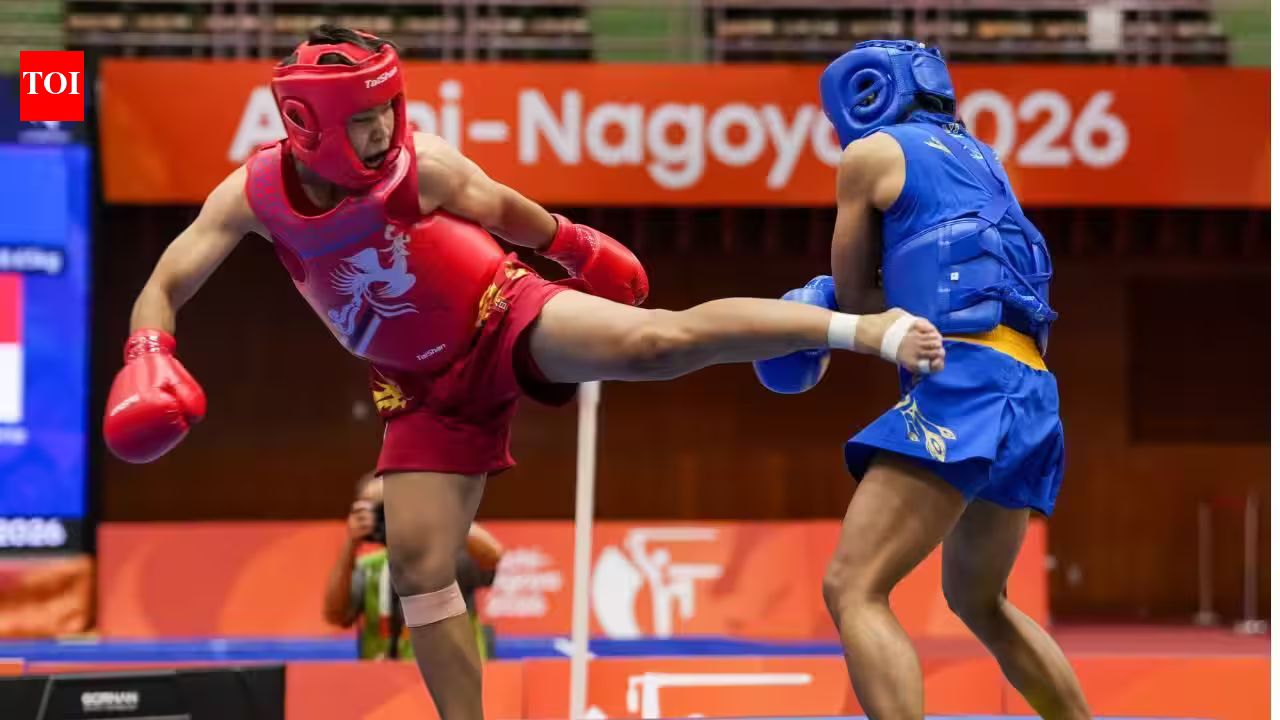
NAGOYA, JAPAN — The mantra of an elite athlete is often to tune out the noise, but for Naorem Roshibina Devi, that noise has been deafening for the better part of the last three months. Amidst the swirling administrative controversies and high-stakes courtroom dramas that preceded her departure for the 20th Asian Games, the Manipuri wushu star has maintained a singular, steely focus. On Wednesday, that focus paid the ultimate dividend as she vaulted into the women’s 60kg sanda final, placing her on the precipice of becoming India’s first-ever Asian Games gold medalist in the sport.
Competing at the Aichi Prefectural Martial Arts Hall, the 25-year-old put on a tactical masterclass, dismantled Indonesia’s Thania Kusumaningtyas with a decisive 2-0 victory. The win did more than just secure her a spot in the gold medal bout; it validated her journey and solidified her status as the undisputed icon of Indian wushu.
## A Legacy in the Making
Roshibina Devi is no stranger to the continental podium, but she is clearly hungry for a change in shade. Her journey began with a bronze medal at the 2018 Jakarta Games, followed by a hard-fought silver at the 2023 Hangzhou edition. By reaching the final in Nagoya, she has already guaranteed herself a third consecutive Asian Games medal—a feat of consistency that is practically unheard of in the discipline.
Her path to this final has been nothing short of dominant. She entered the tournament with a controlled intensity, dismantling Bangladesh’s Shika Khatun in the pre-quarterfinals before delivering a clinical 5-0 thrashing of Macau’s Chu Man Sin in the quarterfinals. The semifinal victory over Kusumaningtyas was the exclamation point on a run that has left spectators and analysts alike marveling at her composure under pressure.
## From Controversy to Contention
The narrative surrounding Roshibina’s presence in Nagoya is a complex one, steeped in internal federation disputes that nearly saw her sidelined entirely. Following her defeat to teammate Divyanshi Choudhary during the Srinagar selection trials in June, it appeared that Roshibina’s dream of a third Asian Games appearance had evaporated.
Fate, however, took a cruel and unexpected turn when Choudhary suffered a high-grade ACL tear. The medical emergency forced the Wushu Association of India (WAI) to look back toward their former medalist. What followed was a volatile period of public outcry, with Choudhary alleging that the federation had engaged in preferential treatment and mental harassment to ensure Roshibina’s return to the squad. The situation reached such a fever pitch that it involved reports of suicide threats, casting a long, dark shadow over the Indian wushu camp heading into the Games.
Through it all, the WAI stood firm, maintaining that the replacement was handled strictly through transparent medical channels. Roshibina, meanwhile, chose to navigate the storm in silence. Rather than engaging in the vitriol on social media or in the press, she retreated to the gym. In Nagoya, the results of that discipline are evident. She has not just performed; she has commanded the arena, silencing her critics with high-precision kicks and superior mat awareness.
## The Final Hurdle
Standing between Roshibina and history is a titan of the sport: China’s Zhang Xiaoyu. The final, scheduled for Thursday, represents the most significant challenge of her career. China has historically been the epicenter of wushu excellence, and Xiaoyu represents the daunting standard the Manipuri athlete must overcome to claim the top spot on the podium.
Regardless of Thursday’s outcome, Roshibina has already proven that her resilience is as formidable as her striking ability. She has weathered institutional upheaval, the pressure of being a replacement athlete, and the weight of national expectation. Should she defeat Xiaoyu, she will not only secure a gold medal; she will effectively end the debate surrounding her selection by cementing her place in the pantheon of Indian sporting legends.
“She has let her performance do the talking,” one coaching staff member noted following the semifinal win. Indeed, as the lights dim in the Aichi Prefectural Martial Arts Hall, the chatter of the past three months has been replaced by the rhythmic thud of combat and the anticipation of a nation.
For Roshibina Devi, the mission is simple: one final fight, one final push, and a date with history. Whether she returns home with the gold or another historic silver, her resilience in the face of adversity has already become the defining story of India’s campaign in Nagoya. The stage is set, the stakes have never been higher, and for six minutes of combat on Thursday, all eyes in India will be fixed on the center of the wushu mat.
Disclaimer: This content is auto-generated for informational purposes only.
Source: Read Original News