









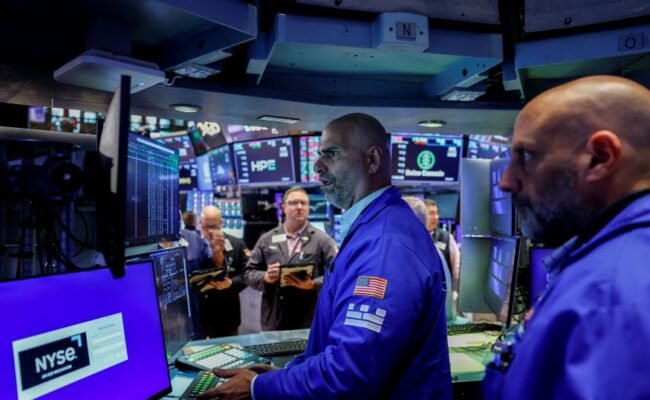
U.S. equity markets faced a sharp sell-off on Wednesday as a surge in Treasury yields reignited concerns over aggressive Federal Reserve monetary policy. The benchmark 10-year Treasury yield climbed to its highest level since 2007, crossing the 5% threshold, as investors digested fresh economic data signaling unexpected strength in the American economy.
The market reaction was sparked by the release of the S&P Global composite PMI Output Index, which jumped to 58.4 for September. This reading, the highest since 2021, indicates that business activity in both the manufacturing and services sectors is accelerating, despite the Fed’s ongoing efforts to cool the economy.
## Markets Brace for “Higher for Longer” Interest Rates
The robust economic indicators have significantly altered interest rate expectations. According to Fed funds futures, the probability of an interest rate hike in October has spiked to 73%, up from 53% just days ago. Investors, increasingly wary that inflation remains stubbornly above the central bank’s 2% target, are pricing in a prolonged period of elevated borrowing costs.
Fed Governor Michael Barr echoed this hawkish sentiment on Wednesday, confirming that the central bank remains focused on “recalibrating” short-term rates to tame price pressures. As a result, the Dow Jones Industrial Average shed 0.18%, the S&P 500 fell 0.53%, and the tech-heavy Nasdaq Composite led the decline, sliding 1.05%.
The tech sector—often sensitive to changes in interest rates—faced particularly intense pressure. While tech giants continue to integrate generative AI into their service portfolios and search engines, institutional investors are pivoting away from growth-oriented equities toward higher-yielding bonds. The broader market sentiment remains jittery, with analysts noting that the momentum-driven nature of current trading makes the S&P 500 vulnerable to any headlines concerning geopolitical instability or fiscal policy shifts.
## Global Economic Ripple Effects and Geopolitical Tensions
The rise in yields also propelled the U.S. dollar to multi-week highs against major currencies, including the euro, sterling, and the Canadian dollar. The strengthening greenback has placed additional strain on global markets, with the MSCI index of global stocks retreating after a four-day rally.
Beyond domestic economic data, investors are closely monitoring an upcoming summit in Washington between U.S. President Donald Trump and Chinese President Xi Jinping. Discussions regarding trade, semiconductor technology, and regional security remain at the forefront of investor concerns. Furthermore, potential policy shifts—such as a proposed ban on U.S. diesel exports—have sparked fears of imported inflation for European markets, which rely heavily on American energy shipments.
## Oil Price Volatility and Market Caution
Energy markets added to the day’s volatility. Crude prices climbed, with U.S. crude rising 1.49% to $91.87 a barrel and Brent reaching $101.62. These gains occurred despite ongoing diplomatic efforts to address the conflict in the Middle East. While there is optimism surrounding potential negotiations between Iran and international mediators, traders remain skeptical of long-term stability.
“We are in a momentum-dominated market,” noted Cole Smead, CEO of Smead Capital Management. “Most participants are hesitant to fight the current trend of headlines, leading to erratic moves across energy and equity segments.”
As the trading week progresses, the combination of high interest rates and geopolitical uncertainty suggests that volatility will remain a fixture in the financial landscape. While companies continue to push the boundaries of productivity through software advancements and AI-driven automation, the “cost of money” is once again becoming the primary driver of market direction.
Disclaimer: This content is auto-generated for informational purposes only.
Source: Read Original News