




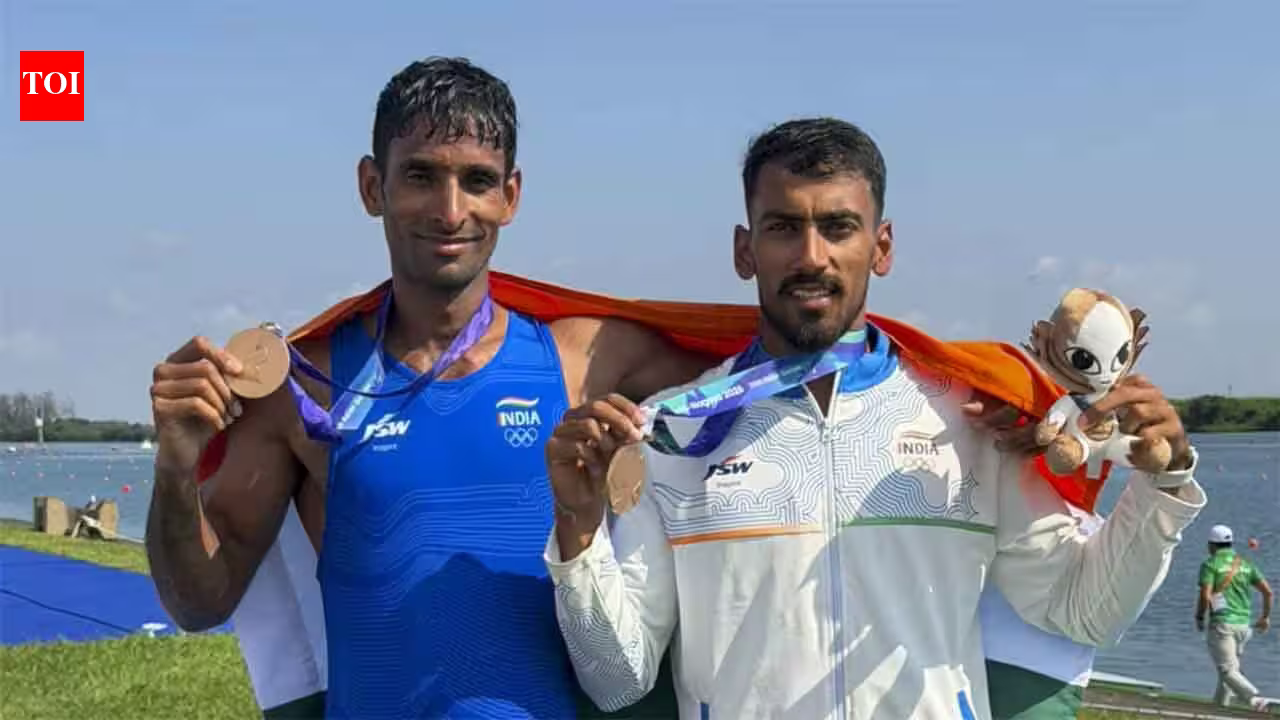
STANDING on the podium at the Nagaragawa International Regatta Course, bronze medal draped around his neck, Salman Khan looked out over the water—a far cry from the bustling, congested streets of Delhi he once navigated as a cab driver. The Asian Games 2026 will be remembered for many feats of athleticism, but few stories carry the emotional weight and sheer improbability of the Indian rower’s rise to international prominence.
Competing in the men’s double sculls alongside teammate Satnam Singh, Khan put on a clinical display of endurance. The Indian duo held a steady second-place position through the majority of the race, maintaining a fierce rhythm against the world’s elite. While a late surge from the competition saw them slip to third in the final 500 meters, their time of 6:13.25 was enough to secure a historic bronze. China’s Yi Xudi and Yide Nie claimed the gold with a time of 6:09.37, while the silver went to Uzbekistan’s Pavel Sorin and Mekhrojbek Mamatkulov (6:10.49). For Khan, however, this medal represented more than just a third-place finish; it was the validation of a decade of personal struggle and unwavering grit.
Tragedy and the Weight of Responsibility
The roots of Khan’s journey lie in Pure Dhingai, a village in Uttar Pradesh, though he spent his formative years in Tauru, Haryana. The eldest of six siblings, his life took a harrowing turn when he was just 18 years old. Following the untimely death of his father, Mohammed Kasim Khan, due to dengue, the teenager suddenly found himself the sole breadwinner for his mother and five younger siblings.
With family survival at stake, the dreams of a young man often dissipate, and for a period, so did Khan’s. He put aside his ambitions of joining the Indian Army, instead opting for the grueling life of a professional driver in Delhi. For months, he worked double shifts behind the wheel of an Uber cab, his life defined by traffic, exhaustion, and the relentless need to keep his family afloat. It was a period of professional transition where survival was the only goal, and the idea of athletic glory was a distant, perhaps even impossible, fantasy.
The Friend Who Rekindled the Flame
Fate, however, had a different trajectory in mind. While resting between shifts one afternoon, a close friend took stock of Khan’s physical stature—his height and lean, athletic build—and suggested that he was tailor-made for the Indian Army. The comment sparked a dormant fire. Khan handed over his cab keys, walked away from the income he relied on, and dedicated four months to pure, physical conditioning.
He ran, trained, and prepared with the discipline of a soldier before even enlisting. His preparation paid off; he breezed through the recruitment rallies, medical tests, and written exams. By September 2018, he had officially joined the Bombay Engineer Group (BEG) in Kirkee, Pune. It was here, in the heart of the military’s sporting infrastructure, that he was first introduced to the sport of rowing.
An Unlikely Athlete
Rowing did not come naturally to Khan, nor did he want it to. When coaches first identified his potential, he was resistant, citing his lack of knowledge and the pressing financial need to support his family. “I knew nothing about the sport,” Khan later noted. “I didn’t think I could pursue it.”
His coaches, however, saw something that Khan could not yet see in himself. They persisted, eventually guiding him into the boat. His breakthrough came at an inter-centre regatta where he secured a silver medal—the first tangible proof that his physical sacrifices were yielding results. By 2021, he had cleared the stringent ergometer benchmarks required to join the Army Rowing Node at the College of Military Engineering (CME) in Pune. Surrounded by the nation’s best rowers, the “reluctant” athlete finally transformed into a dedicated professional.
A Trajectory of Gold
The transition from a novice rower to a powerhouse was swift. In 2022, he took gold at the National Games in Gujarat. By 2023, he was making headlines by defeating Olympian Dattu Bhokanal in the single sculls at the Senior Nationals. This stellar performance earned him a permanent spot in the national camp, and the momentum never stalled.
In 2024, Khan secured his first major international gold at the Asian Rowing Cup in South Korea, a triumph that resulted in a well-deserved promotion to Naib Subedar in the Indian Army. Following up with silver medals at both the 2025 Australian Rowing Championships and the 2025 Asian Rowing Championships, he arrived at the 2026 Asian Games not just as a participant, but as a legitimate contender.
The Strength of Support
Behind the uniform and the medal lies a support system that has remained steadfast. Khan credits his mother, Jabrun Nisha, as his primary inspiration, and his wife, Sahiba Khatoon, for her unwavering support during his most difficult training cycles. Furthermore, the officers and coaching staff at the Army Rowing Node played a pivotal role in keeping him focused during his moments of doubt.
Salman Khan’s journey from a cab driver in Delhi to a decorated Naib Subedar and an Asian Games medallist serves as a profound reminder of the power of discipline. He has navigated the waters of life with the same intensity he brings to the rowing course, turning the tide from a life of necessity to a life of distinction. As he stood on the podium, it was clear: the boy from Amethi had not only found his path, he had rowed his way to the top of it.
Disclaimer: This content is auto-generated for informational purposes only.
Source: Read Original News