









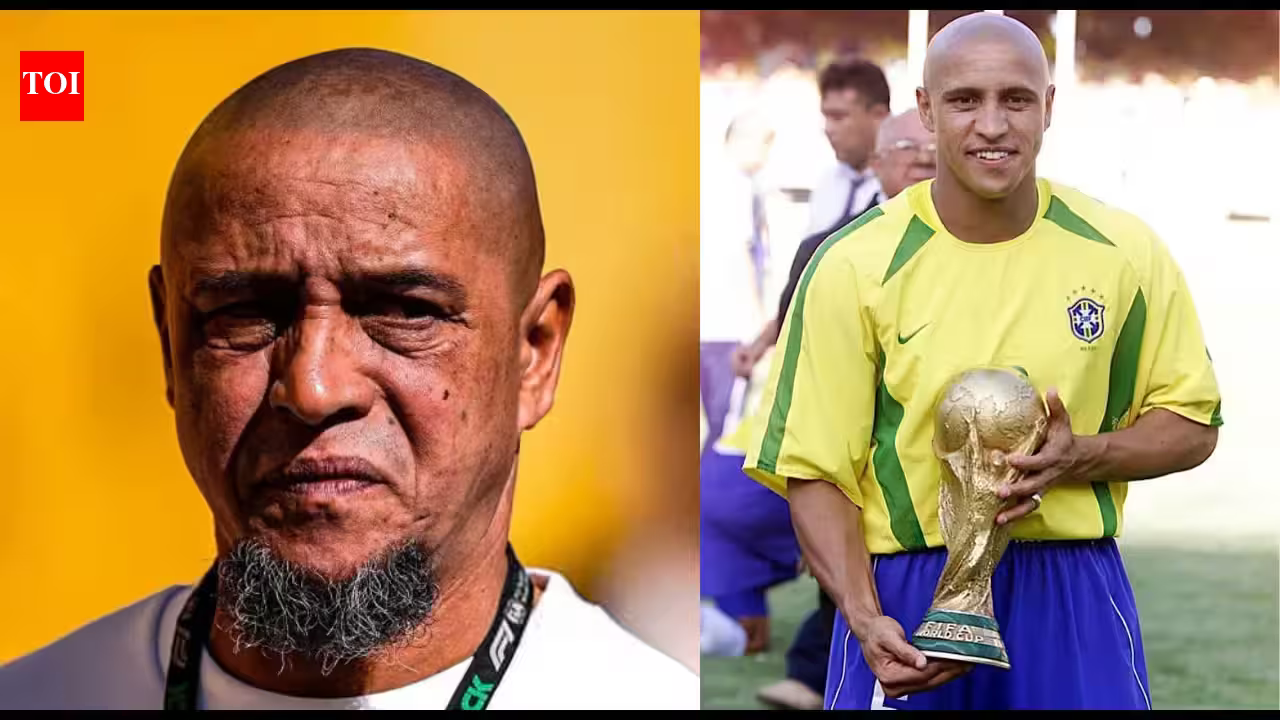
Roberto Carlos, the iconic Brazilian left-back whose blistering free-kicks and relentless pace defined a generation of football, has stunned the sporting world with a sobering revelation regarding his personal finances. Despite a decorated 24-year career that saw him amass roughly $180 million in earnings, the 53-year-old legend recently disclosed that he has lost 99% of his football-generated wealth.
The admission came during a candid appearance at the Portugal Football Summit in Lisbon, where Carlos spoke on the vital necessity for modern athletes to prioritize financial literacy and image protection. Reflecting on his journey from the world’s biggest pitches to a harrowing realization of personal loss, Carlos highlighted how the inner circle of a high-profile athlete can become a source of ruin rather than support.
Carlos says people he trusted emptied his bank account
Addressing the audience in Lisbon, the former Real Madrid star didn’t shy away from the harsh reality of his situation. “I had problems with people who emptied my bank account,” Carlos stated bluntly. “I lost 99% of everything I earned from football. Because of agents and family issues, I lost 99% of everything I had.”
While Carlos remained relatively vague regarding the specific legal or personal details, he described a chilling moment of discovery that serves as a cautionary tale for all professional athletes. He recounted going to sleep on a Thursday night only to wake up the next morning to a pile of documents that effectively signaled the end of his accumulated fortune.
“That’s when I realised I had lost my entire history,” he noted.
The scale of the loss is staggering. If the estimates regarding his $180 million career earnings are accurate, a 99% reduction would leave the Brazilian icon with just a fraction of his original wealth—roughly $1.8 million. While online estimates of his current net worth sit at approximately $5 million, that figure is distinct from the total wealth generated during his prime, underscoring the magnitude of the hole in his former portfolio.
His playing career generated enormous wealth
To understand the scope of the loss, one must consider the sheer commercial and athletic magnitude of Roberto Carlos’ career. As a cornerstone of the legendary Real Madrid “Galácticos” era, he shared the locker room with global icons like Zinedine Zidane, Luis Figo, Ronaldo, and David Beckham.
His time at the Santiago Bernabéu alone featured 527 appearances, four La Liga titles, and three Champions League trophies. The financial rewards were commensurate with his status as one of the best defenders in the history of the sport. By the year 2000, his contract renewal included an $8.5 million signing bonus and a $5.1 million annual salary, complemented by lifestyle perks like paid housing and private travel.
His earning power persisted long after his peak years in Spain. A move to Fenerbahçe in 2007 netted him a reported €4.2 million per season, and as late as 2011, he secured a lucrative contract with Russian club Anzhi Makhachkala worth approximately $9 million annually. Even in the twilight of his career, when he served as a player-manager in India in 2015, Carlos remained a massive commercial draw.
The career behind the fortune was extraordinary
Beyond the bank statements, Carlos’ legacy remains firmly cemented in football folklore. A three-time World Cup participant, he was instrumental in Brazil’s 2002 title run and earned over 120 caps for his country. He was arguably the most famous fullback of the 1990s and 2000s, frequently finishing near the top of individual honor ballots, including a second-place finish in the 2002 Ballon d’Or behind his teammate, Ronaldo.
His influence was so profound that his physics-defying free-kick against France in 1997 remains the subject of academic study, representing the pinnacle of his technical brilliance.
However, Carlos is keen to ensure that his legacy is not just one of athletic triumph, but of hard-won wisdom. He emphasized that he was never naïve about the transitory nature of a professional athlete’s career. By the time he hung up his boots, he had already obtained his sporting director’s license and cultivated brand partnerships to ensure longevity.
“I made mistakes, and therefore, I ask younger players not to do the same,” he told the summit attendees. “I always thought about future plans after my playing career. It’s about building a history as a player and leveraging your image.”
Today, Carlos continues his involvement in the sport, serving as a Real Madrid ambassador for Asia and Oceania and as a director of institutional relations. While his current professional life is stable and high-profile, his message remains a stark reminder that in the high-stakes world of professional sports, the greatest threat to a player’s fortune often comes from within their own trusted circle. For the younger generation of stars, Roberto Carlos’ story is a powerful, if painful, lesson: you may be able to defend the goal against the world’s best strikers, but defending your own bank account requires a different kind of vigilance entirely.
Disclaimer: This content is auto-generated for informational purposes only.
Source: Read Original News