







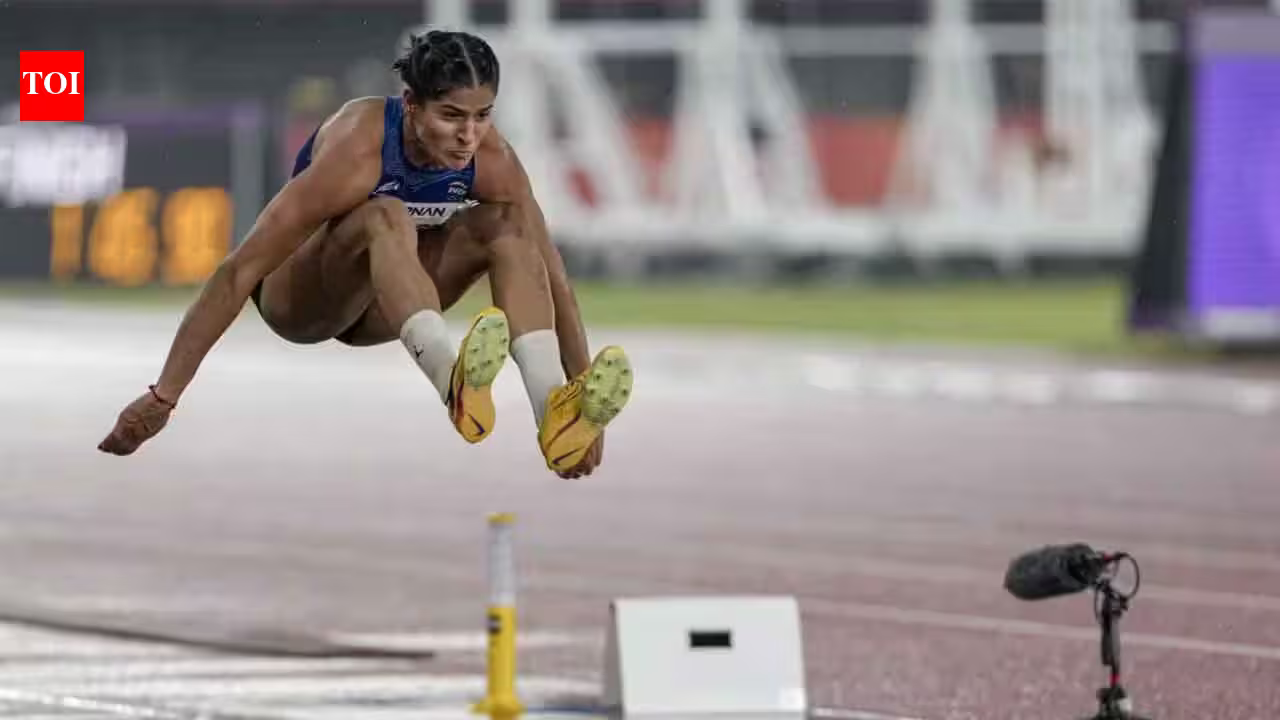
CONTROVERSY has erupted in the corridors of Asian athletics as the Athletics Federation of India (AFI) officially prepares to challenge the result of the women’s long jump final at the Asian Games, citing a catastrophic officiating error that potentially denied Indian rising star Shaili Singh a podium finish.
The dispute stems from a highly contentious fourth-round attempt by Singh, which AFI officials and team mentors claim was measured inaccurately, fundamentally altering the trajectory of the competition and depriving the young athlete of what they believe was a medal-winning effort.
A Heartbreak at the Landing Pit
The women’s long jump final concluded on Sunday with a narrow margin of victory that now feels overshadowed by administrative dispute. India’s Ancy Sojan walked away with a hard-earned silver medal with a jump of 6.53m, while China’s Huang Yingying claimed the gold with a 6.55m leap on her final attempt. Shaili Singh, meanwhile, finished in a frustrating fourth place with a best effort of 6.42m.
However, the AFI’s grievance centers on Singh’s fourth attempt, which was officially recorded at a mere 6.41m. According to the Indian camp, this mark is vastly inconsistent with the reality of the jump, which they assert should have placed Singh in contention for the gold medal.
Legendary Indian long jumper and Singh’s mentor, Anju Bobby George, who witnessed the proceedings from the sidelines, described a chaotic scene near the landing pit.
“We saw her jump was clearly ahead of the gold-winning mark,” Anju told reporters. “Initially, the official near the landing pit pointed to Shaili’s actual leg mark in the sand for the measurement. But then, another official who was standing far behind intervened and pointed to a mark that was significantly shorter from the board.”
The Breach of Protocol
The core of the protest lies in the deviation from standard officiating protocol. Anju, who made history as the first Indian to win a World Championships medal in athletics, emphasized that the official closest to the action—who had the best line of sight—was overruled by a distant colleague.
“They took the measurement at the mark pointed out by the official who was standing far behind,” Anju explained. “The measurement should have been done on the mark pointed out by the official nearest to the landing pit. This isn’t just a minor discrepancy; it is a fundamental failure in officiating that has had a direct impact on the outcome of an international competition.”
Singh herself immediately recognized the inaccuracy, lodging a protest in real-time. Yet, the response from tournament officials only served to deepen the frustration of the Indian delegation.
Video Review Fails to Satisfy
Following the event, Indian officials were invited to review footage of the jump, but the AFI claims the technical transparency was severely lacking. According to Anju, the officials provided a front-view video that failed to offer any clarity on the landing point.
“We were called after the event, and the officials showed us a front-view video, which does not mean anything,” Anju stated. “How would you know exactly where Shaili landed from a front-view angle? We demanded a side-view video, which they initially claimed they did not possess. Later, the jury claimed they had reviewed side-view footage and determined that the original measurement would stand, but they offered no evidence that this review was conclusive.”
The lack of access to the side-view footage—which is standard in high-level jumps to determine accurate marks—has left the AFI feeling stonewalled by the jury of appeal.
Taking the Fight to the CAS
In a move that signals the gravity of the situation, the AFI has formally decided to elevate the protest to the Court of Arbitration for Sport (CAS) in Lausanne, Switzerland. AFI leadership believes that the mismeasurement was not merely a human error, but an injustice that requires an international legal intervention.
“It is an injustice to Shaili,” Anju said. “She has worked incredibly hard, and there is a genuine belief that she could have even won the gold if the correct measurement had been recorded. We cannot let this stand for the sake of the sport’s integrity.”
A senior official within the AFI has confirmed that the process to file the appeal is already underway. While the Asian Games result remains official for now, the intervention of the CAS could lead to an unprecedented review of the competition’s officiating standards.
For Shaili Singh, a rising talent who has been groomed as the successor to Anju Bobby George’s legacy, the incident is a stinging introduction to the political complexities of elite international sports. Whether or not the CAS intervention will result in a change to the medal table remains to be seen, but the AFI has made its stance clear: they are not willing to let their athlete’s hard-won performance be diminished by what they describe as a procedural farce.
As the sporting world looks toward Lausanne, the case of Shaili Singh serves as a sobering reminder of how thin the line can be between a career-defining moment and a devastating bureaucratic error.
Disclaimer: This content is auto-generated for informational purposes only.
Source: Read Original News