







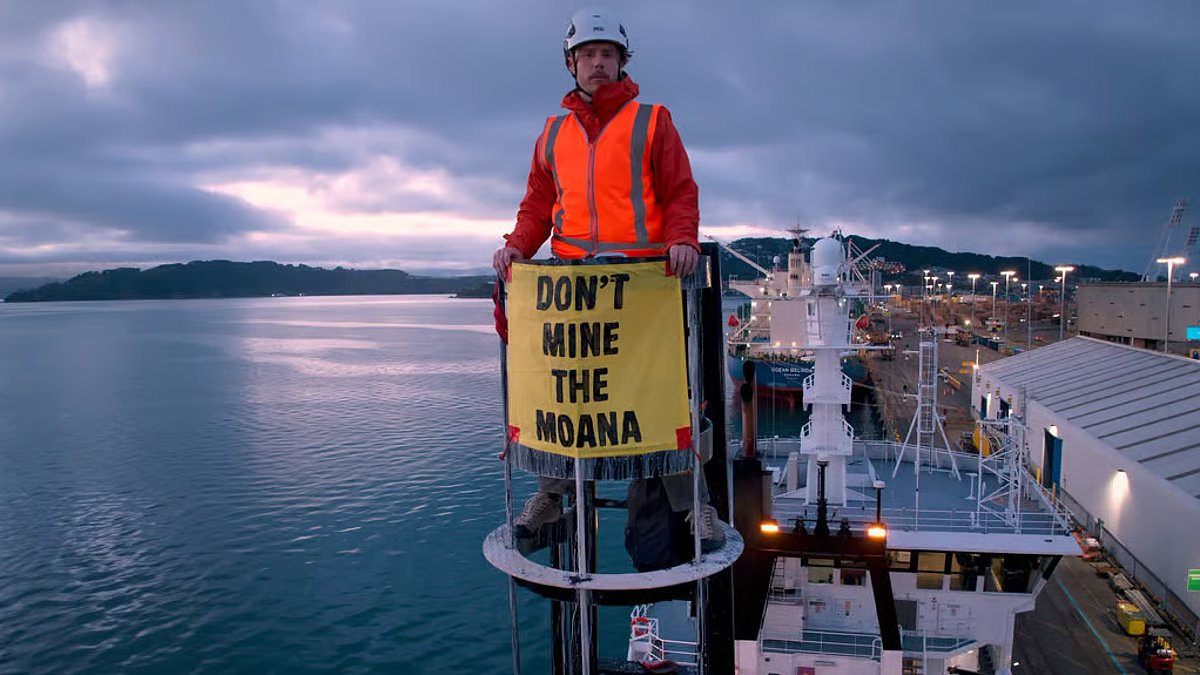
Tensions surrounding the future of deep-sea mining escalated this week as Greenpeace activists staged a protest aboard the Tangaroa, a research vessel operated by the National Institute of Water and Atmospheric Research (NIWA) subsidiary, Earth Sciences New Zealand. The action, which resulted in the removal of protesters from the ship, highlights the intensifying global debate over the extraction of polymetallic nodules from the ocean floor.
The vessel, currently tasked with research activities in the Pacific, has become a focal point for environmental groups concerned about the potential ecological destruction of seabed ecosystems. Greenpeace Aotearoa alleges that the data being collected by the Tangaroa is directly facilitating projects aimed at deep-sea mining, an industry they characterize as a harmful expansion of corporate and geopolitical interests.
“It’s disturbing to see this vessel, which is owned by our government, being used to further American imperialism in the Pacific where resistance to this new form of extraction is strong,” said Juressa Lee, a spokesperson for Greenpeace Aotearoa. The organization argues that deep-sea mining poses an existential threat to delicate marine environments and the livelihoods of Pacific communities who rely on healthy, undisturbed oceans.
The extraction of polymetallic nodules—small, mineral-rich rocks found on the abyssal plains—is a subject of significant interest for technology and energy companies looking to secure minerals like nickel, cobalt, and manganese. Proponents argue these minerals are essential for the global transition to renewable energy and the production of electric vehicle batteries. However, critics, including Greenpeace and a growing number of scientists, warn that the sediment plumes created by mining machinery, along with noise and light pollution, could cause irreversible damage to deep-sea biodiversity, much of which remains poorly understood.
In response to the protest, Earth Sciences New Zealand maintained that its operations are strictly scientific. In a statement provided to RNZ, the operator emphasized that it provides independent research to a variety of domestic and international organizations.
“Our work includes scientific surveys that collect and analyze data to improve understanding of the deep-sea environment, including its biology and ecology,” the operator stated. Regarding the specific nature of the Tangaroa’s current mission and its potential link to commercial mining exploration projects led by external partners such as UK Seabed Resources (UKSR), the operator directed all inquiries to the project developers themselves.
The incident underscores the growing scrutiny placed on government-backed research institutions when their work intersects with controversial commercial industries. For many, the role of public research vessels is to provide unbiased, baseline data that should inform conservation and climate policy, rather than facilitating resource extraction. The environmental advocacy group contends that by engaging in research that may benefit mining interests, state-owned entities risk compromising their commitment to environmental stewardship.
As the International Seabed Authority (ISA) continues to grapple with the drafting of a “Mining Code” to regulate deep-sea exploration and potential exploitation in international waters, the pressure from environmental groups is unlikely to abate. The incident in the Pacific reflects a broader global rift: one side views the deep ocean as a necessary frontier for raw materials in a decarbonizing world, while the other views it as a fragile commons that must be shielded from industrial exploitation at all costs.
For now, the Tangaroa remains at the center of this controversy, serving as a physical manifestation of the unresolved tension between scientific curiosity, economic ambition, and the protection of one of the planet’s final remaining wildernesses. The protest serves as a clear signal that, until the environmental impacts of deep-sea mining are fully understood and mitigated, any activity perceived to be enabling the industry will face significant public and political resistance.
Disclaimer: This content is auto-generated for informational purposes only.
Source: Read Original News