







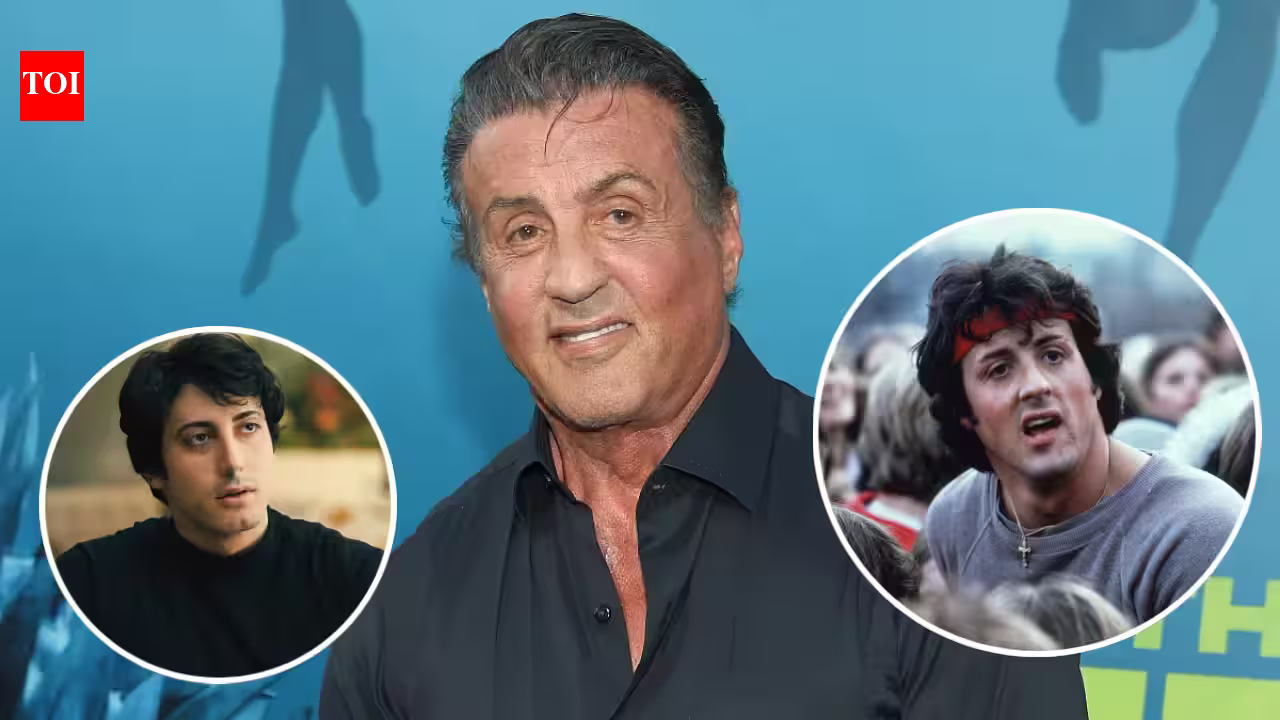
There are few figures in cinema history as mythic as Sylvester Stallone. He is the physical embodiment of the American Dream, a man who clawed his way out of obscurity by betting his entire life on a script about a southpaw pugilist from Philadelphia. So, when the industry decides to turn that specific, lightning-in-a-bottle moment into a biopic, it’s bound to raise an eyebrow—or at least a grumble—from the man himself.
As Hollywood continues its insatiable appetite for origin stories, the upcoming film I Play Rocky—directed by the seasoned Peter Farrelly—has officially landed on the radar. The film explores the gritty, uncertain production of the 1976 classic that changed Stallone’s life forever. But as Stallone recently noted while promoting his new memoir, The Steps, the experience of watching someone else play the version of “Sly” that existed before the world knew his name has been, to put it mildly, a complicated trip.
Sylvester Stallone: “Aren’t we jumping the gun?”
It isn’t every day you’re still standing at the top of the mountain only to see someone else cast as the person you were when you were just beginning the climb. During a recent appearance at 92NY, Stallone was characteristically candid about his initial apprehension regarding the project. When asked about I Play Rocky, the 78-year-old icon admitted he had a “mixed” reaction.
“I’m not dead yet,” Stallone quipped, capturing that legendary, self-deprecating wit that fans have come to love over the decades. “Aren’t we jumping the gun a little bit?”
It’s a fair point. Biopics are typically the domain of the late and the legendary, a retrospective honoring a legacy that has already concluded. For Stallone, who remains an active, producing force in the industry, seeing his younger self portrayed on screen feels less like a tribute and more like a strange, surreal mirror. Yet, true to form, his frustration was tempered by the one thing that has always mattered most to him: the craft.
The uncanny valley of Anthony Ippolito
The skepticism Stallone felt initially melted away the moment he saw the footage of Anthony Ippolito, the actor tasked with stepping into those iconic, beat-up sneakers. The physical transformation and the delivery were enough to stop the “Italian Stallion” in his tracks.
“I actually thought it was me the first moment; there were a couple of angles,” Stallone recalled. He even turned to his daughter during the screening, stunned by the resemblance.
What makes this reaction particularly telling is Stallone’s hands-off approach. He didn’t hover over the production, nor did he demand creative control. He took a seat in the back and let the new guard work. “I told the kid, ‘If you want any questions, here I am,’ and that was it,” he noted.
Seeing Ippolito capture his specific cadence and physical tics provided Stallone with an epiphany he hadn’t anticipated. It was a moment of meta-clarity: “I go, ‘Do I talk like that?’ Now I get it. Now I get it.” It’s rare to see a superstar dissect his own mannerisms through the eyes of a mirror image, and the humility shown by Stallone here highlights why he has maintained his relevance long after other action stars faded into nostalgia.
The “thorn in his side”: Re-imagining Rocky V
While I Play Rocky forces the star to look back at his breakthrough, he is simultaneously obsessing over a different part of his legacy. For decades, the Rocky franchise has been a cornerstone of his career, but even legends have their regrets. For Stallone, that regret is Rocky V.
He described the 1990 installment as a “thorn in my side,” expressing a desire to go back and rectify the creative choices that kept the film from reaching the heights of its predecessors. Stallone was blunt about the failure: “I know I took my foot off the gas.” He lamented that he didn’t direct it himself, admitting that he fell into the trap of trying to be “cool” rather than staying true to the gritty, grounded spirit that made the first film a masterpiece.
Stallone is currently trying to work with Amazon to secure a recut. His goal isn’t to make it a perfect film, but an “acceptable” one. It’s the drive of a perfectionist—even decades later, he isn’t content to let a subpar chapter sit on the shelf.
The death of the “Golden Age” mindset
Beyond his own projects, the conversation with moderator Tracy Smith steered toward the broader state of Hollywood, a topic on which Stallone holds strong, perhaps slightly cynical, opinions. When asked if he could make it in the industry today, starting from scratch like he did in 1976, he was unequivocal: “I don’t think so.”
Stallone believes the “ideology” of modern filmmaking has shifted too far away from the character-driven, slow-burn narratives of the 70s. He pointed to The Godfather as the ultimate example of a film that simply couldn’t be made—or cast—in the current climate. According to Stallone, the success of those films was tied to a unique “social and cultural circumstance” that has since evaporated.
He argues that modern studios often fail to understand that a film is a product of its time. You can’t just re-package the Rocky story or the Godfather aesthetic; you have to capture the specific anxiety and optimism of the moment. It’s a sobering critique from a man who spent his life inside the machinery of the studio system, suggesting that the “magic” that allowed his own career to flourish is becoming an endangered species.
Ultimately, Stallone remains a man caught between the past and the present. He is amused by his own biopic, frustrated by the loose ends of his sequels, and wary of an industry that he no longer fully recognizes. Yet, he is still here, still talking, and still fighting—proving that whether or not Hollywood has changed, the man who created Rocky Balboa still has plenty left to say.
Disclaimer: This content is auto-generated for informational purposes only.
Source: Read Original News