








As rising sea levels and shifting climate patterns drive increased salinization in coastal regions globally, a groundbreaking discovery by researchers at the Royal Netherlands Institute for Sea Research (NIOZ) suggests that some ecosystems possess a built-in defense mechanism. By organizing themselves into distinct spatial patterns, coastal meadows are actively redistributing salt stress, effectively shielding plant life and enhancing the resilience of the entire landscape.
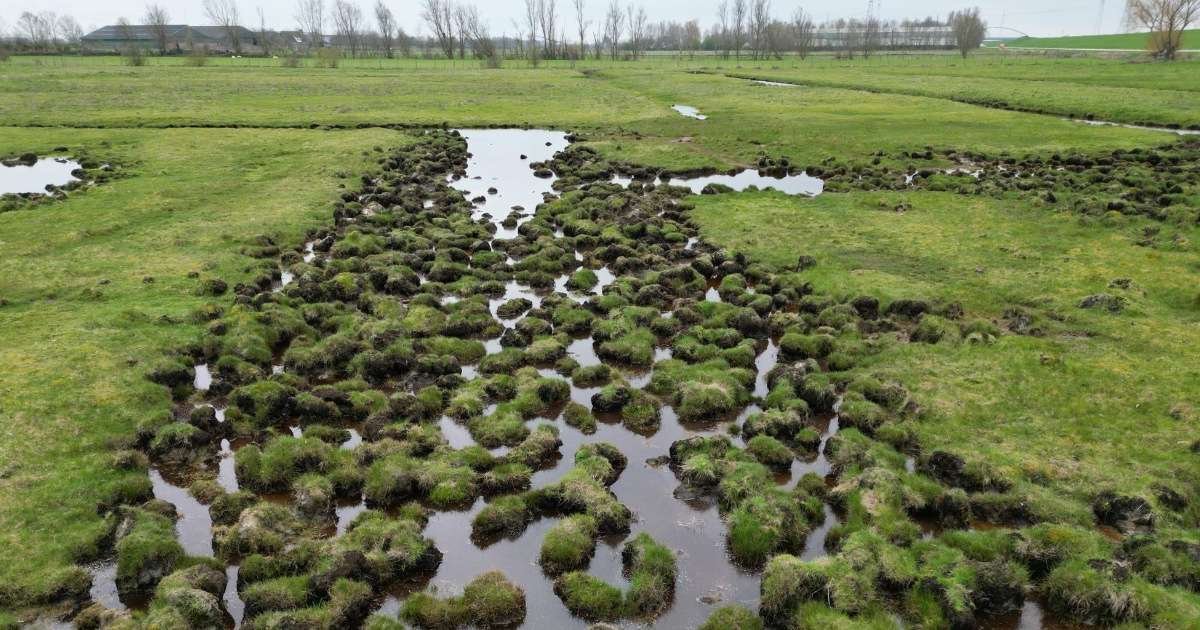
The findings, detailed in a study published in Science Advances on September 30, 2026, center on a saline meadow near Yerseke, Netherlands. Lead researcher Dr. Mingxuan Wu and her team observed a recurring landscape structure composed of raised mounds, or “hummocks,” interspersed with lower, largely barren “hollows.” Through a combination of field measurements, remote sensing, and mathematical modeling, the team uncovered that this pattern is not merely cosmetic; it is a functional adaptation to salt stress.
In these coastal environments, rainfall acts as a vital agent of redistribution. As water percolates through the landscape, it flushes salt away from the elevated hummocks and concentrates it within the lower-lying hollows. This process transforms the hummocks into relatively low-salinity refuges. The result is a landscape where plants can thrive on the mounds, while the “unproductive” hollows act as strategic reservoirs for salt.
“What surprised us was how much the apparently unproductive hollows contribute to the whole meadow,” Dr. Wu noted. “By accumulating salt, they help keep the vegetated hummocks less saline, allowing plants to thrive and produce more seeds while enhancing the resilience of the whole ecosystem.”
The ecological impact of this spatial organization is significant. Comparative analysis revealed that vegetation on the patterned hummocks produced greater biomass and a higher volume of seeds than vegetation in non-patterned coastal areas. Furthermore, plants within the patterned system remained green and metabolically active for two to three weeks longer than their counterparts in uniform meadows. Even when the bare, salt-heavy hollows were factored into the total biomass calculations, the patterned meadows demonstrated superior overall vegetation health and activity.
This study marks a shift in how scientists understand self-organized ecosystems. Historically, research in this field has focused on how plants “engineer” their environment to concentrate scarce resources like water or nutrients. The NIOZ findings demonstrate a counter-intuitive mechanism: the ability of an ecosystem to protect itself by actively displacing stressors. According to the mathematical models developed by the team, these patterned meadows are not only more productive under normal conditions but also more capable of persisting under high-salinity scenarios and recovering rapidly following acute stress events, such as storm-driven saltwater flooding.
The implications for environmental management and restoration are substantial. Modern restoration projects frequently prioritize the replanting of specific species, often ignoring the physical landscape architecture that allowed those plants to survive in the first place. The researchers argue that by focusing solely on species presence, practitioners may be missing the “invisible” feedback loops that sustain those very populations.
“Ecosystems are much better able to adjust to climate-change-induced stresses than we previously thought,” said co-author Dr. Johan van de Koppel. “Essential is that we allow these ecosystems to change naturally, adjusting their spatial arrangement. In our salty meadow system, that means developing hummock patterns.”
As global coastal zones face the increasing pressure of rising seas, the study offers a new framework for conservation. Rather than just protecting species, land managers may need to protect the processes—such as the creation of micro-topography—that allow ecosystems to self-organize against a changing environment. While the researchers emphasize that further study is required to determine the global applicability of this mechanism across different climate zones, the study provides a compelling case for “letting nature do the work” when it comes to climate adaptation.
Disclaimer: This content is auto-generated for informational purposes only.
Source: Read Original News