







A Technical Leap in Portable Hardware
The release of The Witcher 3 Remastered for the Nintendo Switch 2 represents a significant milestone in mobile hardware capabilities. By comparing the original Switch port—a title previously lauded for its ambitious compression techniques—to the new hardware iteration, industry analysts have identified a substantial increase in technical headroom. The jump in file size from 39.1 GB on the original Switch to 55.5 GB on the successor suggests a massive influx of high-fidelity assets, including improved texture resolutions and higher bit-rate encoding for pre-rendered cutscenes.
This update was largely spearheaded by CD Projekt Red, with supplementary support from Virtuos. The collaboration has resulted in a version of the game that brings the title much closer to the modern aesthetic standards of the PlayStation 5 and Xbox Series X versions, even while operating within a portable power envelope. While ray tracing is absent from this release, the developer has implemented a robust suite of visual enhancements that fundamentally alter the rendering pipeline of the game on this platform.
Visual Fidelity and Asset Optimization
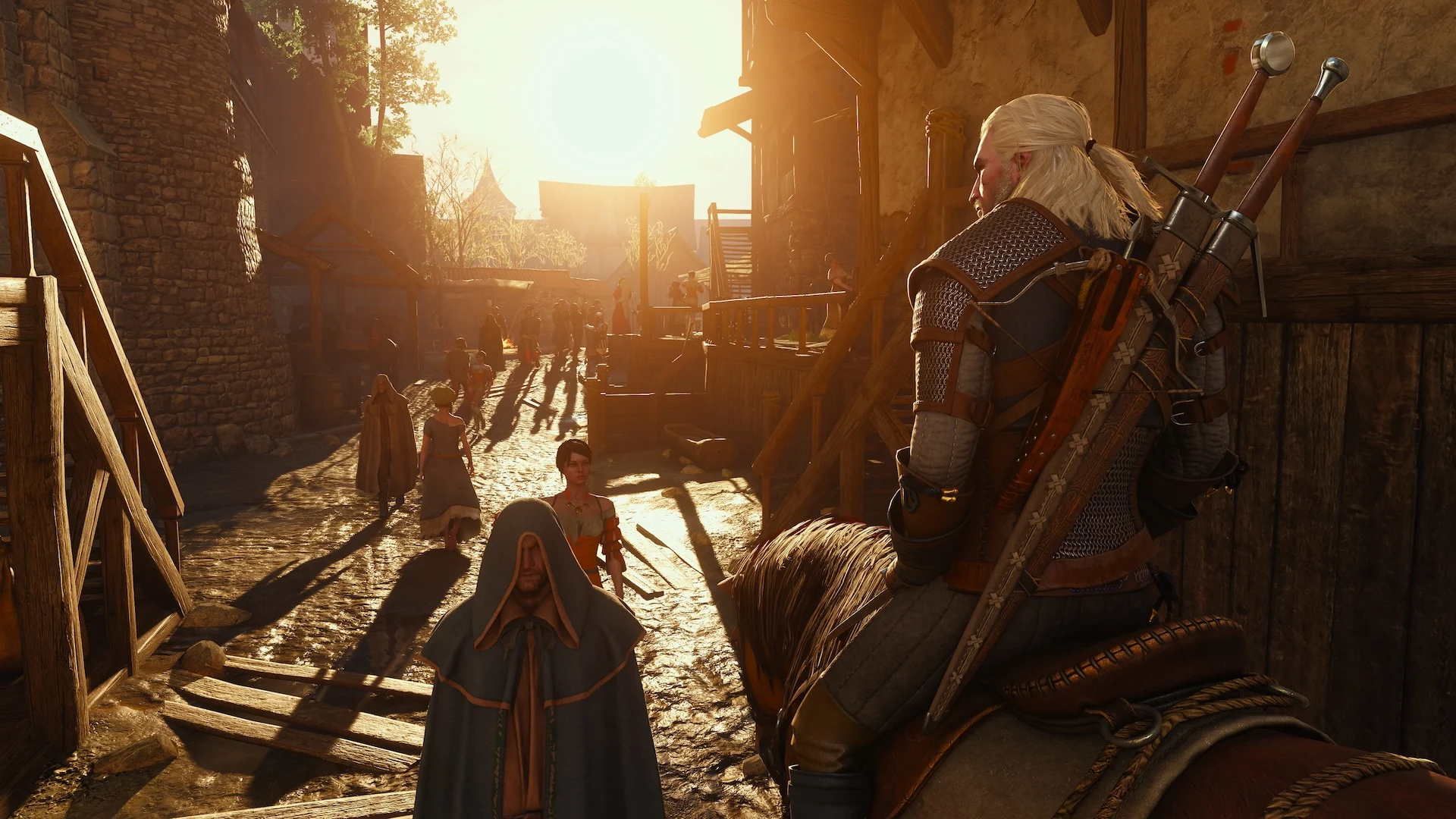
The most striking improvements in the Switch 2 version are found in the geometry and material rendering. Players will notice significant improvements in Levels of Detail (LODs) for both foliage and environment architecture, which effectively minimizes the visual pop-in issues that plagued the original console version. The inclusion of upgraded physically-based textures and new shading models for vegetation creates a more coherent world environment. Furthermore, the lighting engine has received a comprehensive overhaul; local light sources now cast dynamic shadows, providing depth and realism that were previously unavailable in the mobile version.
Ambient occlusion has also received a technical boost. The Switch 2 utilizes more precise algorithms to calculate soft shadows in corners and around objects, grounding the characters within their environment with greater clarity. Combined with reworked color grading and new material definitions for grass and flora, the world of the Continent feels markedly denser and more responsive to the player’s presence.
Dynamic Resolution Scaling and DLSS Integration
Managing performance across both docked and portable modes remains a core challenge for mobile hardware, and the Switch 2 addresses this through aggressive dynamic resolution scaling paired with NVIDIA’s Deep Learning Super Sampling (DLSS) technology. In docked mode, the game targets a resolution range between 540p and 1080p. When the DLSS reconstruction is active, the final output successfully resolves to a crisp 1080p target. In portable mode, the engine shifts to a dynamic range of 360p to 720p, again utilizing DLSS to maintain a 720p output.
While the visual settings remain consistent across both play styles, the lower native pixel count in handheld mode does have a marginal impact on the quality of screen-space reflections and the depth-of-field effects utilized in cinematic sequences. Nevertheless, the consistency in visual presets ensures that the game presents a unified artistic vision regardless of the physical configuration, avoiding the major asset stripping that was necessary for the original Switch port.
Frame Rate Management and Refresh Rates
Perhaps the most debated aspect of the new technical data involves frame rate targets. The Switch 2 version introduces an optional 40 FPS cap, designed specifically for users connected to 120Hz displays. This middle ground between 30 and 60 frames per second provides a smoother motion experience than traditional 30 FPS limits without requiring the same level of overhead as a full 60 FPS target.
However, technical testing reveals that this 40 FPS mode is not sustainable throughout the entirety of the game world. While it performs capably in open fields and areas with low character density, demanding urban environments like Novigrad push the hardware to its limits. Because the 60Hz standard caps the game at 30 FPS, and the 40 FPS target is conditional, the current technical consensus suggests that players seeking a perfectly locked, stutter-free experience should prioritize the 30 FPS mode. This setting offers a rock-solid, consistent cadence that surpasses the performance of the original Switch release, which frequently struggled to maintain 30 FPS and often dropped into the low 20s.
Gameplay Enhancements and Quality of Life
Beyond the raw graphical metrics, The Witcher 3 Remastered on the Switch 2 incorporates several gameplay refinements. CD Projekt Red has integrated updated combat systems and refined skill tree menus that offer a more streamlined experience for the player. These quality-of-life adjustments align the game with modern iterations of the title, reducing the complexity of inventory management and making tactical decisions more intuitive.
Of particular interest to hardware enthusiasts is the inclusion of native Joy-Con gyro controls. By mapping camera movement to the internal gyroscopes of the controllers, the developers have added a level of precision to aiming and environmental interaction that is difficult to replicate with traditional analog sticks alone. These additions, combined with the significant uptick in texture and lighting quality, demonstrate how software-level refinement can leverage better hardware to transform a previously compromised experience into a definitive portable version. For users upgrading from the previous console, the technical advancements and the inclusion of contemporary gameplay features make this release a substantial evolution in the franchise’s handheld history.
Disclaimer: This content is auto-generated for informational purposes only.
Source: Read Original News