








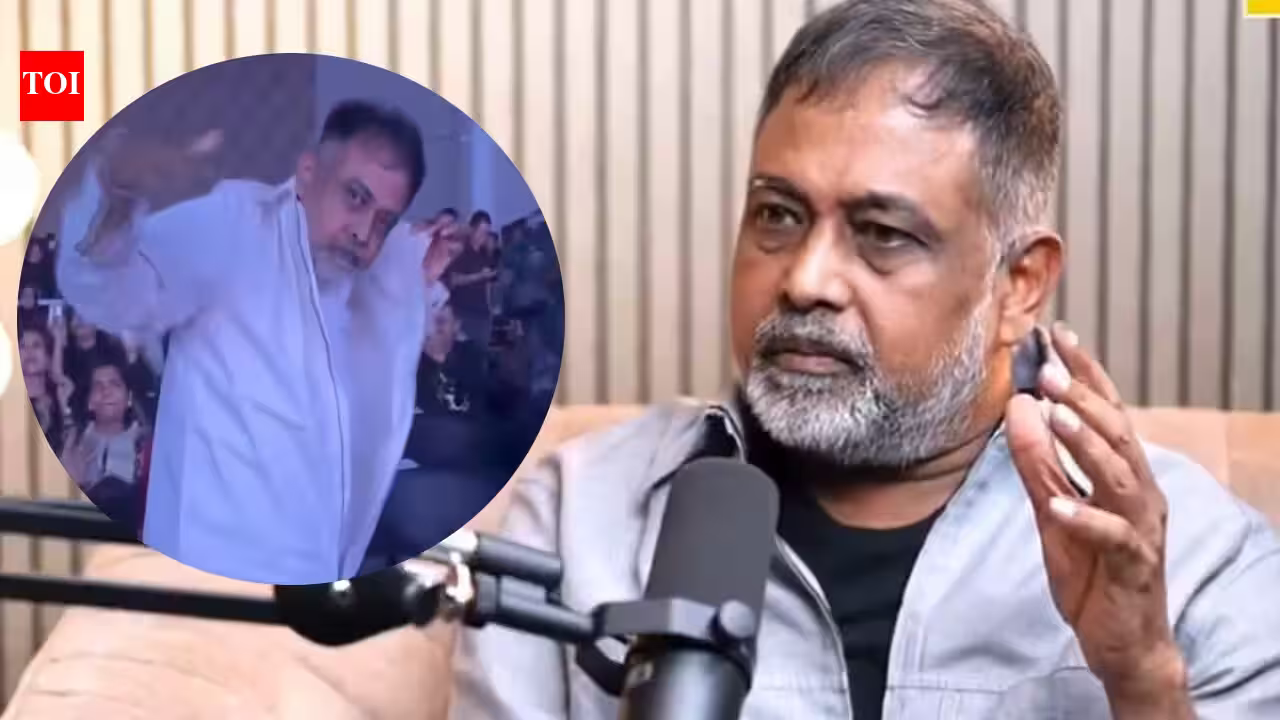
In the hyper-connected world of social media, one stray clip can shift the public narrative of a veteran filmmaker in an instant. For N. Lingusamy, a director synonymous with the high-octane action and emotional resonance of early 2000s Tamil cinema, a recent trip to Malaysia for a musical event has turned into an unexpected digital spectacle. A video of the director letting his guard down and dancing to the iconic “Ava Enna Enna Thedi Vantha Anjala” from Gautham Vasudev Menon’s Vaaranam Aayiram has set the internet ablaze, drawing everything from heart-eyed emojis to stinging keyboard critiques.
Lingusamy’s Candid Take on the Viral Moment
The footage, which captures the director in a moment of festive abandon alongside industry colleagues Radhika and Sarathkumar, quickly transcended the walls of the venue to become fodder for viral discourse. For those unaccustomed to seeing the man behind the camera—a filmmaker known for his tight, rhythmic editing and intense dramatic beats—actually hitting the dance floor, the sight was jarring to some and endearing to others.
When asked about the backlash and the overwhelming attention the clip received, Lingusamy remained characteristically grounded. In an interview with Dinamalar, he addressed the digital noise with the pragmatism of someone who has spent decades navigating the fickle nature of the film industry. He clarified that the impromptu performance was never intended as a choreographed showcase.
“I am not a trained dancer,” Lingusamy stated, his tone matter-of-fact. He explained that his presence at the Malaysia event was a mark of camaraderie with fellow director Gautham Vasudev Menon. Caught in the spirit of the musical celebration, he was invited to join the dance, and he obliged simply for the joy of the moment. He noted that while he is aware of the wide spectrum of comments—ranging from fans cheering his infectious energy to cynics mocking his lack of formal moves—he views it as nothing more than a light-hearted interlude in an otherwise serious career.
A Legacy of Action and Emotion
To reduce Lingusamy to a viral dance clip would be to ignore his foundational contribution to contemporary Tamil cinema. For the uninitiated, Lingusamy is a director who redefined the “commercial entertainer” genre in the early 2000s. He possessed a unique ability to fuse raw, gritty action with sentimental family dynamics, a formula that became his calling card.
His directorial debut, Anandham (2001), was a masterclass in domestic storytelling that hit a resonant chord with audiences. It established him not just as a technician, but as a filmmaker who understood the pulse of the Tamil family audience. However, it was his sophomore project, Run (2002), that truly catapulted him into the stratosphere of success. Starring Madhavan and Meera Jasmine, the film was a frenetic, fast-paced action drama that felt entirely new, cementing Lingusamy’s reputation as a visionary who could inject adrenaline into romance.
The ‘Sandakozhi’ and ‘Paiyaa’ Era
As the mid-2000s rolled on, Lingusamy solidified his status with the massive success of Sandakozhi. Featuring Vishal in a breakout role, the film balanced village-based power dynamics with an elevated, stylish narrative that became a blueprint for many action films that followed. He proved that he could manage large-scale set pieces just as effectively as intimate emotional beats.
Then came Paiyaa (2010), a road-trip romance that showcased his versatility. While his previous works were often defined by blood and fury, Paiyaa leaned into the aesthetics of urban travel and ethereal music. It was a stylistic departure that cemented his versatility, proving that he wasn’t just an action director, but a filmmaker with a sharp sense of visual storytelling. These films remain staples of satellite television and streaming playlists, serving as a testament to his lasting footprint in the industry.
Navigating the Highs and Lows of Filmmaking
Every director’s journey has its ebbs and flows, and Lingusamy is no exception. While the latter half of his career has seen its fair share of professional challenges and mixed receptions at the box office, his influence on the industry remains undeniable. The film industry is an unforgiving landscape, often judged by the most recent release rather than a lifetime of work, yet Lingusamy’s earlier library remains a benchmark for many aspiring storytellers.
The viral video in Malaysia serves as an interesting bridge between the past and the present. It reminds audiences that behind the intense scripts and the high-stakes edit suites, the filmmakers are, first and foremost, people who enjoy the same cultural markers as their audience. While he may not be a professional dancer, his willingness to engage in the moment reveals a personality that is perhaps more relaxed than the high-tension cinema he is famous for.
Why the Internet Can’t Look Away
The intensity of the response to his dance video is a reflection of the parasocial relationship between modern audiences and public figures. We are accustomed to seeing directors as stoic, authoritative figures who orchestrate the chaos on screen. When that veil is lifted—even for a few seconds of clumsy, fun-loving dancing—it creates a cognitive dissonance that the internet feels compelled to resolve, either through mockery or adulation.
Lingusamy’s graceful handling of the situation is perhaps his greatest lesson. By acknowledging the lack of training and framing the event as a simple, happy instance, he effectively took the sting out of the negative comments. He refused to turn a light-hearted moment into a defensive battle, a tactic that reflects the maturity of a man who has spent enough time in the spotlight to know that the internet’s attention span is brief, but one’s own composure is permanent.
As the noise surrounding the video inevitably fades, what remains is the legacy of a director who helped shape the vocabulary of modern Tamil cinema. Whether he is directing a high-octane fight sequence or simply enjoying a song at an event, Lingusamy remains a fixture of the industry, one who continues to capture attention—whether by design or by chance.
Disclaimer: This content is auto-generated for informational purposes only.
Source: Read Original News