








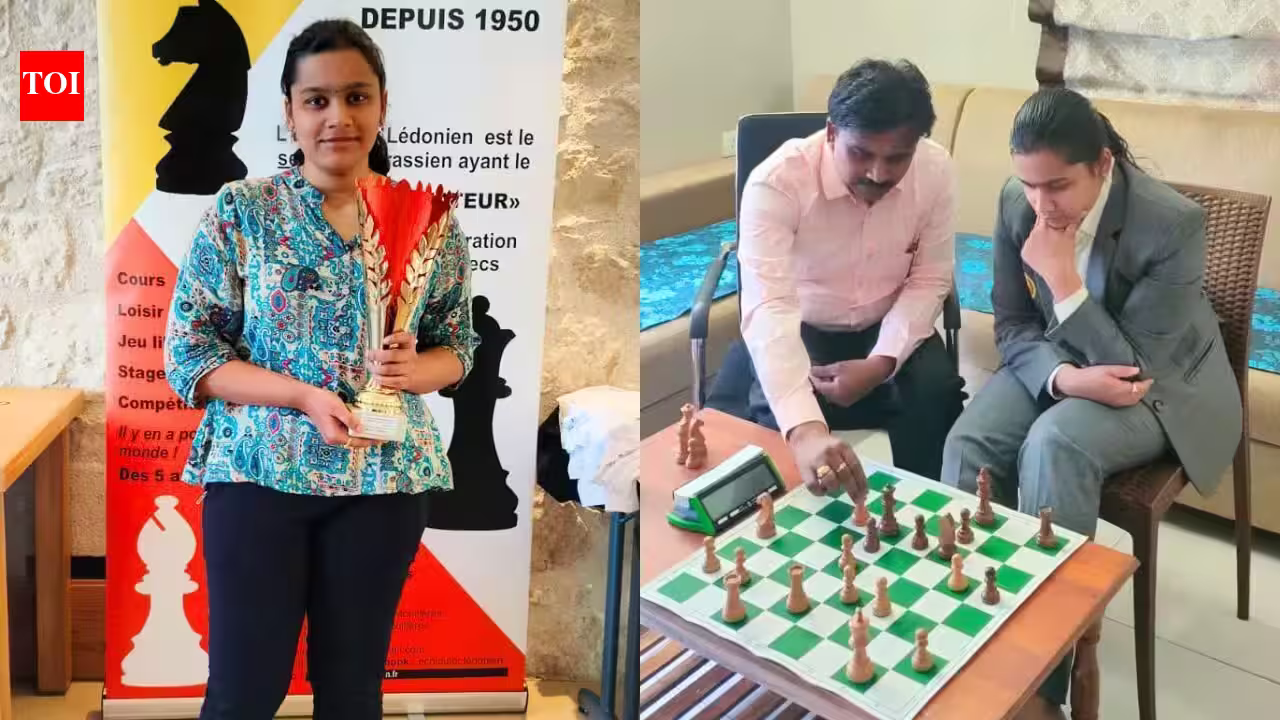
SAHITHI VARSHINI Moogi has officially ascended to the rank of Woman Grandmaster (WGM), a milestone that serves as the latest chapter in one of the most grueling, heartfelt, and improbable sagas in modern Indian chess. While the title marks a significant professional achievement, to those closest to the 19-year-old prodigy, this is not a climax—it is merely a necessary stepping stone.
In May 2019, renowned International Master Sagar Shah famously tipped Sahithi and Savitha Shri Baskar as the next torchbearers for Indian women’s chess, placing them in the same breath as legends Koneru Humpy and Dronavalli Harika. Years later, while the chess world has seen these young stars emerge, the path for Sahithi has been paved not with smooth corporate sponsorships or easy access, but with profound sacrifice, medical crises, and a family’s unwavering faith in the 64 squares.
The Long Road to the Title
Sahithi’s path to the WGM title was finalized last month at the IM VII Round Robin in Serbia, where she finished second with 6/9 and a performance rating of 2408. This victory secured her third and final norm, culminating a pursuit that began in Hungary with her first two norms in 2025 and 2026.
However, the “clean” narrative of a rising star belies a history of near-insurmountable obstacles. At just six years old, Sahithi survived a brush with death after contracting dengue that left her on a ventilator for a week. Her family has viewed her life ever since as a “second chance,” a perspective that has informed their resilience in the face of subsequent hurdles, including a multi-year stagnation during the COVID-19 pandemic and the logistical nightmare of financing international travel.
A Family’s Radical Bet
The architecture of Sahithi’s career is entirely homemade, constructed by her father and sole coach, Lokeswara Moogi Rao. A former engineering professional at HPCL, Lokesh’s commitment to his daughter’s dream reached a point of no return when the costs of training and global competition outpaced their savings.
“I had to sell an apartment,” Lokesh revealed in an exclusive interaction. The family’s dedication went further, with his wife, Jaya Sri, pledging her gold to keep Sahithi’s international tournament dreams alive. Eventually, the mounting pressure forced Lokesh to resign from his secure position at HPCL to focus on his own chess academy. Even then, the transition was far from smooth; Lokesh underwent heart bypass surgery, an ordeal that threatened both his physical health and the family’s fragile financial stability.
Throughout this, the family remained a singular unit. Lokesh describes his wife’s resilience—navigating the sale of property, relocation, and the uncertainty of a career-less existence—as the true backbone of Sahithi’s success. Their elder daughter, Falguni, also contributed to the cause, funding her own education and living expenses to alleviate the financial burden on the household.
The Philosophy of the 64 Squares
Lokesh’s approach to coaching is as unconventional as his personal history. Born in a remote village near the Yarada Hills with no access to electricity, he was self-taught, often sketching chess positions on paper in his refinery’s control room to avoid detection. He never aimed for the conventional milestones of IM or GM titles; his vision for Sahithi was always directed toward greatness, modeling her development on the attacking genius of legendary players like Garry Kasparov and Bobby Fischer.
This “no-fear” style—marked by bold sacrifices and aggressive tactical play—has earned Sahithi praise from elite trainers like Jacob Aagaard and victories over top-tier talent, including World Champion Mariya Muzychuk.
What Lies Ahead
Despite the WGM title, the mood in the Moogi household remains one of focused, if cautious, determination. Lokesh acknowledges that Sahithi has felt the weight of the three years lost to the pandemic and the academic demands of finishing her 10th-grade exams, which forced a temporary hiatus from the board.
“She is a little demotivated, to be frank,” Lokesh admitted. His counsel to his daughter remains consistent: “How you start is not as important as how you end. Whatever you missed, no regrets. Look at the opportunities ahead.”
The family’s immediate challenge is overcoming the lack of institutional support. Without “godfathers” or massive corporate backing, they are reliant on their own resourcefulness to gain entry into the high-cost international circuit. Yet, Lokesh remains characteristically stoic. “There are no big names in this journey. No godfathers. You don’t require big names to make your stamp. It is your willpower, your passion for the game, and your determination that take you forward.”
As Sahithi Varshini moves into this next phase of her career, the goal is no longer just the acquisition of ratings, but the attainment of a level of play that demands respect globally. If her past is any indication—a history of rising from a hospital bed, a small village, and financial ruin to the top of the Indian circuit—the chess world should prepare to see her name, and her game, continue to evolve. The rice, as her father suggests, is still cooking; but it is being prepared for a feast.
Disclaimer: This content is auto-generated for informational purposes only.
Source: Read Original News