









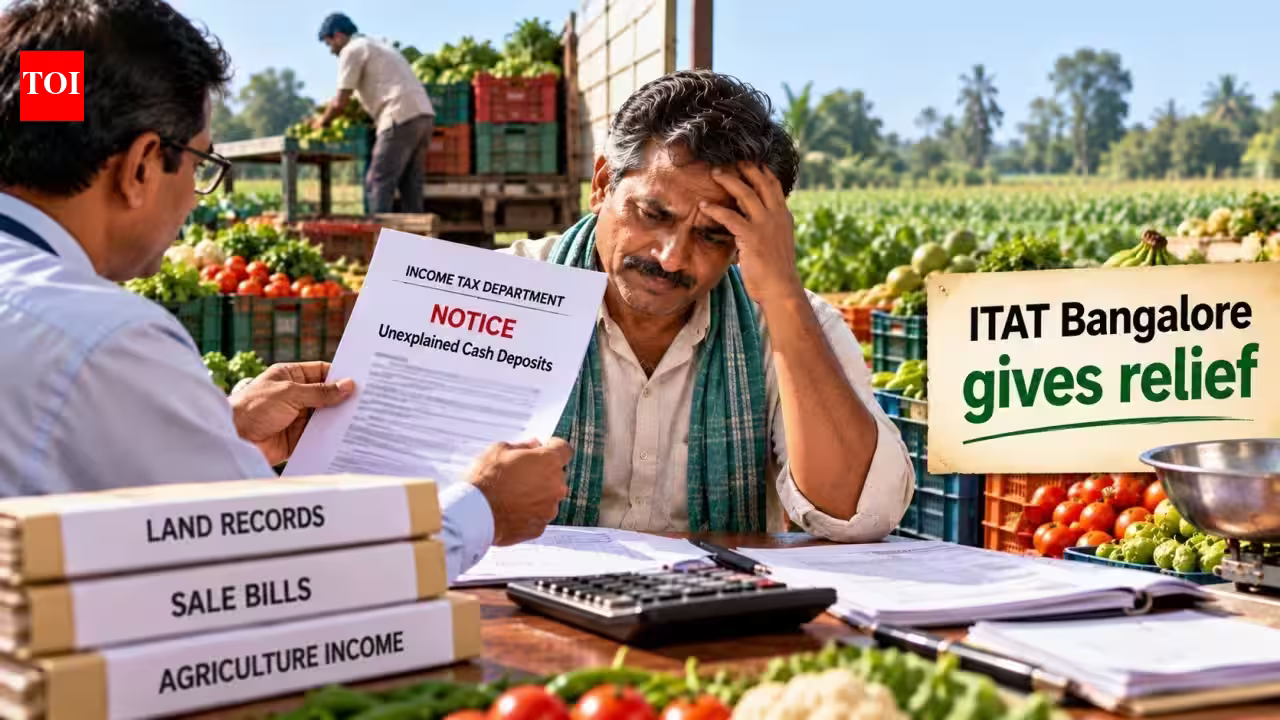
The Intersection of Agricultural Income and Tax Compliance in India
In the Indian fiscal landscape, agricultural income enjoys a unique status, being largely exempt from central income tax under Section 10(1) of the Income Tax Act, 1961. This provision is designed to support the agrarian economy, which serves as the primary livelihood for a vast segment of the population. However, this exemption has frequently become a focal point for tax scrutiny, particularly when significant cash flows in personal bank accounts are attributed to agricultural earnings. The recent ruling by the Income Tax Appellate Tribunal (ITAT) in Bangalore concerning a farmer who faced tax demands on his cash deposits highlights the growing tension between traditional informal farming practices and the rigorous documentation requirements of modern digital tax administration.
For many small-scale farmers, the process of selling produce at Agricultural Produce Market Committee (APMC) yards involves cash transactions. While these transactions are legitimate, they often leave a trail that appears suspicious to automated tax monitoring systems. When large amounts of cash are deposited into bank accounts, the Income Tax Department’s data analytics may flag them as “unexplained cash credit” under Section 69A of the Act. This creates an immediate burden on the taxpayer to prove the source of these funds, a process that can be daunting for individuals who operate outside the formal accounting frameworks of corporate India.
Documentation Challenges in the Agricultural Sector
The primary challenge faced by the farmer in the recent Bangalore case was the lack of granular documentation. The Assessing Officer (AO) rejected the taxpayer’s claims primarily because the land records, specifically the Record of Rights, Tenancy and Crops (RTC), did not explicitly detail the specific crops cultivated. Furthermore, the absence of ledger-style records for input costs—such as seeds, fertilizers, and irrigation expenses—led tax authorities to question the feasibility of the reported income.
In the Indian agricultural context, this expectation of “formal” record-keeping is often mismatched with the reality of rural operations. Many farmers function as sole proprietors without formal bookkeepers or sophisticated software. They rely on local market receipts and traditional methods of crop management. The ITAT’s intervention is significant because it acknowledges this reality, ruling that the absence of detailed crop-specific entries in government land records does not automatically invalidate a farmer’s earnings. The tribunal emphasized that the burden of proof, while initially on the taxpayer, should be evaluated with an understanding of the practical limitations inherent in small-scale farming.
The Role of Burden of Proof and Tax Investigation
One of the most critical aspects of this judicial outcome is the emphasis placed on the investigative duties of the Income Tax Department. The ITAT Bangalore observed that the Assessing Officer had dismissed the taxpayer’s explanation without conducting independent verification. In legal terms, once a taxpayer provides primary documentation—such as land ownership records, APMC sale bills, and bank statements—the onus shifts back to the tax authorities to produce evidence that contradicts these claims.
The ruling sets an important precedent for future cases involving unexplained cash deposits. It reinforces the principle that tax authorities cannot rely solely on the absence of specific ledger entries to dismiss a claim when credible alternative evidence exists. By failing to perform local inquiries or site visits to verify the agricultural activity, the AO’s initial rejection was deemed procedurally insufficient. This serves as a reminder to the department that tax enforcement must be balanced with a logical assessment of the taxpayer’s specific business context, especially when dealing with rural populations that may not be fully integrated into the formal financial system.
The Impact of Digital Scrutiny on Rural Taxpayers
As India moves toward a more digitized tax regime, the scrutiny of high-value bank transactions has become automated. Every large cash deposit is now captured and reflected in the Annual Information Statement (AIS) of taxpayers. For farmers who have traditionally dealt only in cash, this represents a major shift in how they interact with the state. The case in question serves as a cautionary tale: even if income is exempt under the law, the failure to reconcile high-value cash deposits with underlying business activities can lead to lengthy and stressful legal battles.
For the agricultural community, the takeaway is clear: while agricultural income is tax-exempt, the “exempt” status does not grant a blanket immunity from the necessity of maintaining records. The tribunal’s relief for the farmer was contingent upon his ability to produce APMC sale bills. These documents served as the bridge between his assertions and the physical reality of his trade. As the formalization of the Indian economy continues, farmers and agricultural entrepreneurs must shift toward maintaining a basic trail of sales and associated input costs to avoid potential litigation, even if their net tax liability remains zero.
Strategies for Compliance and Future Defense
To navigate the current regulatory environment, farmers and landowners should adopt a structured approach to record-keeping. While the ITAT ruled in favor of the farmer, the process was undoubtedly time-consuming and required legal representation. To preempt such scrutiny, taxpayers should consider the following practices:
First, maintain a dedicated folder for all land-related documents, including RTC records and revenue receipts. These provide the legal foundation for the claim that one is indeed an active agriculturist. Second, preserve all receipts from APMC yards or private aggregators. These invoices are the most vital piece of evidence in demonstrating the quantum and source of cash income. Third, ensure that bank accounts used for agricultural operations are distinct from general household accounts where possible. This simplifies the reconciliation process if an audit is triggered.
Finally, while not mandatory for income tax purposes, maintaining a simple register of cultivation expenses—even for minor items—provides a layer of credibility that tax officers find difficult to refute. The Bangalore ruling does not grant farmers a pass to ignore tax compliance; rather, it highlights that the law is willing to accommodate the practical limitations of rural commerce, provided that the taxpayer can establish a clear, documented nexus between their land, their crops, and their bank deposits. As India continues to integrate its agricultural sector into the broader economy, the ability to substantiate income sources will remain the primary defense against the complexities of modern tax administration.
Disclaimer: This content is auto-generated for informational purposes only.
Source: Read Original News