









Transforming Discovery with Advanced AI Integration
The Google Play Store is undergoing a significant transformation as Google integrates sophisticated artificial intelligence to overhaul how users locate and evaluate software. While the initial implementation of the Ask Play feature—a chatbot interface designed to answer basic inquiries about specific application listings—was a functional proof of concept introduced in 2025, the latest expansion turns this tool into a central pillar of the digital storefront. Users are no longer restricted to querying information about a single title. Instead, the interface now functions as a comprehensive search assistant capable of parsing complex natural language queries to identify the most suitable applications and games across the entire catalog.
This evolution brings a functional shift in how search results are presented. When a user enters a query, the system generates synthesized recommendations that go beyond a simple list of links. The AI creates detailed comparison charts, allowing users to weigh the features, pricing, and capabilities of multiple apps side-by-side without needing to click into individual pages. This streamlined methodology is designed to reduce the friction of manual research, providing immediate clarity on which software meets specific technical requirements. Furthermore, integration with Gemini is expected to enhance these analytical capabilities, providing even deeper insights into cross-platform application performance and utility.
Introducing Game Finder and Gamer DNA
Perhaps the most ambitious addition to the ecosystem is Game Finder, a discovery engine specifically engineered to solve the problem of choice paralysis in a library containing millions of titles. Leveraging historical telemetry data from over 1.2 billion Android users, Google has developed a mechanism that categorizes user behavior into what it terms “Gamer DNA.” This digital profile is not merely a record of what a person has downloaded; it is an analytical assessment of playstyles, engagement duration, genre preferences, and specific mechanics that consistently hold a user’s attention.
The platform matches a user’s unique Gamer DNA against the broader gaming community, identifying titles played by others with similar profiles. The system is designed to be dynamic and reactive. By rating previously played games, users can refine their DNA profile, ensuring the engine remains aligned with their evolving interests. This move toward personalized modeling suggests that Google is moving away from the static, popularity-based rankings that have historically dominated mobile storefronts, favoring a predictive model that anticipates what a specific user will enjoy based on their past actions.
Customization and Algorithmic Tuning
To ensure that the Game Finder remains transparent and controllable, Google has introduced manual tuning mechanisms. Users can browse curated playlists, which are segmented by broad categories such as “relaxing” or “trending,” but they can also dive into granular mechanics. If the system suggests a title that does not align with a user’s preferences, the user has the ability to add or remove specific tags to adjust the underlying logic of the recommendations.
This level of granular control is vital for a platform of this scale. By allowing the end-user to signal precisely which mechanics—such as multiplayer modes, specific visual styles, or progression structures—are desirable, the system creates a feedback loop that improves accuracy over time. While Google has indicated that future updates will allow users to provide natural language prompts to steer these suggestions, the current implementation provides a robust framework for manual refinement. This balance of automated discovery and user-led adjustment represents a shift in how algorithmic content is delivered, moving the user from a passive recipient to an active curator.
Supporting the Creator Ecosystem
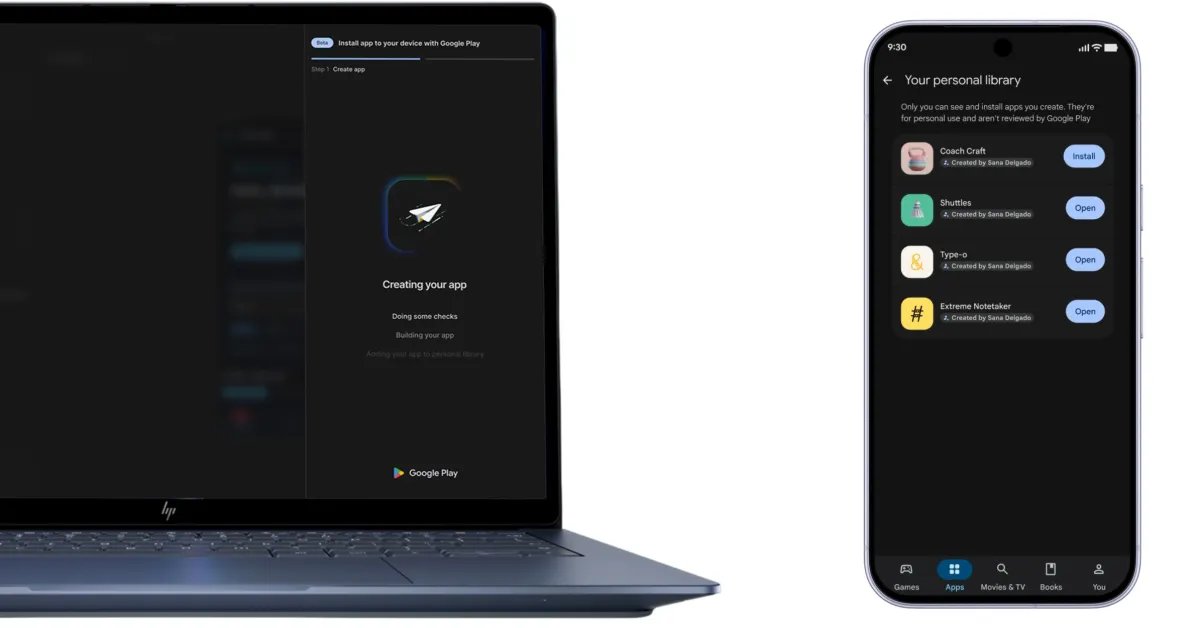
Beyond consumer-facing discovery, Google is addressing the needs of the rising demographic of AI-assisted developers. As generative AI tools become more prevalent for code generation and application prototyping, the volume of niche, self-built, or experimental software is increasing. Google has recognized that many of these creators require a secure environment to test and iterate on their work without immediately exposing it to the full public marketplace.
Consequently, the Play Store is introducing a private hosting and sharing capability. This feature allows individuals who build applications using AI-assisted workflows to store their creations in a private repository. This provides a secure, low-latency method to share experimental builds with selected individuals, such as collaborators or test groups, without the overhead of a full public release process. This infrastructure improvement recognizes that the line between “user” and “developer” is blurring, and that the infrastructure required to distribute software must be as agile as the tools used to create it.
The Broader Impact on Digital Infrastructure
The introduction of these features signals a long-term shift in the role of the app store. By utilizing massive datasets to power discovery, Google is attempting to solve the fragmentation of the mobile landscape. For the average user, the impact is a reduction in time spent searching for software that satisfies their specific needs. For developers, the challenge shifts toward ensuring their applications are tagged and categorized correctly so that the AI can accurately map them to the appropriate user profiles.
As these tools roll out in the United States and prepare for global expansion, the reliance on Gamer DNA and AI-generated search results will likely redefine the success metrics for application developers. Success will no longer be solely dependent on total downloads or aggregate ratings, but on how well an application aligns with the specific segments of the user base identified by Google’s algorithms. As these technologies mature, the digital storefront will evolve from a static catalog into an adaptive, personalized environment that functions more like a curated partner than a simple directory.
Disclaimer: This content is auto-generated for informational purposes only.
Source: Read Original News