







The air in the room shifted the moment the first notes of Led Zeppelin’s “Stairway to Heaven” began to echo through the theater. It is a bold, almost sacrilegious choice for a fantasy trailer—a song so tethered to classic rock mythology that its use in a film adaptation usually signals a project of staggering scale. But as the screen illuminated with the first footage of Greta Gerwig’s Narnia: The Magician’s Nephew, it became clear: this isn’t just another franchise reboot. It is, quite possibly, the most ambitious swing of Gerwig’s career to date.
On Tuesday, Gerwig unveiled the first look at her long-gestating adaptation of C.S. Lewis’s creation myth. Eschewing the well-trodden ground of The Lion, the Witch and the Wardrobe, Gerwig has opted to start at the absolute beginning, diving into the 1955 prequel that charts the genesis of the Narnian universe. If the trailer is any indication, she has traded the whimsical, low-budget charm of previous iterations for an IMAX-sized, cosmic grandeur that feels both ancient and refreshingly new.
The Genesis of a New World
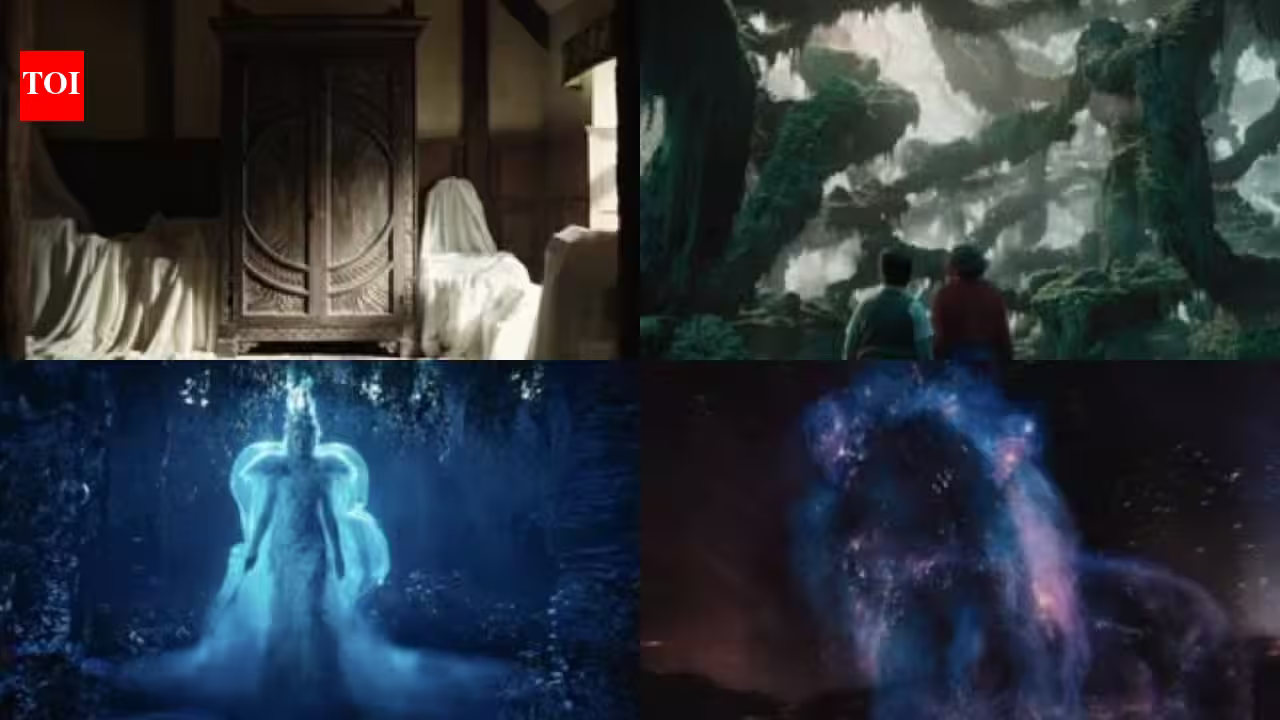
“Have you ever seen a world born?” The line, whispered against a backdrop of swirling celestial nebulae and budding life, sets the tone for a film that aims to be profoundly different from the action-heavy blockbusters currently saturating the market.
“Movies this size are usually about destruction,” Gerwig remarked during the debut, her hands folded with the quiet confidence of a director who knows she has captured lightning in a bottle. Her version of Narnia seems intent on building, not breaking. The footage is lush, brimming with the kind of tactile, high-fantasy wonder that defined the golden age of cinema, yet it carries the distinct, sharp emotional intelligence that has become a hallmark of Gerwig’s filmography.
The most discussed element of the trailer, however, is the film’s take on Aslan. The legendary lion, the divine heart of Lewis’s allegory, appears not as a creature of flesh and fur, but as a shimmering, cosmic outline. Voiced by Meryl Streep, the character is a radiant, ethereal presence that roars with the weight of an entire galaxy. It is a radical departure—and one that has already sparked a firestorm among purists.
Casting Choices and the Weight of Expectation
The decision to cast Meryl Streep as the voice of Aslan has drawn immediate fire from conservative corners of the internet. Aslan, traditionally interpreted as a Christ-figure in Lewis’s work, has long been gendered as male in the text. By casting Streep, Gerwig is making a stylistic and theological choice that favors the “voice of authority” over the rigid adherence to canonical gender roles.
Gerwig has remained characteristically diplomatic. She didn’t address the controversy directly, choosing instead to pivot to her gratitude toward the Lewis estate for their “public support” of the project. It is a wise maneuver; after all, the film’s ensemble cast—featuring heavyweights like Daniel Craig, Emma Mackey, Ciaran Hinds, and Carey Mulligan—is arguably the strongest collection of talent ever assembled for a Narnia project. With newcomers David McKenna and Beatrice Campbell anchoring the human element as the children who stumble upon the magic rings, the film appears to strike a delicate balance between star power and the innocence required for such a high-fantasy premise.
The “Stairway” Gambit
Securing the rights to Led Zeppelin’s “Stairway to Heaven” is, in industry terms, a near-impossible feat. Jimmy Page and Robert Plant are notoriously protective of their catalog, famously turning down massive offers for decades. Gerwig’s success in securing the song is a testament to the persuasive power of her vision.
“They did it because they saw the heart in the story,” Gerwig explained. “And they, too, love C.S. Lewis.” It’s a marriage of mediums that feels surprisingly organic. The song’s slow-burn build, moving from acoustic introspection to full-blown electric majesty, mirrors the narrative arc of The Magician’s Nephew—a story that begins with two children in a quiet 1900s London and explodes into the violent, beautiful birth of a world.
Netflix’s Theatrical Pivot
Perhaps the most surprising aspect of this production is its distribution strategy. Netflix, the streaming behemoth that famously keeps its biggest tentpoles behind a digital wall, is giving Narnia a sprawling, traditional wide theatrical release on February 12, with a streaming debut on April 2.
This, Gerwig notes, was a condition of her participation. She remembers the initial pitch to Netflix CEO Ted Sarandos at a cocktail party with the kind of clarity that only comes from a make-or-break moment. “I told Ted I only know how to make movies for the big screen,” she recalled. His response was equally direct: “Make the movie for the biggest screen you can imagine.”
With a reported $280 million budget, this is Netflix’s most expensive, high-stakes gamble. It is a clear signal that the streamer is attempting to reshape its image, moving away from being a mere content provider and toward being a prestige studio that creates communal, “event” cinema.
The Thread of Faith
For Gerwig, Narnia is not a cynical IP grab; it is a spiritual homecoming. Raised in a household that leaned into the communal aspects of faith, and having attended an all-girls Catholic high school, Gerwig sees the spiritual underpinnings of Lewis’s work as the vital, beating heart of the project.
“For me, film and faith have always gone hand in hand,” she said. “They are both communal experiences.” When she speaks about the Chronicles of Narnia, it’s with the same reverence she applied to Little Women. For her, these are foundational texts—stories that didn’t just entertain her, but constructed the framework of her adult identity.
As we look toward the February release, the film feels like an outlier in the best possible way. In an era where big-budget fantasy is often defined by CGI battlefields and dark, gritty nihilism, Gerwig is promising something else: a film about creation, awe, and the thin, magic line between our world and the next. Whether the audiences who grew up with the books will accept a celestial, Streep-voiced Aslan remains to be seen. But one thing is certain: Greta Gerwig has managed to make us look at Narnia—and the cinema screen—with brand-new eyes.
Disclaimer: This content is auto-generated for informational purposes only.
Source: Read Original News