









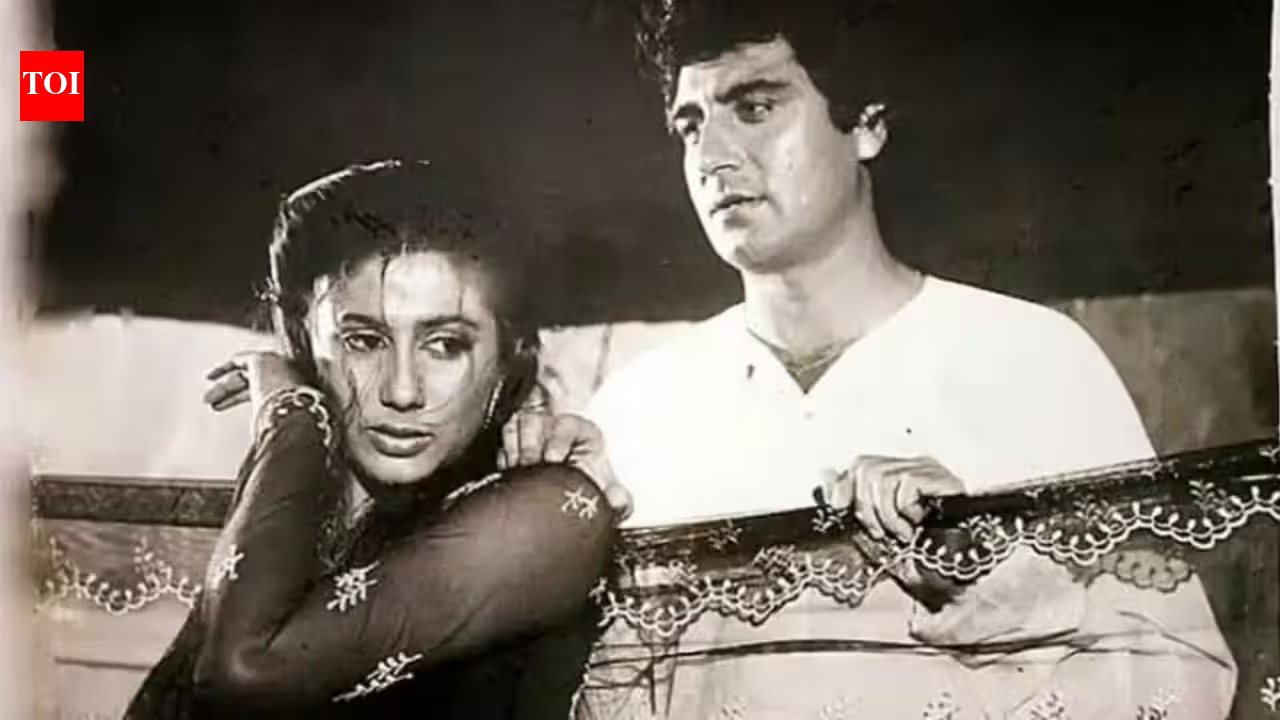
In the annals of Indian cinema, few love stories have been as polarizing, profound, and ultimately heart-wrenching as the union between Raj Babbar and Smita Patil. It was a narrative that played out like a cinematic tragedy—marked by intense passion, the weight of societal judgment, and a conclusion that left an entire industry reeling. Even decades later, the shadow of their short-lived life together continues to loom large over Bollywood’s romantic history, offering a sobering reminder of how quickly the spotlight can shift from celebration to mourning.
A Meeting Destined by a ‘Sweet Clash’
To understand the intensity of their connection, one has to go back to 1980. While the two had been part of the industry’s fabric, it was the location shoot of Satish Misra’s Bheegi Palken in Rourkela, Odisha, that acted as the catalyst. It wasn’t a conventional “love at first sight” moment; instead, it was something more grounded. Raj Babbar has often described their first interaction as a “sweet clash,” a friction of personalities that surprisingly acted as the foundation for their future.
Even at the time, Smita Patil was already a formidable force—a powerhouse of talent known for her raw, earthy intensity in parallel cinema. Raj, already an established actor, found himself drawn not just to her undeniable beauty, but to the sheer depth of her character. He was married to theater personality Nadira Zaheer, and they had two children, Juhi and Arya. When he and Smita began to grow closer, it was a move that defied the conventions of the time, placing both under the unforgiving scrutiny of the public eye.
Defying Conventions and the Price of Love
It is rarely simple when two lives collide in the public domain, especially when one is already committed to another. The narrative that emerged—and one that Raj has been quick to clarify over the years—is that this was not a byproduct of a failing marriage. He has maintained in several interviews that his life with Nadira was stable, and that his falling for Smita was an “unexpected” development that simply happened.
Smita, a woman of fierce independence, found herself in the middle of a moral firestorm. She knew exactly what she was entering into—she was aware of Nadira’s position, the implications for the children involved, and the inevitable judgment of society. Yet, the emotional magnetism between her and Raj was too potent to ignore. They eventually moved in together, and in 1983, they were married. For a brief period, they existed in a bubble of their own creation, a life that culminated in the birth of their son, Prateik Babbar, in 1986.
The Tragic 15 Days of Motherhood
If their union was the climax of a romance, the aftermath was a tragedy of Shakespearean proportions. The joy of welcoming a child into the world is meant to be a high-water mark of any relationship, but for Raj and Smita, that joy was cruelly truncated. Just 15 days after giving birth to Prateik, the world shifted on its axis.
Smita Patil, the icon who had mastered the art of conveying profound human emotion on screen, fell critically ill. Complications following childbirth set in with terrifying speed, leaving her family and the entire Indian film industry in a state of paralysis. At just 31 years old, Smita was at the zenith of her career, yet her story was nearing its final page.
Echoes of Regret in the Final Moments
Years after the dust settled, Raj Babbar opened up about the final, harrowing hours leading up to her passing. Recounting that drive to the hospital to Rediff, he provided a glimpse into the raw vulnerability of a woman who had lived life on her own terms, yet was burdened by the complexity of her final choices.
Throughout that desperate journey to the hospital, Smita was not lamenting her fate or struggling for breath; she was apologizing. Her repeated apologies were a poignant reflection of the guilt she carried, perhaps for the path she had chosen or the pain her choices had inadvertently caused others. Raj remembers the look in her eyes—tears, acknowledgment, and a quiet, terrifying realization of the inevitable. “Everything will be okay,” he had promised, but it was a promise the universe would not allow him to keep. Within an hour of reaching the hospital, the doctors confirmed she had slipped into a coma. She never woke up.
A Legacy Beyond the Controversy
The discourse surrounding Raj Babbar and Smita Patil often focuses on the “scandal” of the affair, but that perspective ignores the humanity of the individuals involved. Smita Patil remains a towering legend, a woman whose influence on Indian cinema is immeasurable. Her life was a testament to passion—the kind that moves mountains and breaks rules, even when those rules exact a heavy toll.
For Raj, the memory of that time remains a complex mix of professional admiration for her craft and the lingering ache of a life cut short. He has always spoken of Nadira’s maturity in handling the situation, noting that his children, like Juhi, formed a bond with Smita. It is a testament to the fact that real life is rarely black and white.
Looking back, their story serves as a mirror to the late 80s film industry—a time of immense talent and messy personal lives. But more than that, it is the story of two people who, for a brief window in time, found in each other a kindred spirit, regardless of the cost. Smita may have left us decades ago, but the intensity with which she lived—and the tragic beauty of her final moments—remains etched in the memories of those who followed their journey from a distance.
Disclaimer: This content is auto-generated for informational purposes only.
Source: Read Original News