







The Economic Mechanics of In-Kind Transfers in India
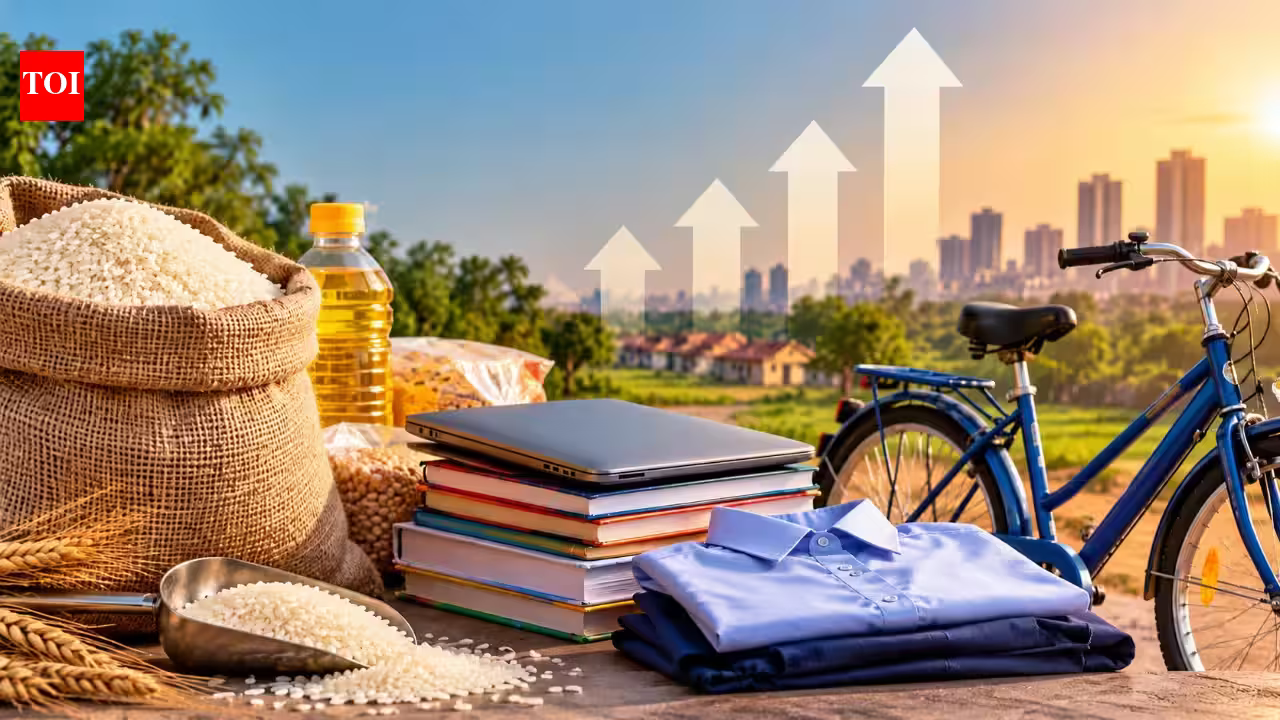
The recent release of the Household Consumption Expenditure Survey (HCES) 2022–23, published in the National Statistical Office (NSO) journal, provides a quantitative lens through which to view the impact of government-led in-kind welfare distribution in India. The study reveals that the strategic provision of non-monetary aid—ranging from foodgrains via the Public Distribution System (PDS) to essential assets like school uniforms, bicycles, and laptops—has successfully transitioned approximately 22 crore people into higher consumption brackets. This shift represents a significant pivot in the evaluation of household economic well-being, moving beyond traditional income-based metrics to include the imputed value of government-supported goods and services.
In the Indian macroeconomic context, consumption expenditure is the primary driver of domestic demand. By lowering the out-of-pocket burden for essential commodities, the state effectively enhances the discretionary purchasing power of the most vulnerable households. When a family receives its foodgrain entitlement, the cash that would have otherwise been allocated to caloric sustenance is redirected toward other household needs, effectively raising their Monthly Per Capita Consumption Expenditure (MPCE). This mechanism of economic elevation is not merely a social safety net; it is a structural intervention that alters household consumption patterns and deepens the penetration of various consumer markets into the rural hinterlands.
Quantifying Upward Mobility and Inequality Reduction
The data indicates that at the national level, 15.8% of the population experienced a tangible improvement in their standard of living when the monetary value of in-kind transfers was incorporated into their total consumption profiles. For rural areas, this impact was pronounced, with nearly 19% of the population moving up the consumption ladder, compared to 8.4% in urban centers. This disparity underscores the critical role of the PDS and similar rural-focused welfare programs in bridging the development gap between India’s agricultural heartlands and its urban economic corridors.
Beyond the immediate elevation of individual households, the study highlights a crucial secondary effect: the reduction of consumption inequality. By measuring the Gini coefficient—a standard statistical index of distribution inequality—researchers observed a flattening of the consumption curve. Because these transfers are heavily skewed toward the bottom of the socioeconomic pyramid, the effective purchasing power of the poorest deciles has seen a disproportionate boost. This suggests that the current model of in-kind welfare acts as a progressive fiscal instrument, successfully mitigating the widening consumption chasm that often accompanies rapid industrial growth in developing economies.
Regional Divergence: A Tale of Two Indias
The NSO study exposes a striking regional divergence in how state-level welfare programs influence consumption habits. West Bengal emerged as the leader in this transition, with 46.5% of its rural population and 24.9% of its urban population moving into higher consumption brackets due to these transfers. Significant impact was also recorded in Chhattisgarh, Assam, Karnataka, and Uttar Pradesh. These states, which have historically focused heavily on localized welfare distribution, demonstrate how government intervention acts as an engine for stimulating demand in regions where private sector reach may still be in its nascent stages.
Conversely, more industrialized states such as Gujarat, Kerala, and Haryana reported substantially lower transition rates—3.7%, 4.6%, and 7.1% respectively. This does not necessarily imply a failure of welfare mechanisms in these regions; rather, it suggests a higher baseline for the population. In states with more developed private sector ecosystems and higher per capita incomes, the relative impact of basic in-kind transfers on consumption status is smaller because the households are already positioned at higher brackets. This regional contrast provides a valuable roadmap for policymakers and market strategists to understand where the “bottom-of-the-pyramid” market growth is being fueled by state policy and where it is being driven by structural economic development.
Strategic Implications for Business and Markets
For the private sector, these findings offer a vital signal regarding the evolution of the Indian consumer base. The movement of 22 crore individuals into higher consumption tiers implies a significant expansion of the addressable market for consumer packaged goods (CPG), durables, and financial services. As these households transition into higher MPCE categories, their consumption profiles typically shift from subsistence-level buying to include branded items, better-quality home utilities, and digital access tools.
Businesses that align their distribution strategies with these welfare-heavy regions stand to benefit from a more stable and growing customer base. Furthermore, the fact that these households have shifted their spending from basic survival to other categories provides an opportunity for firms to invest in rural marketing and localized distribution channels. By recognizing that state-supported in-kind transfers are effectively creating a new class of consumers, companies can better calibrate their product offerings and price points to capture the potential represented by this upwardly mobile demographic.
Limitations and the Scope for Future Analysis
While the figure of 22 crore is significant, the research team acknowledges that it represents a conservative estimate. The study explicitly excludes large-scale public service benefits such as free healthcare under the Ayushman Bharat (PM-JAY) initiative and public school education. These services represent massive household savings that, if imputed into the survey data, would likely show an even more dramatic shift in the standard of living. For instance, the out-of-pocket expenditure on health is a major contributor to “poverty traps” in rural India; the alleviation of this burden through government insurance schemes is a powerful, though often unmeasured, catalyst for economic mobility.
The exclusion of these variables suggests that the current NSO findings only scratch the surface of how the Indian welfare state is reshaping the economy. As the government continues to formalize its welfare delivery through digital infrastructure and direct benefit mechanisms, the integration of health and education savings into household expenditure analysis will become essential. For analysts and economists, this highlights an urgent need for more comprehensive survey designs that capture the holistic value of public-funded services. As these longitudinal data points mature, they will provide a more precise view of how India’s welfare architecture is fundamentally altering the nation’s long-term socioeconomic trajectory and the underlying drivers of domestic consumption.
Disclaimer: This content is auto-generated for informational purposes only.
Source: Read Original News