








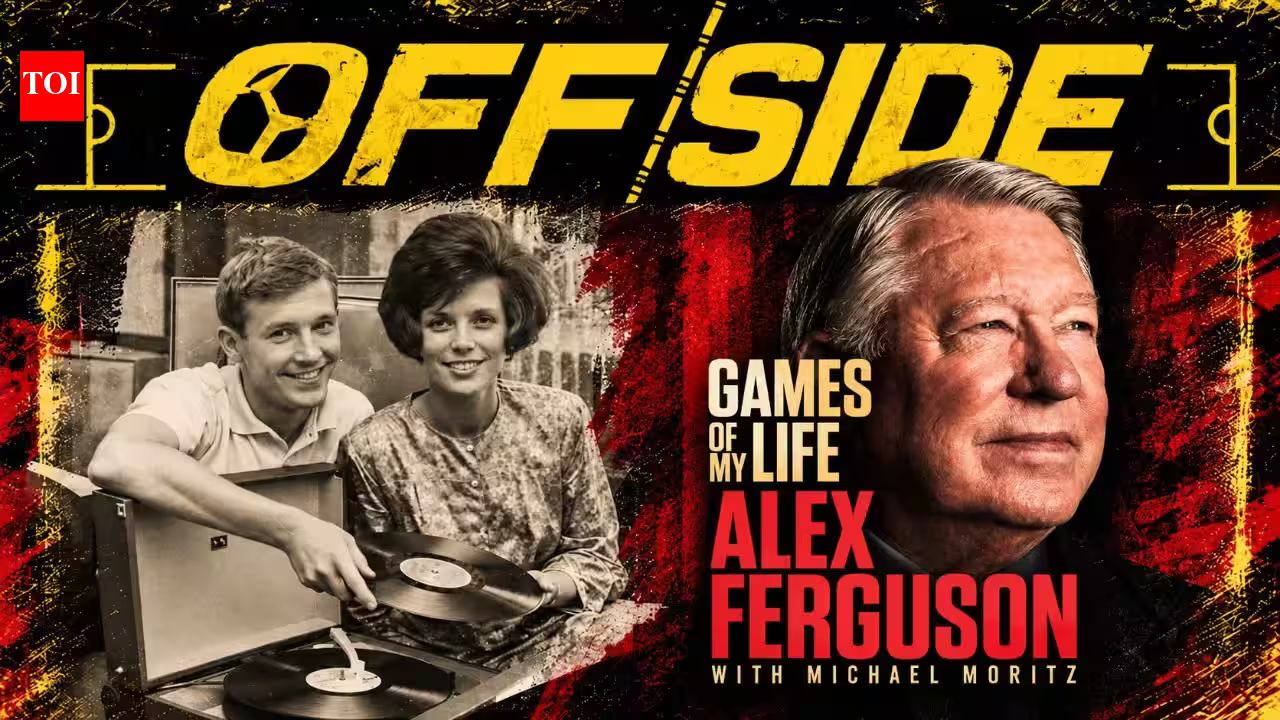
NOSTALGIA, as Don Draper once famously posited, is a “time machine.” For the modern Manchester United supporter, currently adrift in a sea of mediocrity, Sir Alex Ferguson’s new book, Games of My Life, serves as exactly that: a bittersweet journey back to a time when the club’s dominance was not merely a hope, but a constitutional right.
A Legacy Beyond the Trophies
Sir Alex Ferguson is arguably the most documented figure in the history of football. Yet, his latest literary effort manages to bypass the well-trodden ground of trophy counts and tactical breakdowns. Instead, Games of My Life offers a deeply personal curation of 21 matches spanning seven decades. In a move that highlights the gulf between public perception and personal significance, the legendary 1999 Champions League final in Barcelona is notably absent.
Instead, Ferguson reaches back to his roots: a schoolboy cup final at Govan High and a hat-trick for St Johnstone that, by his own admission, saved him from a mundane life as a toolmaker in Canada. These are the vignettes of a man whose relentless drive was forged in the shipyards of the River Clyde, influenced by a hard-nosed father and the early demands for discipline that would eventually evolve into the infamous “hairdryer” treatment.
From Youthful Promise to Chaotic Farewells
The book serves as a masterclass in the evolution of the Ferguson era. Readers are taken through the pivotal 1992 defeat to Liverpool—a result that inadvertently paved the way for Leeds United’s title—and the subsequent recruitment of Eric Cantona, a decision that fundamentally altered the trajectory of English football.
Ferguson masterfully weaves the tactical with the emotional. He highlights the 1995 win over Bolton, which vindicated his faith in the “Class of ’92” youngsters, and draws a direct line to the 2007 vintage of Wayne Rooney and Cristiano Ronaldo. Perhaps most striking is the inclusion of the 1999 Champions League semi-final against Juventus. Despite the acrimonious end to his professional relationship with Roy Keane, Ferguson holds nothing back in labeling it the Irishman’s finest hour, proving that the appreciation for footballing genius can outlive the most bitter personal fallout.
Even the finale of his 1,500-game career—a bizarre, chaotic 5-5 draw against West Bromwich Albion—is addressed with a candidness that feels refreshing. For a man who built an empire on structure, control, and absolute order, concluding his managerial tenure with such a defensive implosion remains a hilariously human footnote to an otherwise disciplined career.
Moments of Quiet Significance
While the world remembers the Treble and the European nights, Ferguson’s own hierarchy of memories offers a more intimate perspective. He chronicles his return to Old Trafford following a life-threatening brain haemorrhage and finds immense pride in his son Darren’s victory at Wembley with Peterborough United.
Perhaps the most poignant chapter involves a Scotland cap, finally awarded in 2021 at the age of 79. After 54 years of administrative neglect, the Scottish FA corrected an anomaly from his 1967 tour appearances. That small blue-and-gold cap, worn by a man who conquered Europe twice over, underscores that for the greats, the most meaningful victories are often those tied to national identity and personal closure.
The Seagulls and the Trawler
For the Manchester United supporter of today, reading Games of My Life is an exercise in painful contrast. As the club struggles through its worst start to a season since 1986—recently extending a winless run against Leeds United—the past feels like a different planet.
The “Theatre of Dreams” has, for many, transitioned into a place of predictable disappointment. As Ferguson famously said regarding the media, “When seagulls follow the trawler, it’s because they think sardines will be thrown into the sea.” Today’s fans are those seagulls, circling the wreckage of a dynasty, desperately sifting through the archives for a taste of the glory that once defined their lives.
Ultimately, Games of My Life is a delightful, if heart-wrenching, read. It reminds us that while the Ferguson era was a period of casual, monarch-like entitlement, the reality of the present is far more grounded. We can look back at the highlights, the Fergie-time winners, and the brilliance of the academy graduates, but the clock only ticks in one direction. As the pages turn, one realizes that the price of those magical childhood nights is the current, long-standing, and seemingly never-ending hangover of the post-Ferguson era.
Disclaimer: This content is auto-generated for informational purposes only.
Source: Read Original News