








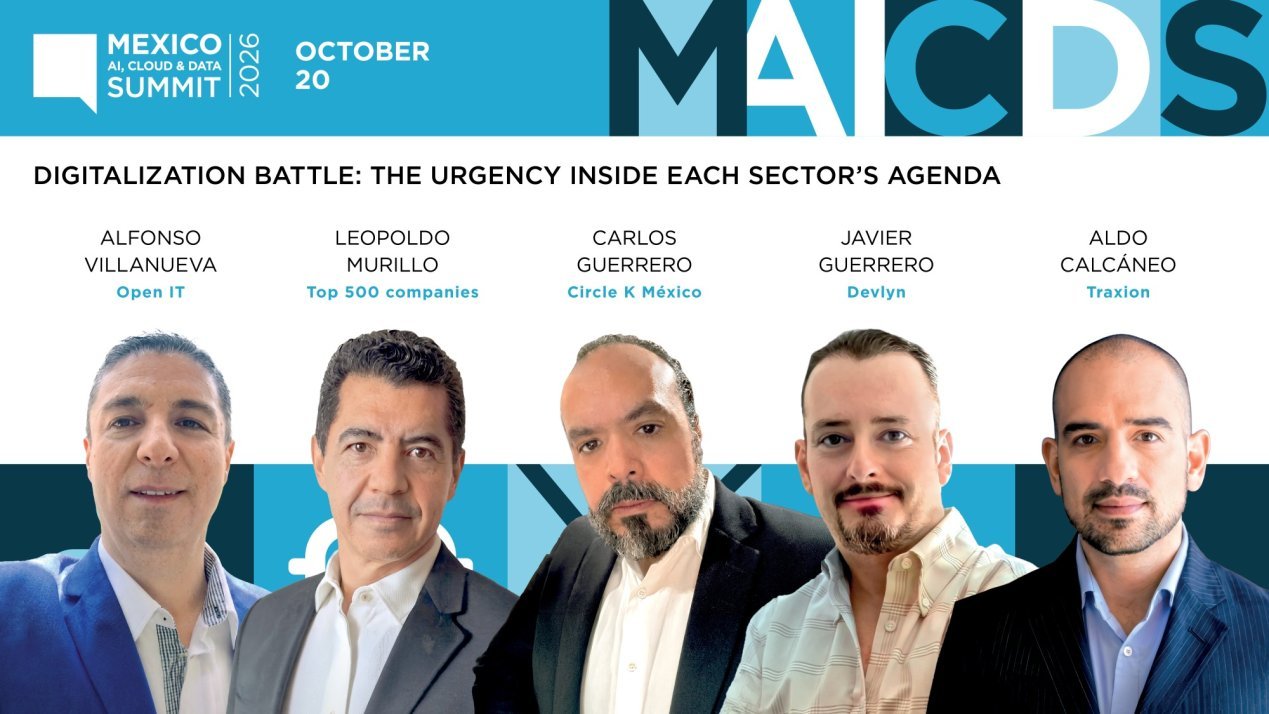
Mexico’s corporate landscape is undergoing a fundamental transformation as business leaders shift their focus from the simple procurement of new software to the complexities of data governance and strategic alignment. At the recent Mexico AI, Cloud & Data Summit 2026, industry experts from major firms including Circle K, Traxión, and Devlyn argued that the race for digitalization is no longer about which tools a company possesses, but rather how they govern the information fueling their artificial intelligence systems.
## The Governance Challenge in the Age of Shadow AI
As AI technologies proliferate, organizations are finding that their internal processes are failing to keep pace with the rapid adoption of new tools by employees. Carlos Guerrero, CTO of Circle K México, highlighted the growing concern over “shadow AI”—unauthorized use of AI software within the workplace. For IT leaders, this creates a catch-22: overly restrictive bans drive employees toward risky, unvetted alternatives, while an open-door policy leaves critical company data exposed.
The consensus among summit panelists is that “there is no AI without data.” Consequently, companies are now prioritizing the creation of robust, governed orchestration layers. These frameworks act as a bridge between core legacy systems and modern AI agents, ensuring that data definitions remain consistent across disparate platforms, such as ERP and CRM systems. By standardizing what constitutes a “customer” or a “trip” before the data even reaches a repository, businesses can avoid the fragmented insights that historically plagued digitalization efforts.
## Prioritizing Business Value Over Tool Adoption
Technology leadership in Mexico has moved beyond the “cost center” mindset. CIOs are increasingly tasked with demonstrating direct, measurable returns on investment. Javier Guerrero of Devlyn noted that modern AI initiatives are distinct from traditional long-term software deployments; they are often smaller, more agile projects that can generate tangible gains in productivity or revenue within weeks.
This shift has forced a reassessment of architecture. Companies are now deciding between the “build vs. buy” debate with a sharper focus on business utility. For example, Traxión is adopting a hybrid model—purchasing established human capital software while internally developing proprietary algorithms to optimize logistics. Similarly, Circle K has moved away from a total ERP overhaul, opting instead to build an agentic orchestration layer that links its existing finance, point-of-sale, and logistics stacks. This strategy allows the company to remain flexible, as it acknowledges that the “tool is merely a consequence of the business need.”
## Bridging the Gap: Data, People, and Performance
Despite the optimism surrounding AI, significant structural hurdles remain. Industry reports suggest that a large percentage of Mexican organizations still struggle to integrate AI and data security into a unified strategy, often treating them as siloed projects. Experts warn that this fragmented approach leads to inefficiencies that can stifle innovation.
Furthermore, the “human factor” remains paramount. Alfonso Villanueva of Open iT emphasized that technology alone cannot drive productivity; it requires a workforce trained to use new tools effectively. Many companies continue to pay for expensive software updates while relying on legacy workflows, failing to see the benefits of their own investments.
Looking forward, the role of the developer and the office worker is being redefined rather than replaced. By utilizing AI as an extension of existing expertise, companies can optimize processes—such as refining prompts to control cloud costs or using telemetry to reduce fuel consumption. As Mexico’s market continues to integrate production-grade agentic systems, the winners will be the organizations that successfully marry disciplined data governance with an agile, business-led approach to technology.
Disclaimer: This content is auto-generated for informational purposes only.
Source: Read Original News