









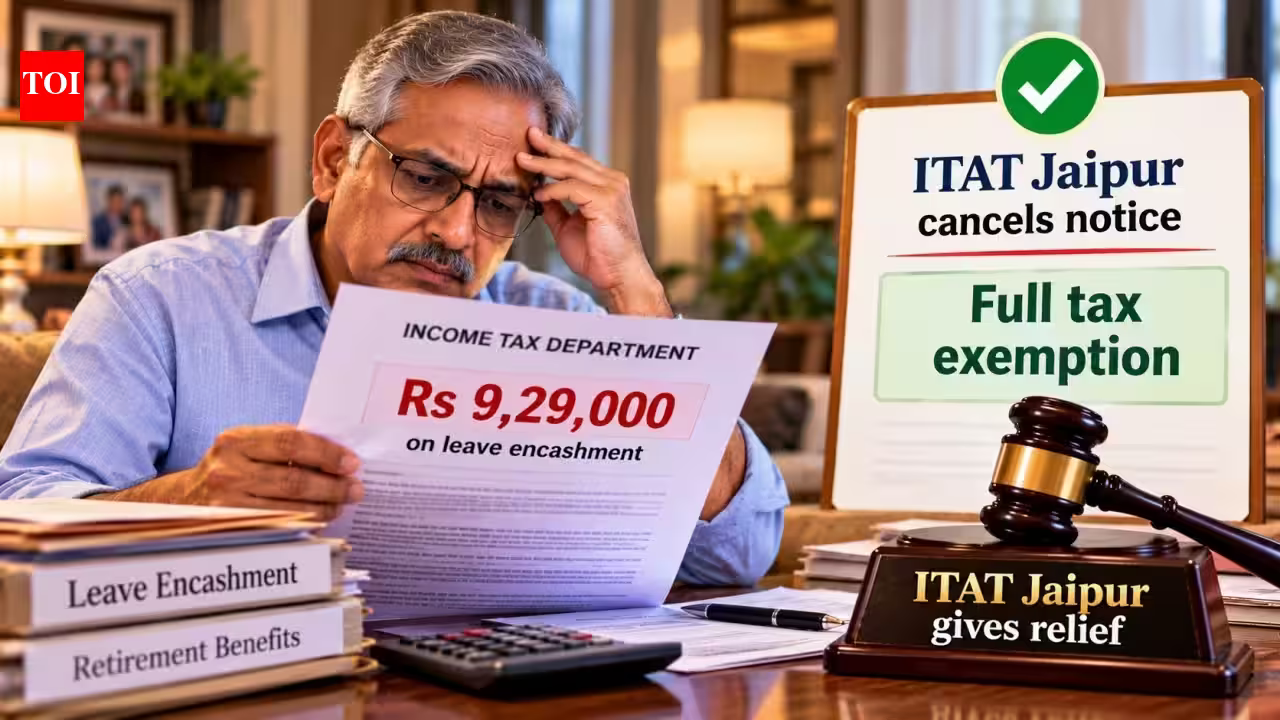
The intricacies of Indian tax law often present challenges for retired individuals, particularly when legislative updates coincide with long-standing disputes between taxpayers and the Revenue Department. A recent landmark ruling by the Income Tax Appellate Tribunal (ITAT) in Jaipur highlights the intersection of statutory interpretation, economic fairness, and the treatment of employees in the public sector. By granting relief to a retired State Bank of India (SBI) employee, the tribunal has provided a significant precedent regarding the retrospective application of tax exemptions for leave encashment.
The Statutory Framework of Leave Encashment
Under the Income Tax Act, 1961, Section 10(10AA) governs the taxability of cash equivalents received by employees in lieu of unutilized leave at the time of retirement or resignation. The law creates a distinct categorization between two classes of workers: government employees and non-government employees.
For central and state government employees, the entire amount of leave encashment received at the time of retirement is fully exempt from income tax. In contrast, for non-government employees—a category that includes staff of public sector undertakings (PSUs), nationalized banks, and private corporations—the exemption is capped. Historically, this ceiling remained stagnant at Rs 3 lakh for over two decades, specifically since 2002. It was only in May 2023, through notification number S.O. 2276(E), that the Central Board of Direct Taxes (CBDT) revised this threshold to Rs 25 lakh, reflecting the realities of inflation and increased compensation structures.
The Dispute: When Statutory Timing Meets Retirement
The case involving the retired SBI employee originated from his retirement in 2020. Upon exiting his service, he received Rs 9.29 lakh as leave encashment. At the time of his retirement, the prevailing statutory exemption limit was Rs 3 lakh. Consequently, he became liable for tax on the excess amount of Rs 6.29 lakh. However, the taxpayer claimed the full Rs 9.29 lakh as exempt in his Income Tax Return (ITR), relying on the premise that such retirement benefits should be tax-neutral.
The Assessing Officer (AO) strictly adhered to the law as it stood in 2020, restricting the exemption to Rs 3 lakh and treating the remainder as taxable income. This assessment was initially upheld by the Commissioner of Income Tax (Appeals), who referenced established judicial precedents confirming that SBI employees do not hold the same status as government employees for the purposes of Section 10(10AA). The retired employee’s financial burden effectively increased due to this administrative interpretation, prompting him to escalate the matter to the ITAT.
The ITAT Jaipur’s Remedial Interpretation
The decision delivered by the ITAT Jaipur on September 22, 2026, represents a departure from a rigid chronological application of the law. While the tribunal acknowledged that SBI staff remain classified as non-government employees, it focused on the intent behind the 2023 notification. The tribunal argued that the upward revision of the exemption limit was not a novel benefit but a long-overdue correction of a limit that had not been adjusted since 2002, despite substantial changes in salary standards and cost-of-living indices.
By framing the notification as a remedial measure, the tribunal sought to mitigate the disparity that would have otherwise disadvantaged employees who retired shortly before the amendment. The ruling emphasized that denying the increased ceiling to individuals like the appellant would perpetuate the very inequity the government aimed to resolve by raising the limit. Consequently, the ITAT declared the Rs 9.29 lakh payout to be within the newly defined Rs 25 lakh threshold, effectively deleting the tax addition of Rs 6.29 lakh.
Market Insights and Corporate Implications
This judgment provides critical insights into how tax tribunals in India are increasingly adopting a pragmatic approach to legislation. In the Indian corporate context, this ruling serves as a vital signal for retired PSU and bank employees who may have faced similar tax additions in recent years. It suggests that while strict adherence to the letter of the law is a standard tax practice, the spirit and purpose of remedial legislation can play a pivotal role in litigation.
For HR departments and financial planners in public sector banks and large corporations, this case underscores the importance of clear communication regarding tax liabilities. Many employees approaching retirement may operate under the assumption that all terminal benefits are tax-free. The clarification provided by the ITAT helps in managing expectations for future retirees, while also validating that the judiciary is willing to bridge gaps created by slow-moving bureaucratic updates to fiscal policy.
Broadening the Precedent
The Jaipur tribunal’s reliance on its own coordinate benches—such as the cases of Dashrath Kumar Sen and Govind Chhatwani—reveals a growing consistency in how these matters are handled across different tax jurisdictions in India. This alignment is crucial for tax stability. It prevents a scenario where taxpayers are subjected to varying interpretations of the same statute based on their geographic location or the specific bench handling their appeal.
Furthermore, it is essential to note that this ruling does not abolish the distinction between government and non-government employees. As pointed out by experts, the tribunal did not categorize SBI staff as government employees. Instead, it recognized the economic reality of the threshold change. For the broader market, this provides a clear legal pathway for other retirees to seek rectification of their tax assessments if their leave encashment fell between the old Rs 3 lakh limit and the new Rs 25 lakh threshold during the intervening years.
Conclusion: The Balance of Law and Equity
The ITAT Jaipur decision is a significant example of judicial intervention where fiscal policy lags behind economic reality. By allowing the retrospective benefit of a higher tax exemption for a retired employee, the tribunal has prioritized the objective of tax relief over a strictly temporal interpretation of the statute.
For the Indian taxpayer, particularly those in the public sector, this verdict offers a glimmer of relief and a roadmap for potential appeals. It serves as a reminder that tax law is not merely a collection of rigid figures, but a system that, when challenged effectively, can accommodate the principles of fairness and equity. As the Indian tax landscape continues to evolve, cases like this will remain foundational in defining how terminal benefits are protected against the eroding effects of inflation and outdated thresholds.
Disclaimer: This content is auto-generated for informational purposes only.
Source: Read Original News