







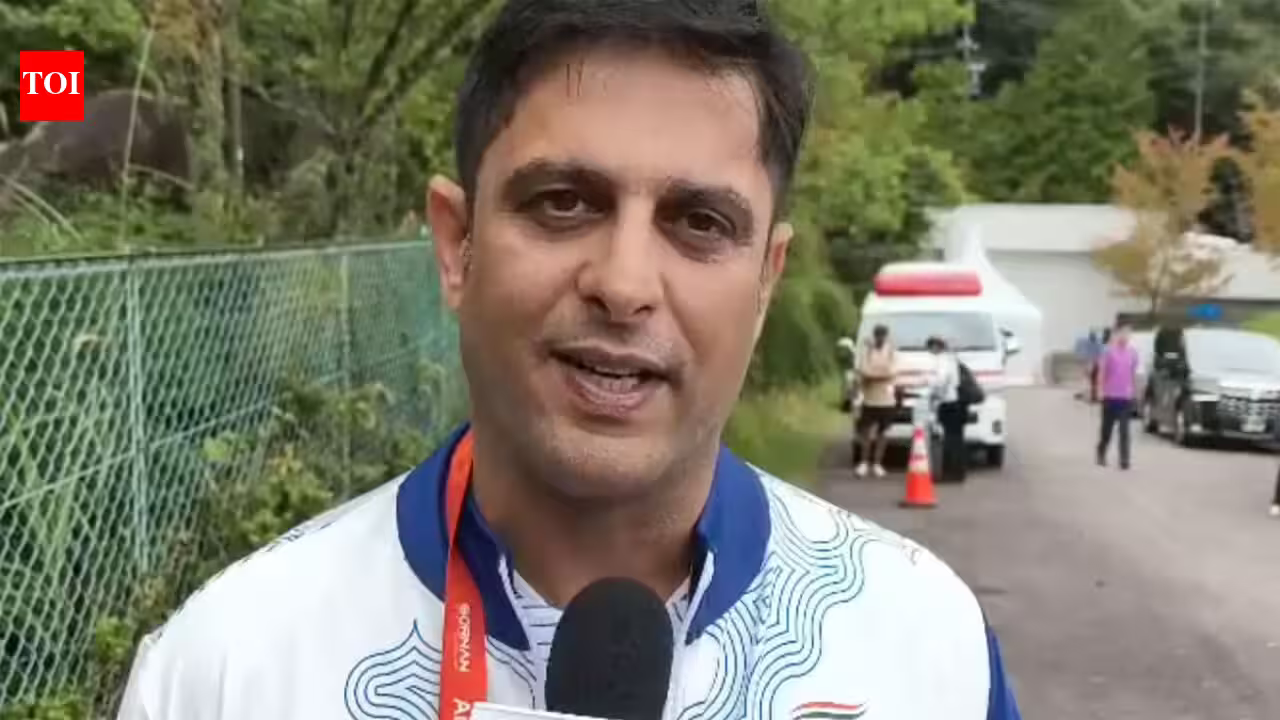
PUNE – The echoes of the Aichi-Nagoya Asian Games have barely faded, but for the National Rifle Association of India (NRAI), the post-mortem analysis of the recent campaign is already in full swing. While a haul of 15 medals—comprising three gold, eight silver, and four bronze—is an achievement that would satisfy many federations, NRAI president Kalikesh Singh Deo is setting his sights higher. Sitting firmly in second place behind the shooting powerhouse of China, which secured 28 medals, India proved its mettle as an Asian shooting juggernaut, yet the leadership remains unsatisfied, eyeing the gaps that prevented an even more dominant display.
Addressing the Air Pistol Deficit
Despite the overall success, a glaring blind spot emerged in Japan: the 10m air pistol events. In what is typically a competitive stronghold for Indian shooters, the contingent returned with empty hands in the men’s and women’s individual and team categories. The lone glimmer of success in the discipline came via Suruchi Phogat and Kamaljeet, who secured gold in the mixed team event, acting as the sole consolation in an otherwise barren run for the pistol specialists.
The irony of the result lies in the pedigree of the squad. The women’s roster boasted the presence of global icons, including Paris Games double medallist Manu Bhaker, alongside the talented Esha Singh and Suruchi. Conversely, the men’s team faced the tournament with a squad described by many as inexperienced, featuring Kamaljeet, Kedarling Balakrishna, and Aakash Bhardwaj. For Kalikesh, the disparity in results highlights a systemic challenge that the federation is now forced to confront.
The Cost of Inconsistency
A major talking point surrounding the men’s air pistol squad has been the lack of team stability. Unlike the rifle disciplines or the women’s pistol categories, where a core group often provides a predictable foundation, the men’s air pistol side has seen a revolving door of personnel. Kalikesh admits that while the selection policy is purely meritocratic, the constant turnover is a double-edged sword.
“There have been frequent changes in the composition of the men’s air pistol team,” Kalikesh told the Times of India. “Our selection policy is completely objective. We use a rolling average of scores, so we do not exercise discretion in the selection process. However, frequent changes in the team can be a problem because athletes do not get enough time to gain experience. The sports science support we need to provide them also sometimes gets disrupted.”
By relying strictly on a rolling average of performance, the NRAI ensures fairness, but it inadvertently prevents the formation of a cohesive unit that can withstand the high-pressure environment of continental and global championships. The shooters are essentially competing for their survival in every tournament, leaving little room for the long-term psychological conditioning required at the elite level.
Building a Deeper Bench
The “problem of plenty” is a luxury, but only if managed correctly. The NRAI has seen an influx of young talent, creating fierce domestic competition. To capitalize on this, the federation has already begun experimenting with a “double-track” international strategy.
“We have to find a way to work with a larger pool of athletes, perhaps even beyond the core team,” Kalikesh explained. “We had anticipated this issue, not just in air pistol but in some other events as well. In the year preceding this one, we introduced a policy of sending two teams to international competitions. Alongside the main team, which competed at every World Cup, we sent another team and gave its members ample opportunities.”
This proactive approach has resulted in roughly 10 to 15 shooters per discipline gaining critical international exposure. While this depth is vital for the future, the federation is now tasked with refining how those individual talents transition into successful team units.
Looking Toward the Future
With the World Championships on the immediate horizon, the NRAI has opted for a “steady-as-you-go” approach. Kalikesh emphasized that the priority is to avoid disrupting the current rhythm of the high-performance coaching groups while they are in the heat of the season.
“Men’s air pistol remains an issue we need to address,” Kalikesh noted. “We are waiting for the World Championships to conclude because we do not want to disturb either the team or the high-performance coaching group at this stage.”
The message from the NRAI leadership is clear: the era of relying on a handful of superstars is ending. The focus is shifting toward institutionalizing consistency through broader exposure and specialized support. For India’s shooters, the road to future Olympic cycles will be paved with the lessons learned in Japan—proving that while the medal tally was respectable, the goal remains perfection on the world stage. Whether through refining selection metrics or fostering more stable team environments, the federation is signaling that a larger, more experienced pool of shooters is no longer just an ambition; it is an organizational mandate.
Disclaimer: This content is auto-generated for informational purposes only.
Source: Read Original News