







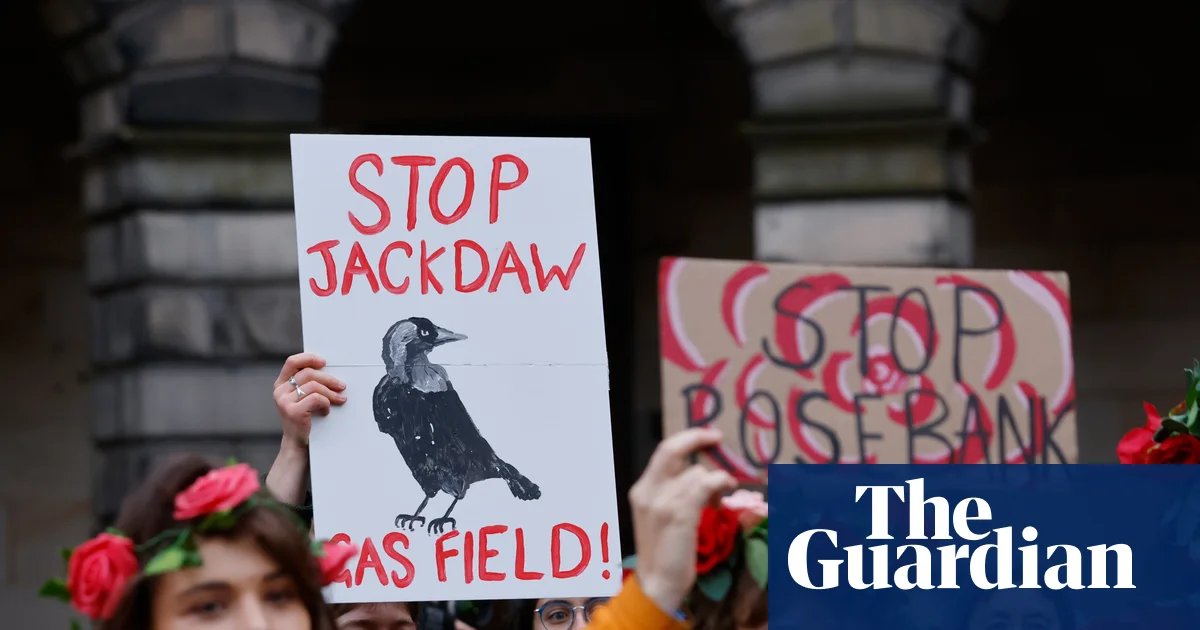
The UK government has officially approved the controversial Jackdaw gasfield in the North Sea, a move that provides a significant boost to the fossil fuel industry while sparking intense backlash from environmental advocates and members of the governing Labour Party.
Energy Secretary Miatta Fahnbulleh confirmed the decision this week, stating that the project will begin supplying gas to British homes and businesses by the end of the month. The approval comes after a period of intense lobbying from energy firms, specifically regarding existing licences that had faced legal hurdles following a court ruling requiring operators to account for the carbon emissions generated by burning their products.
In her statement, Fahnbulleh defended the decision as a pragmatic step for national energy security. “Following careful consideration of all relevant factors, I have agreed that the regulator can grant consent for gas to be produced at Jackdaw,” she said. “This decision will support the country’s energy security with homegrown gas this winter and help minimise the UK’s use of imported higher emission fuels as we continue our transition to renewables and nuclear.”
The government has been careful to frame the approval as compatible with its broader climate strategy, emphasizing that it remains committed to ending new exploration licences and achieving net-zero emissions by 2050. However, the timing of the announcement—which follows a calculated delay past the Holborn and St Pancras by-election—suggests a government acutely aware of the political volatility surrounding the issue.
For environmental campaigners, the decision is a direct contradiction of the party’s manifesto commitments. Tessa Khan, executive director of the group Uplift, criticized the project’s scope and impact. “Jackdaw will provide around just 2% of our gas demand for roughly 10 years,” she said. “It has been oversold and won’t stop the overall decline in North Sea jobs, as it will be largely unmanned and operated remotely.”
The project, operated by Shell, has been a flashpoint in the debate over the UK’s energy transition. While the oil and gas industry maintains that projects like Jackdaw and the separate, pending Rosebank field are vital, claiming they could account for 10% of total UK output at peak, critics argue that the environmental cost renders any economic benefit negligible. A report commissioned by Adura, a joint venture between Shell and Equinor, warned that rejecting these projects could cost the UK economy nearly £10.8bn over the next decade.
The internal and external political fallout is expected to be significant. Although the move may satisfy unions and industrial interests in north-east Scotland, it risks alienating a key segment of Labour’s voter base. Recent polling by Savanta for the climate thinktank E3G indicates that nearly a third of voters are less likely to support Labour if it pursues further North Sea drilling, a sentiment that is particularly acute among younger voters.
Green party leader Zack Polanski condemned the approval as “climate vandalism.” Polanski argued that the project represents a betrayal of climate commitments, noting that the minimal job creation and lack of impact on consumer energy bills make the project a “victory for Shell over the people.”
As the government attempts to balance its long-term climate ambitions with short-term energy requirements, the Jackdaw approval signals a precarious path forward. With the decision on the much larger Rosebank field still pending, the government remains under intense scrutiny to prove that its “net zero” credentials can survive the realities of North Sea extraction. Ellie Mae O’Hagan of E3G summarized the sentiment of the opposition: “If the prime minister wants a decade in power to change the country, he should invest in heat pumps and solar, not tax breaks for the oil and gas companies.”
Disclaimer: This content is auto-generated for informational purposes only.
Source: Read Original News