








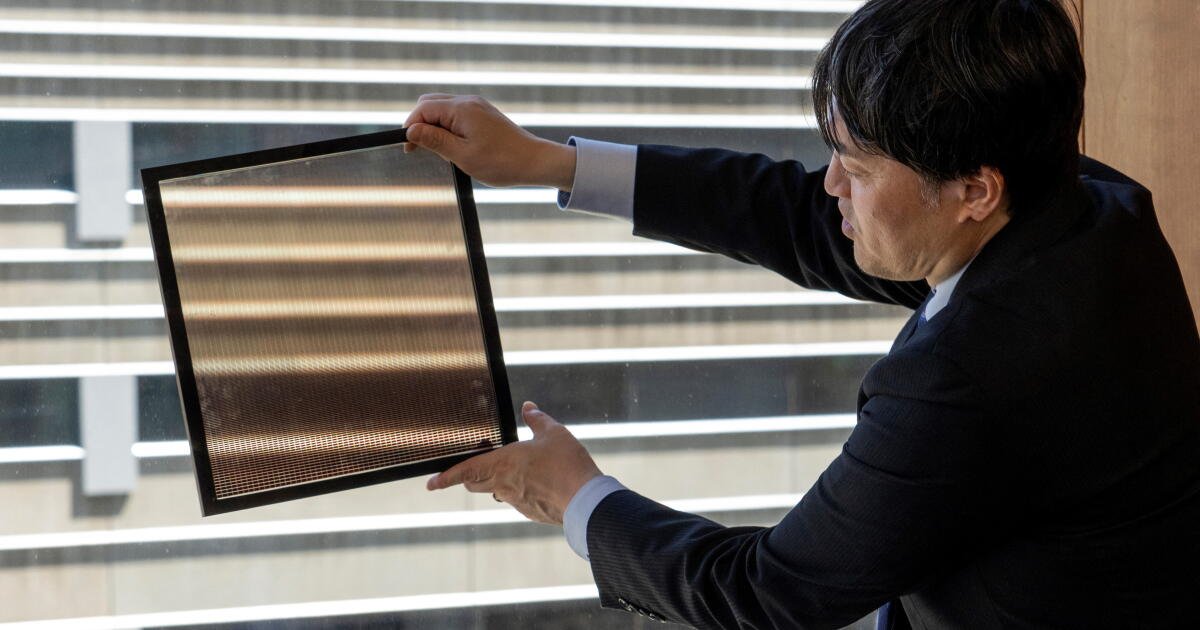
Panasonic Holdings Corp. has announced an aggressive acceleration of its production timeline for next-generation solar technology, signaling a significant shift in Japan’s renewable energy strategy. The electronics giant confirmed Tuesday that it will begin mass-producing perovskite solar cells integrated into glass in April 2029—a full year ahead of its original schedule.
The manufacturing operations will be centered at a facility in Nagahama, Shiga prefecture. This move follows the company’s initial market foray in September, when it began selling smaller-scale units manufactured at its Osaka development site. By transitioning to large-scale production, Panasonic aims to solidify its position in the burgeoning market for building-integrated photovoltaics (BIPV).
Perovskite solar cells represent a departure from traditional, bulky silicon panels. By utilizing a crystalline structure that can be applied as a thin, lightweight film, these cells can be embedded directly into glass surfaces. Panasonic is marketing this “power-generating glass” as a customizable solution for windows and exterior walls, with adjustable levels of transparency, size, and design aesthetic.
For Japan, which faces unique geographical challenges including a mountainous landscape and high population density, the technology offers a path to increase renewable energy capacity in areas where space is at a premium. Conventional silicon panels require significant roof space and structural support, limiting their utility in densely developed urban environments.
“Particularly in urban areas, many buildings have limited roof space available for solar panel installation, leading to increased expectations for building-integrated photovoltaics,” Panasonic noted in a statement. By turning the building envelope itself—windows and facades—into a power-generating asset, the company hopes to bypass the spatial constraints that have historically hampered solar expansion in Japan’s major cities.
However, the road to mass adoption remains complex. Despite their versatility, perovskite cells are currently more expensive to produce than traditional silicon-based panels. Bridging this cost gap is considered the primary hurdle for wide-scale commercial deployment. Furthermore, the global race to dominate this technology is intensifying. While Japan is positioning itself as an early mover, it faces stiff competition from China, which currently maintains a dominant grip on the global solar manufacturing industry and is also investing heavily in perovskite research and development.
The success of Panasonic’s initiative may depend on its ability to lower manufacturing costs through the efficiency gains expected at the Nagahama plant. While the company has not yet disclosed specific production volume targets for the new facility, the decision to pull forward its timeline suggests a high degree of confidence in the scalability and market demand for the technology.
As the global energy transition accelerates, countries are increasingly looking toward “invisible” solar solutions to integrate clean power into the built environment. By embedding solar cells into the very infrastructure of modern cities, Japan hopes to transform its skylines into decentralized, self-sustaining power plants. Whether perovskite technology can move from high-end architectural applications to a mainstream building standard will largely depend on the output and economic viability of facilities like the one Panasonic is preparing to launch in Shiga.
The shift to mass production by 2029 marks a pivotal moment for both Panasonic’s corporate strategy and Japan’s broader efforts to reach its ambitious carbon neutrality goals. With this announcement, the company is signaling that the era of solar panels being restricted to rooftops may be coming to an end, paving the way for a more integrated and flexible energy future.
Disclaimer: This content is auto-generated for informational purposes only.
Source: Read Original News