







Controversy at Bikaner House: Raihan Vadra’s Exhibition Stripped of Protest Photography
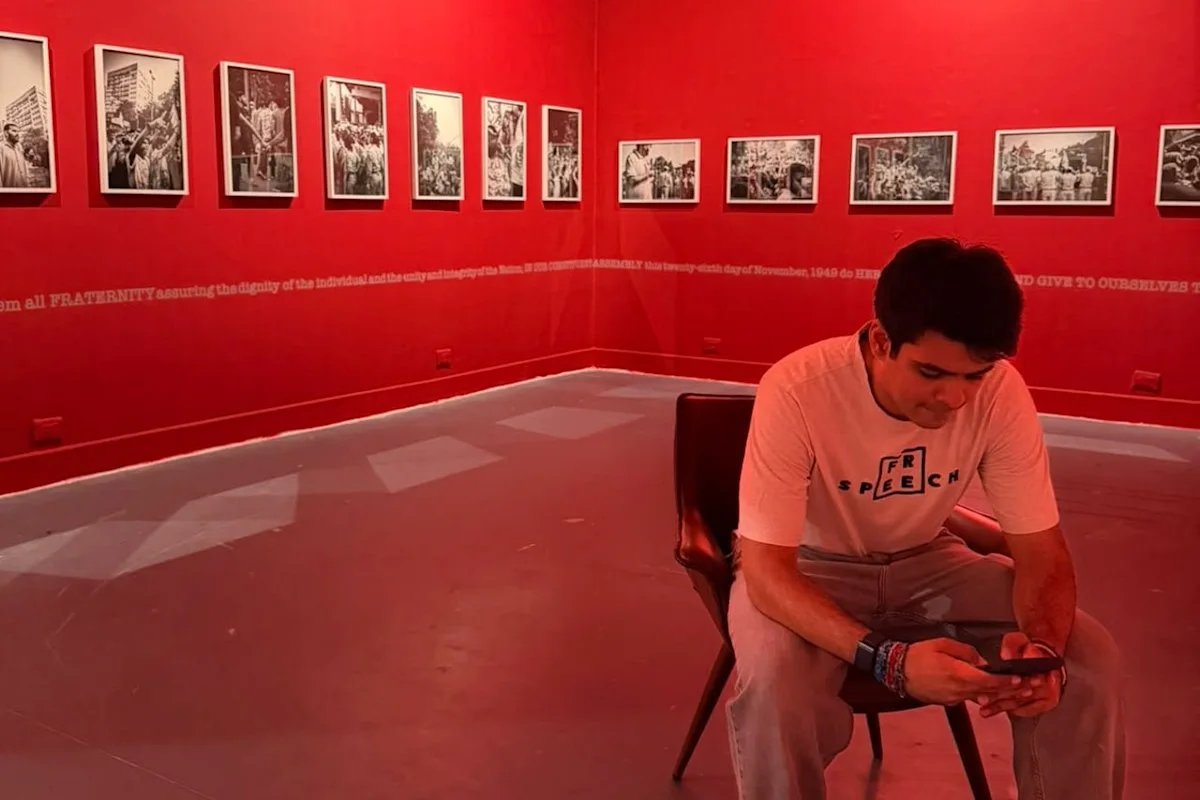
A storm of controversy erupted in the national capital this week after Raihan Vadra, the 26-year-old photographer and son of Congress leader Priyanka Gandhi Vadra, alleged that authorities at the government-run Bikaner House forced him to pull down a significant portion of his latest exhibition, No Idea Is Final. The removal occurred just hours before the scheduled public opening on Wednesday, leaving the venue’s walls largely bare.
Allegations of Censorship
The exhibition was intended to showcase a collection of 105 works, a major segment of which documented recent youth-led protests in Delhi. According to Mr. Vadra, the management of Bikaner House—a cultural venue owned by the Rajasthan government—abruptly demanded the removal of these images, citing their “political nature.”
Mr. Vadra claimed that the management had approved his exhibition proposal months in advance. However, the situation took a turn on Tuesday evening when he was informed that several pieces were deemed “objectionable.” By Wednesday, he had received a written notice threatening to cancel the entire exhibition unless he complied with the demands. The venue’s administration reportedly argued that the photographs violated their policy against political content.
The scope of the censorship was stark. Not only were photos depicting police detentions and protest crowds removed, but officials also requested the removal of images featuring the Indian national flag. Mr. Vadra stated that he categorically refused to take down the flag photographs.
A Strained Compromise
In an attempt to salvage the exhibition, the photographer attempted to negotiate with the venue management, even offering to remove specific identifiers like references to the Indian Youth Congress. These efforts proved futile, as officials insisted that all visual documentation of the protests be scrubbed.
The resulting display was a testament to the conflict: visitors were greeted by empty frames and stark, bare walls. In some instances, when his team attempted to leave the frames as a symbolic protest, they were ordered to remove the hardware entirely.
Political Backlash
The incident has ignited a fierce debate regarding artistic freedom and the narrowing space for dissent in public institutions. Priyanka Gandhi Vadra has been vocal in her support for her son, framing the incident as part of a broader trend of silencing youth voices.
“They are muzzling the voice of the youth across the nation,” she remarked to reporters on Wednesday. In a subsequent post on social media, she challenged the motives of those in power, suggesting that fear of expression is a sign of vulnerability rather than strength.
Congress spokesperson Pawan Khera also weighed in, highlighting the absurdity of a government venue deeming the national flag “objectionable.” He remarked that when the tricolour itself is subject to the censor’s scissors, it points to a deeper crisis within the administration.
Looking Ahead
Despite the setbacks at Bikaner House, Mr. Vadra confirmed that the truncated version of No Idea Is Final will remain open to the public as a record of what could not be shown. Meanwhile, the photographer has expressed his intention to secure an alternative space in Delhi where the full collection—including the censored protest imagery—can be viewed in its entirety. As of now, both Bikaner House management and the Rajasthan government have faced widespread criticism, with the event serving as a flashpoint for discussions on state-sanctioned censorship in India’s art scene.
Disclaimer: This content is auto-generated for informational purposes only.
Source: Read Original News