







A New Era for Retro Gaming on Apple Hardware
The landscape of retro gaming on Apple devices has undergone a significant transformation with the release of Delta 2.0. As a prominent emulator, Delta has solidified its reputation for bringing classic handheld experiences to modern screens. This latest iteration is not merely a maintenance update but a comprehensive expansion of functionality, design, and hardware compatibility. By integrating support for new architectures, refined user interfaces, and experimental hardware peripherals, the update positions Delta as the primary hub for archival gaming on iOS and iPadOS.
Optimized Support for the iPhone Duo
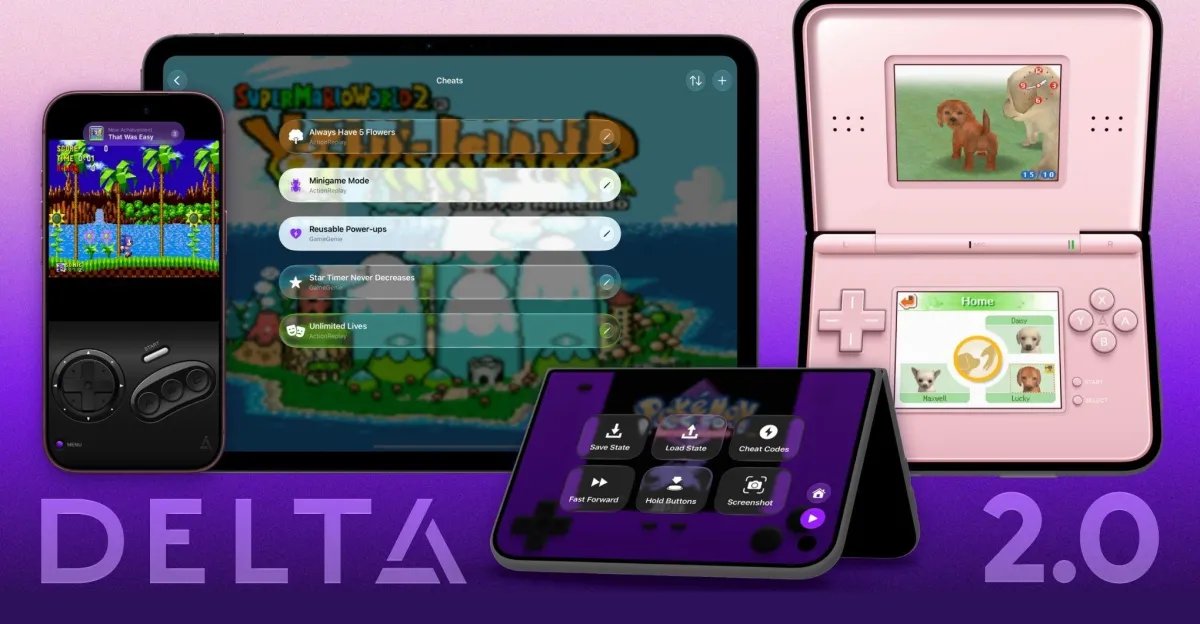
Perhaps the most technical achievement in the Delta 2.0 release is its dedicated optimization for the iPhone Duo. Emulating dual-screen hardware like the Nintendo DS on a foldable device presents unique challenges regarding aspect ratios and touch input responsiveness. Riley Testut, the creator of the application, has implemented a system where controller skins dynamically adjust to every orientation—whether in portrait or landscape—ensuring that the bottom screen interface never obscures the primary gameplay.
Furthermore, the integration extends beyond simple screen mapping. The emulator now leverages the physical state of the iPhone Duo to mimic the hardware logic of a Nintendo DS. When a user folds the device, the emulator automatically triggers a sleep mode, mirroring the behavior of closing the original handheld console. This attention to detail demonstrates a commitment to preserving the original tactile and functional experience of retro gaming, bridging the gap between historical hardware and modern folding displays.
Sega Genesis Emulation and Pokémon DLC
Delta 2.0 expands the library of playable systems by introducing support for the Sega Genesis. To accompany this, the development team has crafted custom controller skins that faithfully recreate the aesthetic and button layout of the classic Genesis gamepad. This inclusion marks a transition for Delta from a primarily Nintendo-focused emulator into a more versatile, multi-console platform.
Perhaps more innovative is the introduction of custom DLC functionality for classic Pokémon titles. This feature allows users to inject external content into mainline Game Boy Advance titles, such as rare items or specific character encounters. Developed in collaboration with the ROM hacking community, these modifications operate without the use of automated machine learning tools, relying instead on manual, precision-based game design. This empowers users to breathe new life into decades-old titles, turning static games into living projects that receive community-driven updates.
Expanding the Interface with Liquid Glass
The visual language of Delta 2.0 has been overhauled to align with Apple’s Liquid Glass design philosophy. The objective was to create an interface that feels native to current Apple hardware while maintaining high legibility. This involves a UI that scales intelligently across the varying form factors of the standard iPhone, the larger iPad, and the iPhone Duo.
The update introduces a glassy, translucent aesthetic for menu overlays and library artwork, providing a refined and modern look. The library management system has also been enhanced, introducing dedicated sections for recent activity and user-selected favorites. By implementing animated controller skins—which support both official and third-party contributions—the interface is now more interactive, providing visual feedback during button presses that elevates the sense of immersion during gameplay.
Bridging Physical and Digital Media
Delta 2.0 ventures into the realm of hardware connectivity through experimental support for the Epilogue GB and SN Operator devices. These peripherals allow users to connect physical Nintendo Game Boy and Super Nintendo cartridges to an iPhone or iPad, bridging the gap between legacy physical media and digital emulation. This allows for legitimate ownership to be verified and utilized within the software, providing a bridge for collectors who wish to play their original game library on modern displays.
Coupled with this is the introduction of Custom Filters. These filters allow for real-time post-processing of the video output. Users can apply a CRT-inspired filter to simulate the scanlines and color bleeding of old televisions or customize their own visual profiles to match their specific memories of these games. By allowing the end-user to manipulate the rendering pipeline, Delta acknowledges that the “look” of a game is just as important as its performance.
Accessibility and Global Distribution
Beyond the technical enhancements, Delta 2.0 signals a major shift in how the application is distributed and sustained. The developer has integrated in-app purchasing as a way for the community to provide financial support through a new “Become a Patron” system. This move is designed to ensure the long-term maintenance of the project as it scales in complexity.
Perhaps most importantly for the international community, this update marks the official release of Delta on the EU App Store. By making the application available globally on Apple’s official marketplace, in addition to the AltStore PAL, the developer has removed many of the barriers to entry that previously existed for casual users. This expansion ensures that as the feature set grows—incorporating complex support for folding displays, external peripherals, and ROM modifications—a wider audience can access these tools within a secure and standardized ecosystem. Delta 2.0 stands as a significant milestone in software preservation, proving that classic games can remain relevant and highly functional when supported by modern, forward-thinking development practices.
Disclaimer: This content is auto-generated for informational purposes only.
Source: Read Original News