






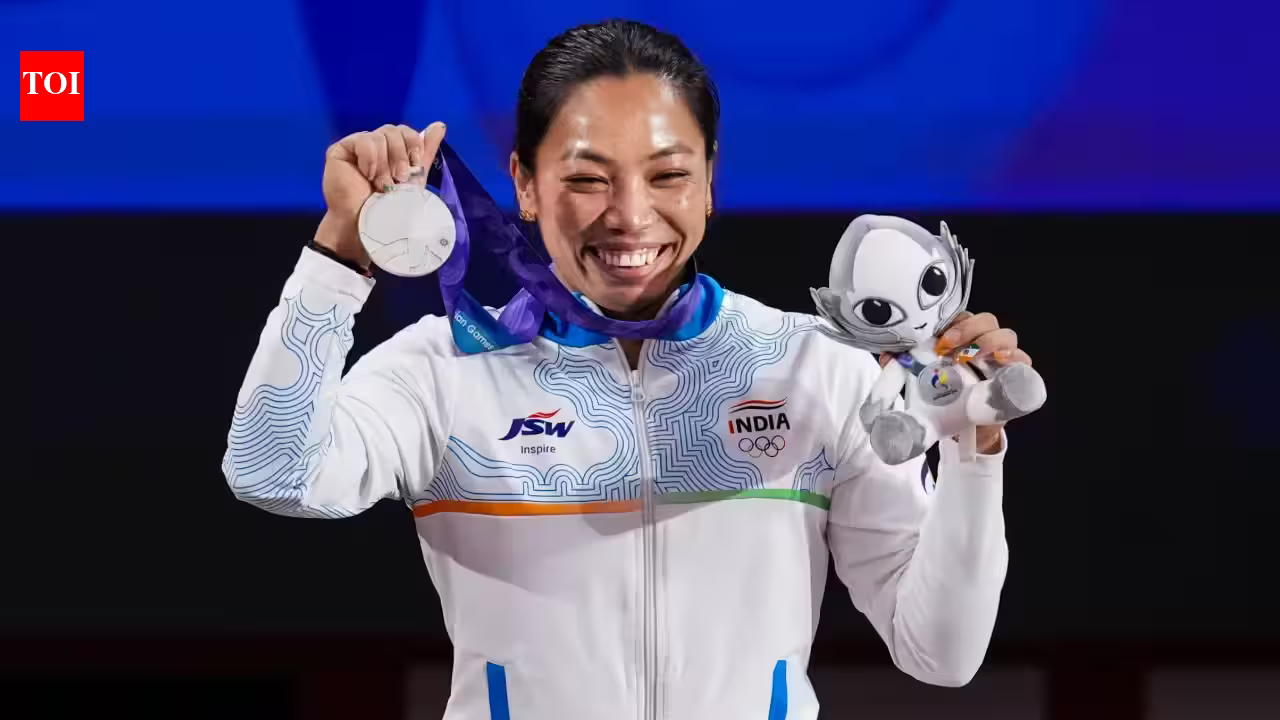
MANAMA — The international weightlifting stage proved to be a bittersweet theater of ambition and caution this week as the IWF World Championships delivered both a promising performance from a rising Indian star and a jarring setback for one of the nation’s most decorated athletes.
While 23-year-old Gyaneshwari Yadav displayed remarkable poise to secure an eighth-place finish in the women’s 53kg category, the spotlight shifted prematurely to the medical tent, where Olympic medalist Mirabai Chanu was forced to withdraw from the competition due to persistent back issues. The absence of Chanu, who had been slated to make her highly anticipated debut in the 53kg class, left a void in the lineup and served as a stark reminder of the physical toll extracted by the sport at the highest level.
Gyaneshwari Yadav’s Resilient Display
For Chhattisgarh’s Gyaneshwari Yadav, the World Championships served as a vital proving ground. Entering the fray in Group C, the Asian Championship silver medalist showcased technical precision and strength, recording a combined lift of 198kg. Her performance, broken down into an 88kg snatch and a 110kg clean and jerk, saw her dominate the Group C field.
Statistically, Yadav’s performance was an eye-opener. Her total of 198kg ultimately placed her ahead of several seasoned competitors from the elite Group A and B brackets, underscoring her potential to challenge for top-five finishes on the world stage. However, the result was tinged with the familiar frustration of “what could have been.” Coaching staff noted that Yadav fell just shy of her personal best of 199kg—a milestone that was firmly within her grasp. Had she successfully converted two narrow misses—one in the snatch and one in the clean and jerk—Yadav likely would have climbed higher in the final rankings.
As she continues her development, the 23-year-old’s ability to hang with the world’s elite provides a blueprint for her trajectory toward the 2028 Los Angeles Olympics.
The Cautionary Withdrawal of Mirabai Chanu
The narrative took a sobering turn with the withdrawal of Mirabai Chanu. Having been assigned to Group B with a formidable entry total of 200kg, the veteran lifter was expected to be a major contender. However, back pain—an ailment that has shadowed her grueling training cycles—flared up prior to the start, forcing a strategic withdrawal.
In the high-stakes environment of elite weightlifting, where the margin for error is measured in grams and the risk of catastrophic injury is ever-present, the decision to pull Chanu from the competition was viewed as a necessary precaution. With the qualification cycle for the 2028 Los Angeles Games now underway, keeping the star athlete healthy for future high-priority events is clearly the priority for the Indian contingent.
International Podium and Evolving Standards
The competition itself was a masterclass in modern weightlifting dominance. China’s Zhang Haiqin walked away with the gold medal, posting a total of 221kg (98kg in the snatch and 123kg in the clean and jerk). The competition was fierce, with American Eleanor Ulrey nipping at her heels to secure the silver with a 220kg total (98kg+122kg). North Korea’s So Hyon Kim rounded out the podium with a bronze, finishing at 214kg (91kg+123kg).
The technical level of the 53kg category was notably high, evidenced by the fact that seven lifters managed to clear the 90kg mark in the snatch portion of the event. For Indian observers, this specific benchmark held historical significance; Chanu has been meticulously working toward consistent 90kg+ snatch performances for over six years, highlighting the aggressive evolution of the field.
The Road to Los Angeles 2028
The IWF World Championships represent the first phase of the rigorous qualification process for the 2028 Los Angeles Olympics. The system, which allocates spots based on performances across six designated events, demands a delicate balance of aggressive competition and injury management.
For India, the path forward involves a double-pronged strategy: nurturing the burgeoning talent of lifters like Yadav, whose performance in Group C proved she belongs in the upper echelon, and ensuring the physical longevity of veterans like Chanu. As the calendar shifts to the next qualification event, the focus will undoubtedly turn to recovery protocols and tactical adjustments.
Despite the setback, India leaves this World Championship with proof that its depth is increasing. Yadav’s ability to outperform competitors from higher-seeded groups is a positive harbinger for Indian weightlifting. However, the lessons of this week—the importance of technical conversion in medal-winning lifts and the uncompromising nature of physical conditioning—will serve as the core focus for training camps in the months to come. The journey to the L.A. stage is long, and as this tournament proved, every kilogram counts.
Disclaimer: This content is auto-generated for informational purposes only.
Source: Read Original News