





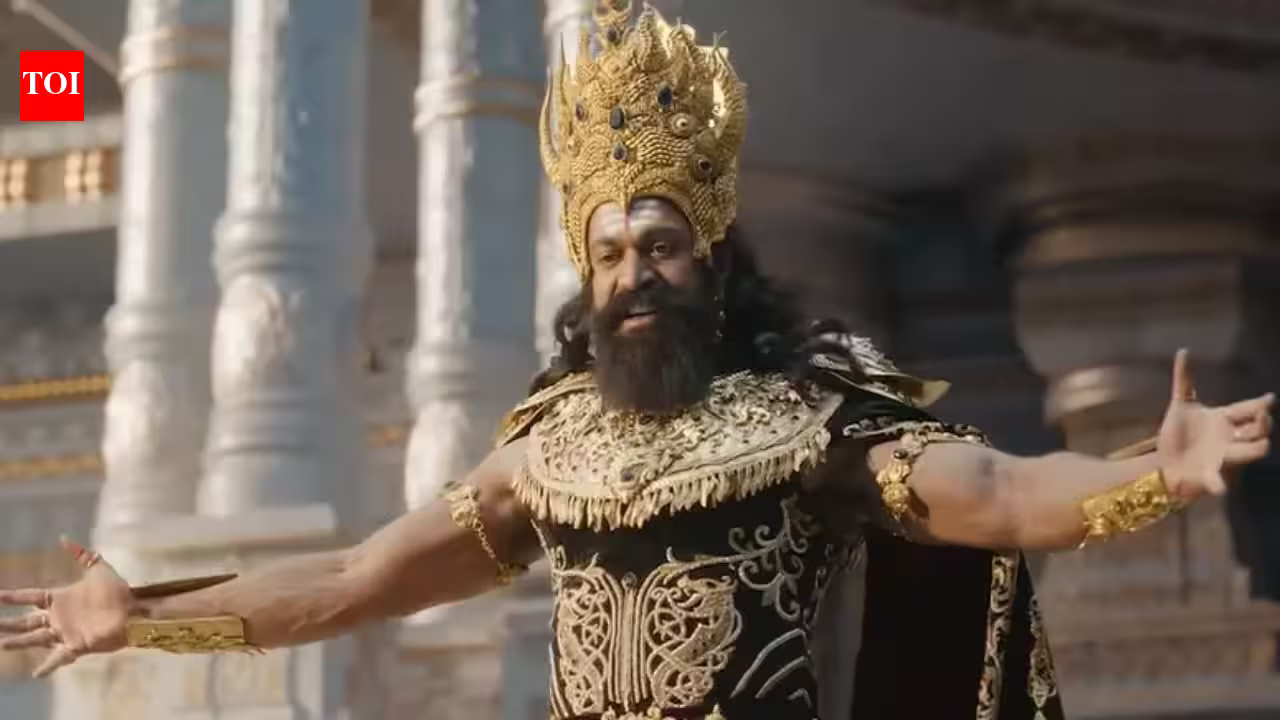
The cinematic landscape is bracing for a tectonic shift as director Nitesh Tiwari prepares to unveil his magnum opus, Ramayana. While the star-studded ensemble cast—featuring Ranbir Kapoor as the divine Lord Rama and Sai Pallavi as the graceful Sita—has already set the internet ablaze, it is the casting of Kannada superstar Yash as the formidable demon king, Ravana, that has generated perhaps the most intense scrutiny.
Known for his larger-than-life presence in the KGF franchise, Yash is synonymous with heroic grit. Stepping into the shoes of the antagonist in India’s most revered mythological epic is a bold departure for the actor. But as it turns out, the toughest critic he’s had to face so far isn’t a cynical film reviewer or a purist on social media—it’s his own young son.
The ‘Bad Guy’ Dilemma
In a candid revelation, Yash shared a deeply humanizing moment from his household, where the boundaries between professional ambition and parental guidance blurred. Like millions of children across India, Yash’s son is familiar with the moral compass of the Ramayana. When news reached the little boy that his father would be stepping into the role of the ten-headed King of Lanka, the reaction wasn’t one of awe at his father’s reach into pan-Indian cinema—it was one of pure, unadulterated shock.
“My son knows who his father is, but now that he knows the story of the Ramayana, he was shocked,” Yash admitted in an interview. “He said, ‘No, you’re the bad guy! How can you do that?’”
It is a dilemma many actors playing iconic villains face, but when the narrative is as spiritually and culturally charged as the Ramayana, the “bad guy” label carries significant weight. For a child, seeing a parent embody a character who represents the antithesis of dharma is confusing. Yash, ever the thoughtful parent, used the opportunity to pull back the curtain on the craft of acting, explaining to his son that portraying an antagonist is a narrative necessity—a vehicle to tell the full story—rather than an endorsement of the character’s dark choices.
Crafting the Lesson: Rama as the Ultimate Ideal
The actor didn’t just leave the conversation at the technicalities of filmmaking. He took the opportunity to reinforce the very values the epic is intended to teach. Yash explained that while his son might be curious about his father’s transformation, the narrative focus must remain fixed on the hero.
“I had to sit my son down and tell him: in this story, the central figure you must look up to is Lord Rama,” Yash shared. “Everyone should walk Rama’s path. Ravana may appear grand, powerful, and imposing, but true, lasting victory in life only comes when you embody Rama’s righteousness.”
It is a sophisticated distinction: the difference between cinematic allure and moral truth. Yash is effectively teaching his son that while Ravana is a figure of immense power and “grandeur,” the victory of the story belongs to the righteousness of Rama. “I told him, ‘You can cheer for me as an actor in the theatre, but do not mistake the character for the ideal,’” he added.
The Inevitable End: A Child’s Unfiltered Query
Perhaps the most poignant moment of this domestic debate arrived when the boy confronted the reality of the epic’s climax. After processing the moral conflict, the young fan moved to the practical consequences of the plot: “Do you die in the end? Do you lose?”
For an actor who has built his career on invincible, high-octane personas, this question hit home. Yash confessed that while he was mentally preparing for the technical rigors of the shoot and the pressure of a massive budget, he hadn’t quite prepared for the emotional weight of explaining death in a story to his child. “That was hard,” Yash admitted. “When I signed the project, I was thinking about giving my audience a compelling performance, but I hadn’t anticipated my son’s questions. Teaching him the distinction between an actor and a dramatic role was quite an experience.”
A Production of Epic Proportions
As the dust settles on these candid home conversations, the industry’s eyes remain locked on the sheer scale of Tiwari’s project. Ramayana is shaping up to be more than just a film; it is a global event. With a cast that reads like a who’s who of Indian cinema—including Ravi Dubey as Lakshman, the legendary Arun Govil as Dasharatha, and Lara Dutta as Kaikeyi—the film is an ambitious attempt to package ancient scripture for a modern, international audience.
The technical pedigree behind the camera is equally staggering, with the musical score being helmed by the combined brilliance of AR Rahman and Hans Zimmer. When titans of global music composition join forces with a director known for his meticulous storytelling, the expectations for a sensory masterpiece are understandably sky-high.
The Long Road to 2026
With the first installment slated for a worldwide release on November 5, 2026, there is ample time for the hype cycle to reach a fever pitch. Yash’s involvement as Ravana represents a deliberate choice—the actor’s magnetic screen presence will surely bring a level of complexity to the character that avoids the tropes of a one-dimensional villain.
By grounding his performance in the realization that his son—and by extension, the audience—needs to see the difference between the man and the myth, Yash is signaling a performance that will be layered and perhaps even melancholic. As we wait for the first look and the eventual premiere, one thing is certain: Yash is already doing the hard work of internalizing the weight of the Ramayana, one conversation at a time. Whether or not his son is entirely convinced, the rest of the world is waiting with bated breath to see this transformation unfold.
Disclaimer: This content is auto-generated for informational purposes only.
Source: Read Original News