








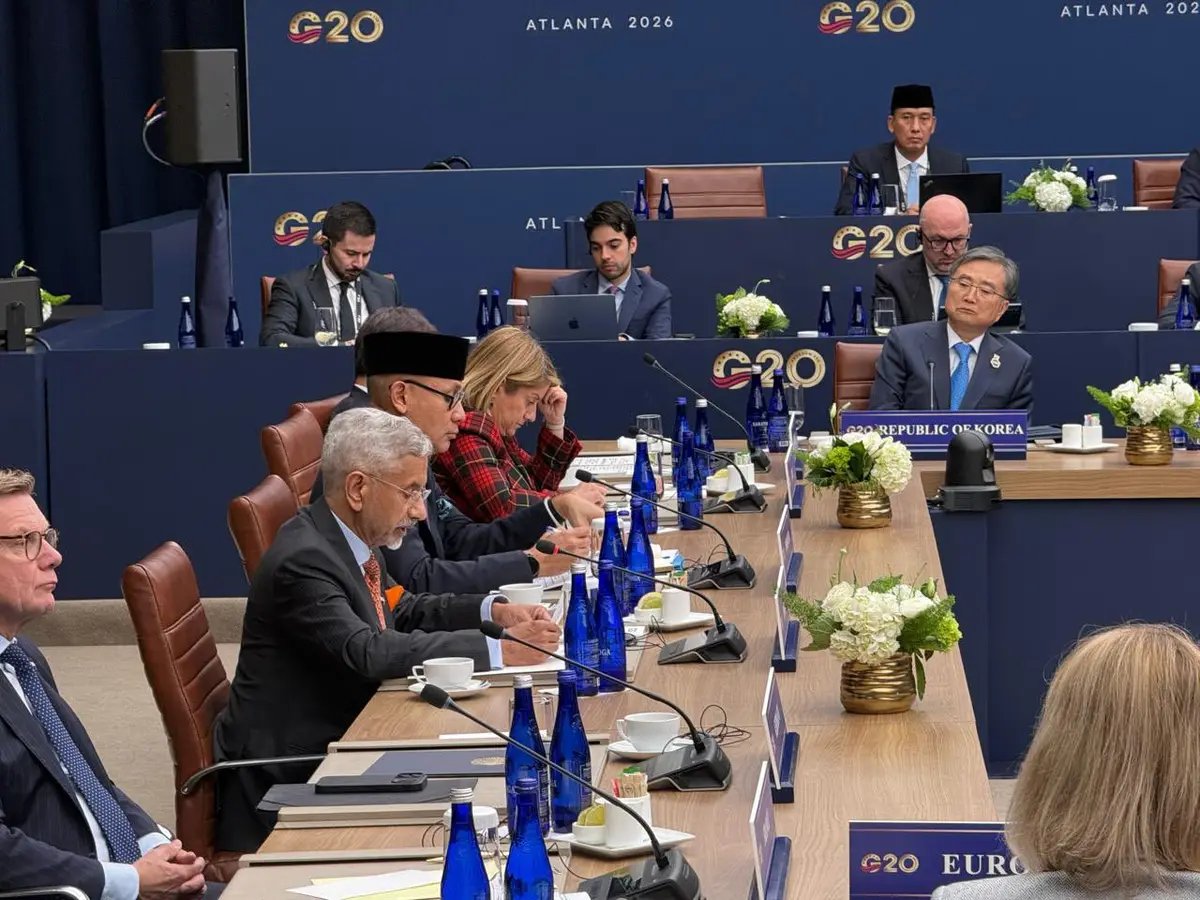
Jaishankar Calls Out Global Energy Weaponization at G20
New Delhi: External Affairs Minister S. Jaishankar has delivered a sharp critique of the current geopolitical climate, warning that the deliberate manipulation of energy supply chains is being employed as a tool to hold global markets hostage. Speaking at the G20 Plenary, the minister cautioned that the increasing frequency and complexity of sanctions, trade obstacles, and disruptions at maritime chokepoints are creating an environment of profound instability.
The minister’s address highlighted that the world is currently grappling with an energy crisis defined by extreme unpredictability, where soaring costs and logistical hurdles are undermining the economic recovery of developing nations. “Continuous distortions of energy markets through obstacles, sanctions, and chokepoints are happening with increasing frequency, greater complexity, and wider impact,” Jaishankar noted in a post following his session.
His intervention comes at a volatile time for global commodity markets. Recent years have seen a chaotic pendulum swing in energy policy, characterized by the enforcement and subsequent wavering of heavy sanctions on Iranian and Russian oil. Notably, the introduction of the Lindsey O. Graham Sanctioning Russia and Iran Act of 2026, which initially threatened prohibitive tariffs on major buyers before witnessing rapid policy reversals, has left global energy importers in a state of uncertainty.
Securing Energy Equity and Predictability
For India, the impact of these geopolitical maneuvers is direct and significant. As the nation pushes to accelerate its transition to cleaner domestic energy sources, the security of supply chains remains a non-negotiable priority. Jaishankar specifically highlighted the vital need for reliable Liquefied Petroleum Gas (LPG) supplies, which are essential for the government’s efforts to promote clean cooking in rural and urban households alike.
India has consistently urged G20 member states to prioritize open, transparent, and predictable energy markets. By advocating for a multilateral approach, New Delhi aims to insulate the global south from the inflationary shocks caused by unilateral trade interventions and regional conflicts that threaten the flow of energy through critical maritime routes.
A Broader Pushback Against Unilateralism
The minister’s remarks on energy represent only one facet of India’s intensifying pushback against unilateral trade measures. The sentiment was echoed recently by Union Commerce Minister Piyush Goyal, who has emphasized that any tariffs or trade barriers imposed by global powers must strictly adhere to World Trade Organization (WTO) protocols. India is currently navigating a challenging trade landscape, facing a 10% “forced labor” tariff imposed by the United States and responding to ongoing American investigations into claims of excess industrial capacity.
Beyond traditional energy, Jaishankar also used the G20 platform to pivot toward the future of industrial development—specifically, critical minerals. With the global transition toward electric vehicles and renewable technologies, India is championing a robust framework for mineral exploration and recycling. He reiterated the importance of India’s National Mission on critical minerals and formally proposed a G20 Critical Minerals Circularity Initiative.
As India positions itself as a central voice for the Global South, the minister’s message is clear: the era of weaponizing trade and energy security under the guise of geopolitical strategy is unsustainable and requires a collective commitment to rules-based international commerce.
Disclaimer: This content is auto-generated for informational purposes only.
Source: Read Original News