









The Resurrection of Valve’s Lost Prototype
For over a decade, the gaming community has circulated rumors regarding a mysterious project known as F-Stop. This title, once destined to be the prequel to the original Portal, was relegated to the status of industry folklore after Valve canceled the project during its mid-development phase. However, a significant development in the archival community has changed the status of this ghost project. Through the systematic reconstruction of data extracted from a massive 12-terabyte leak of Valve’s internal servers, developers and enthusiasts have successfully compiled a playable version of F-Stop.
The data recovery effort began in earnest following a breach that exposed years of internal research and development files. While initial leaks provided various assets, the crucial pieces—source code and specific map geometry—remained elusive until surfacing in the Valve Cut Content community this week. By integrating these files with previously available assets, modders have achieved a functional build, allowing the public to experience the mechanics that Valve famously sidelined before the launch of Portal 2.
The Camera Mechanic: A Shift in Spatial Logic
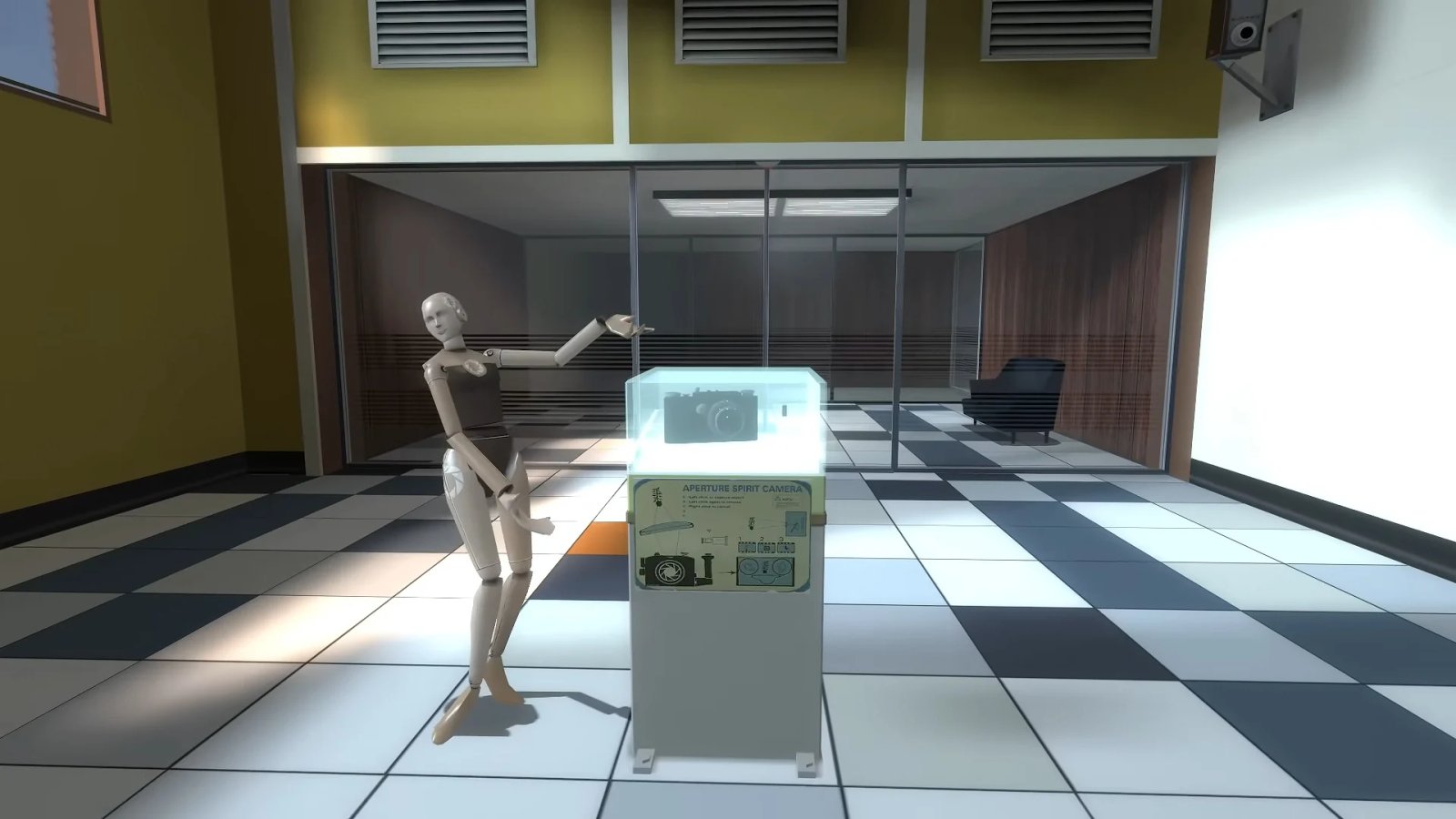
The defining feature of F-Stop is its core interaction model, which deviates significantly from the iconic portal-generating gun seen in later entries. Instead of manipulating spatial folding through orange and blue gateways, players navigate environments using a camera-based mechanic. This system allows the player to photograph specific objects within the game world. Once an image is captured, the player can project that object back into the environment as a physical entity.
This mechanic relies on a logic of scaling and perspective manipulation. By taking a photograph of a small object and placing the resulting Polaroid-like image elsewhere, the object is rendered into the world, often at the scale dictated by the perspective of the camera. This interaction bears a striking resemblance to the title Viewfinder, which gained notoriety years after F-Stop’s cancellation for utilizing this exact spatial logic. In F-Stop, this was not merely a puzzle gimmick; it served as the primary method for obstacle traversal and environmental manipulation, challenging players to rethink how depth and scale function within a 3D engine.
The Origin of the Directed Design Experiments
F-Stop did not emerge from a conventional development cycle. Its existence is rooted in a unique corporate initiative Valve conducted in 2007, known as the Directed Design Experiments. During this period, the studio divided its staff into five distinct teams, each tasked with building a novel, experimental gameplay concept over the course of three months. This initiative was designed to foster creativity and explore new mechanics without the pressure of producing a full-scale commercial release.
F-Stop was the output of one of these teams. Because it was essentially a three-month design sprint, the scope of the project was inherently limited. The recently recovered playable version confirms this brevity, with full campaign playthroughs typically lasting less than one hour. Despite its short duration, the project provided a sandbox for mechanics that would eventually inform the polish and complexity of Valve’s subsequent titles. The experimental nature of the build is evident in its rough textures and unfinished environmental transitions, yet the mechanical core remains robust enough to function as intended by its original developers.
Legacy and Integration into Portal 2
While F-Stop never reached the retail market, its DNA was not entirely purged from Valve’s archives. Several dialogue snippets, narrative concepts, and mechanical ideas from the project were repurposed and folded into the development of Portal 2. The Aperture Science history, characterized by its corporate hubris and technological experimentation, owes some of its narrative foundation to the world-building exercises conducted during the F-Stop development cycle.
The transition from a camera-based puzzle system to the portal gun was a deliberate shift in focus. Valve ultimately determined that the portals offered a more intuitive and high-speed experience for players. However, the influence of F-Stop lingers in the test chamber design philosophy that defined the series. By observing the prototype, researchers and historians can now see how the team pivoted from a conceptual, perspective-based game to a kinetic, spatial-warping experience. The playable build serves as a bridge between the early, unconstrained creative phase at Valve and the highly refined, commercial success of their finished software.
The Impact of Preservation and Data Accessibility
The successful reconstruction of F-Stop raises important questions regarding the preservation of digital history. As large-scale breaches and leaks become more frequent in the technology sector, the internal development history of major studios is being exposed to the public. For developers, this provides an unprecedented opportunity to analyze the iteration process of industry giants. For the general public, it offers a window into the “what-ifs” of game design—the projects that were abandoned due to technical constraints or shift in vision rather than a lack of quality.
This playable build is not just a curiosity for fans; it is an academic artifact. It demonstrates how experimental prototypes, even when considered failures or abandoned experiments, carry significant technical value. The F-Stop project underscores the reality that many high-quality mechanics are often discarded not because they lack merit, but because they do not align with the specific trajectory of a primary franchise. With the community having successfully bridged the gap between raw data and a playable build, F-Stop now stands as a permanent fixture in the documented history of video game development, serving as a reminder of the iterative, often chaotic path taken to create modern gaming experiences.
Disclaimer: This content is auto-generated for informational purposes only.
Source: Read Original News