








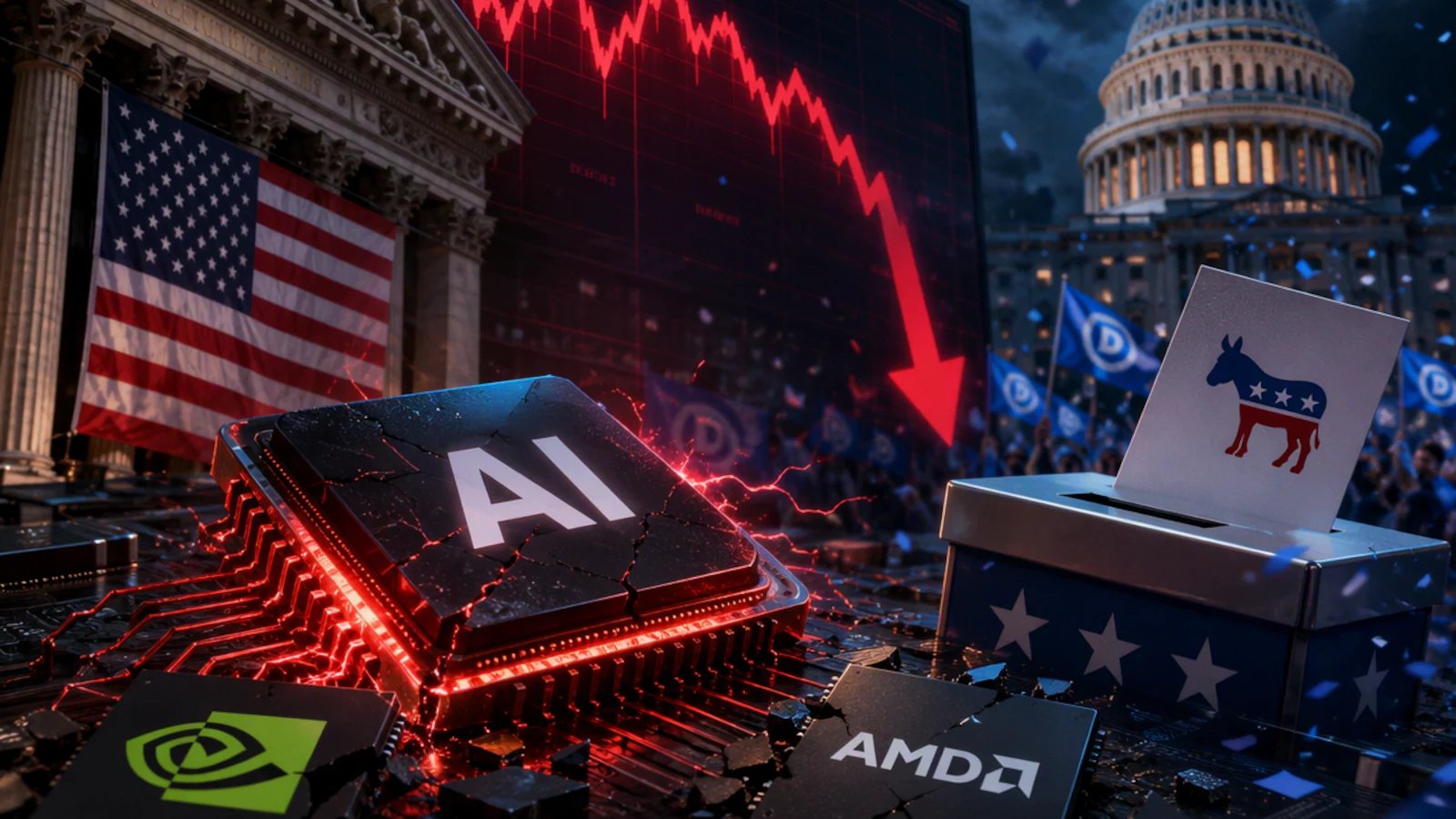
Wall Street experienced a jarring wake-up call on Thursday as the artificial intelligence trade, which has driven equity markets to record heights for months, faced a massive sell-off. The Nasdaq 100 alone saw $2.5 trillion in market value evaporate in a single session, marking one of the most volatile days for technology stocks in recent memory.
The retreat was broad, hitting the heart of the AI supply chain, including semiconductor manufacturers, cloud infrastructure providers, and data center operators. As investors scrambled to exit positions, the Nasdaq Composite plummeted 5.5%, officially entering correction territory. Meanwhile, the S&P 500 slid 4.4%—its steepest decline since April 2025—and the Dow Jones Industrial Average shed 3.4%.
## Regulatory Clouds Over AI Infrastructure
The sudden market downturn followed an initial period of optimism surrounding the U.S. election results. While investors initially rallied on hopes of political stability, that sentiment soured as the implications of a Democratic-led Congress became clearer. Markets are now pricing in a potential shift toward stricter oversight regarding the massive expansion of AI infrastructure.
The AI boom is fundamentally tethered to physical development: companies are pouring billions into chips, energy-intensive data centers, and massive server farms. Fears are mounting that Democratic lawmakers may prioritize environmental regulations, land-use restrictions, and tougher permitting processes for these energy-hungry projects. According to industry data, nearly 30% of projected U.S. data center capacity for 2028 could face significant construction delays or regulatory bottlenecks if these policy shifts materialize. This uncertainty has sent a chill through the technology sector, as investors question whether the breakneck speed of AI infrastructure development can be sustained under a more restrictive policy environment.
## Profitability Concerns and Market Reassessment
Beyond the immediate political jitters, the sell-off reflects a deepening maturity in how investors evaluate AI. For the past two years, excitement over AI capability often overshadowed concerns about capital expenditure. However, with trillions of dollars already deployed, the market is shifting its focus toward return on investment (ROI).
Analysts note that the era of blind enthusiasm is being replaced by a more selective, skeptical approach. Shareholders are increasingly demanding clear evidence of how massive infrastructure spending will translate into sustainable revenue and profitability. This “reality check” was already brewing prior to the market crash, as disappointing earnings reports from several tech giants had already signaled that the high costs of AI integration were pressuring margins. Investors are now moving away from companies that lack a clear, near-term path to monetizing their expensive AI assets.
## Global Ripple Effects and The Outlook for India
The impact of this volatility is not confined to the U.S. markets. Global technology sectors, including India’s IT services industry, are bracing for the aftershocks. As foreign portfolio investment flows are sensitive to shifts in Wall Street sentiment, Indian tech stocks could face increased pressure in the coming weeks.
However, market experts suggest that the current correction should not be viewed as a total loss of confidence in the AI revolution. Instead, it represents a necessary valuation adjustment. Abhishek Bhilwaria of Bhilwaria Finserv points out that while regulatory uncertainty will likely maintain near-term volatility, companies with solid fundamentals and verifiable AI-driven business use cases remain well-positioned. For Indian firms, the current market climate acts as a filter: the focus is shifting toward those that can demonstrate tangible efficiency gains and margin improvements rather than just promises of future AI adoption. Ultimately, while the “AI trade” has lost its easy momentum, the industry is transitioning into a phase where operational rigor—not just hype—will determine the winners.
Disclaimer: This content is auto-generated for informational purposes only.
Source: Read Original News