






Indian Households Face Squeeze as Inflation Nears RBI’s Upper Tolerance Limit
BENGALURU – Indian households are bracing for a steeper cost-of-living crisis as consumer inflation is expected to have surged in October, inching precariously close to the Reserve Bank of India’s (RBI) upper tolerance threshold of 6%. Economists warn that a confluence of supply-side constraints and global market volatility is fueling a relentless rise in the prices of essential commodities.
According to a recent Reuters poll of 36 economists, annual consumer inflation likely climbed to 5.93% in October, up from 5.54% in September. With official data scheduled for release on November 12, market watchers are bracing for a potential breach of the 6% ceiling, as nearly half of the surveyed experts anticipate the index hitting or exceeding that limit.
Food Prices Drive Inflationary Pressures
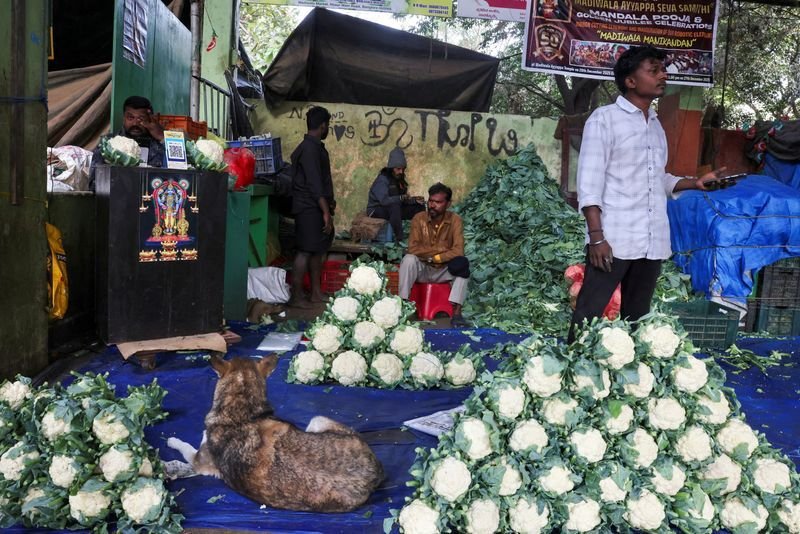
The primary driver behind this inflationary spike remains the food basket, which comprises nearly 40% of India’s Consumer Price Index (CPI). Experts point to the erratic and deficient southwest monsoon as the culprit, which has severely disrupted the supply chains of key household staples.
“Higher food inflation continues to be the largest contributing factor to the acceleration,” noted Dhiraj Nim, senior economist at ANZ. He highlighted that the uneven monsoon has created drought-like conditions in several regions, suggesting that India may be bracing for a prolonged period of elevated price pressures.
Vegetables, led by a sharp spike in onion prices—which have nearly doubled since the beginning of the year—are not the only culprits. Analysts at BofA Securities anticipate double-digit inflation across several categories, including meat, fish, edible oils, fruits, and sugar. Beyond domestic supply issues, global market trends are also exerting upward pressure, particularly through the rising costs of imported edible oils and energy commodities.
Monetary Policy Under Pressure
The persistence of high inflation, which has now stayed above the RBI’s 4% medium-term target for four consecutive months, is forcing a rethink of monetary strategy. The central bank has already shifted its outlook, projecting an average inflation rate of 5.2% for the current financial year, up from its earlier forecast of 5.0%.
In response to these tightening conditions, economists largely expect the RBI to maintain its hawkish stance. There is a growing consensus that the central bank will move forward with a second consecutive repo rate hike, potentially bringing it to 5.75% during the December policy review.
“It may be prudent for the RBI to continue with its calibrated 25-basis-point rate-hike momentum,” suggested Kanika Pasricha, chief economic advisor at Union Bank of India, emphasizing the need to anchor inflation expectations.
Wholesale Woes Loom Large
Compounding the distress for retail consumers is the trajectory of the Wholesale Price Index (WPI). The survey suggests that wholesale inflation likely accelerated to 12.10% in October, compared to 11.39% in September.
This widening gap between wholesale and retail prices poses a significant risk. If producers continue to pass their rising input costs—exacerbated by global oil prices that remain 40% higher than pre-conflict levels—onto the end-user, retail inflation could remain entrenched well into the coming year. As the economy navigates these headwinds, the balance between curbing inflation and supporting growth remains the primary challenge for policymakers in the months ahead.
Disclaimer: This content is auto-generated for informational purposes only.
Source: Read Original News