






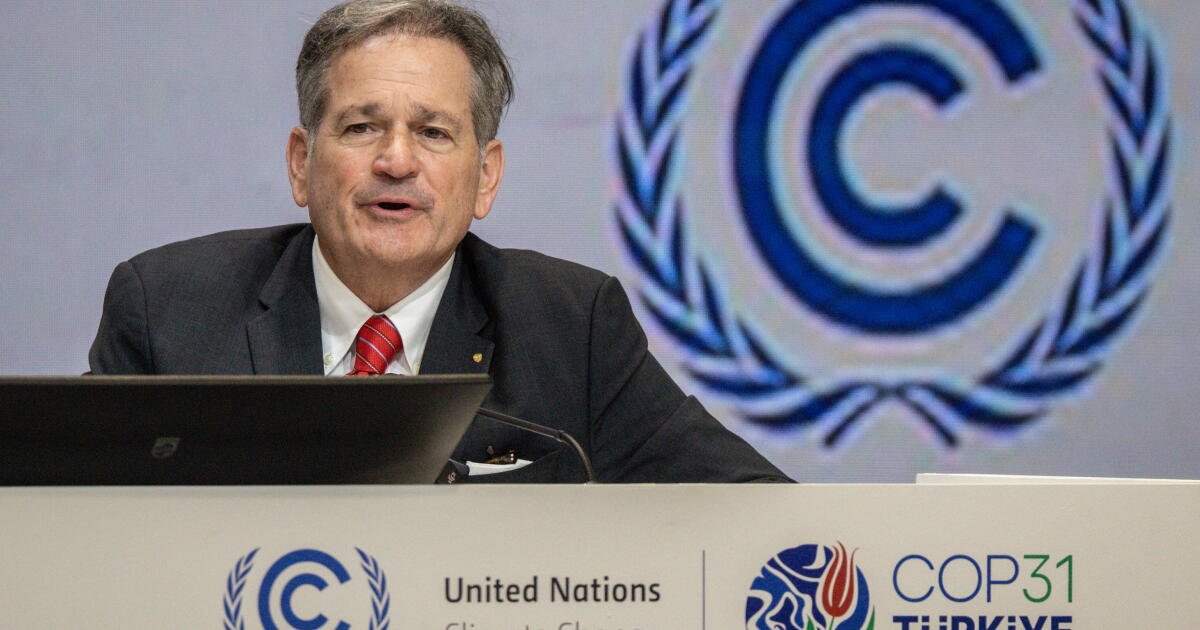
ANTALYA — Panama’s Environment Minister, Juan Carlos Navarro, launched a blistering critique of the global climate negotiations at COP31 this week, accusing a “petroleum mafia” of holding the summit hostage. His remarks, delivered during a press conference alongside representatives from vulnerable island nations, served as one of the most pointed condemnations of fossil-fuel-producing states in the history of the annual climate talks.
Navarro’s address, characterized by sardonic metaphors and a sense of existential urgency, likened the international community’s reliance on oil, gas, and coal to Stockholm syndrome. “We are in love with our kidnappers,” Navarro told reporters. “They torture us for our own good. They destroy our planet for our own good. They destroy nature to help us.”
The speech resonated deeply with a coalition of small island nations, including Vanuatu, Tuvalu, and Fiji, who are using the summit to advocate for a legally binding international treaty to curb the extraction of fossil fuels. Proponents of this proposed Fossil Fuel Treaty argue that while the Paris Agreement successfully established a framework for reducing emissions, it contains a critical omission: it fails to directly mandate limits on the production and supply of the fuels that drive global warming.
The proposed treaty seeks a tripartite commitment: halting all new fossil-fuel expansion, coordinating an equitable phaseout of existing production, and securing robust financing to help developing economies diversify their energy sectors while protecting the workforce throughout the transition. For many of the nations involved, the issue is not a diplomatic exercise but a matter of national viability. “Climate change is a risk to our very survival as a nation,” Navarro stated. “For Pacific nations, this isn’t another agenda item. This isn’t a game for us.”
Navarro also took aim at the discourse surrounding “overshoot,” a scenario in which global temperatures temporarily exceed the 1.5C threshold set by the Paris Agreement before potentially being brought back down through carbon removal or technological intervention. Dismissing the concept as a dangerous fantasy, Navarro likened the promise of a future return to 1.5C to a hollow resurrection. “I kill you now, but maybe in a few years you may resurrect. Yeah, sure. Now tell me another one,” he said. “We already blooped up by the 1.5. It’s probably irreversible.”
A primary point of contention for the minister was the perceived failure of major oil-producing nations to provide adequate financial support to those on the front lines of the climate crisis. Despite the immense wealth generated by fossil fuel exports, Navarro argued that these nations have consistently failed to contribute their fair share toward adaptation, biodiversity preservation, or addressing the loss and damage caused by climate-driven disasters.
“Oh, and those lovely petroleum-producing countries,” Navarro said. “They’re so generous, except they don’t give one dime for adaptation or for facing the climate crisis or for saving biodiversity.”
As COP31 enters its final days, Navarro’s intervention has served as a catalyst for a broader debate over the structure of climate negotiations. By framing the influence of fossil-fuel-producing nations as an obstructionist force, the minister has intensified pressure on negotiators to move beyond incremental adjustments and toward the “radical change of course” he insists is necessary.
Whether this rhetoric will translate into concrete policy shifts remains to be seen. However, the coalition backing the Fossil Fuel Treaty has succeeded in injecting a sense of moral and structural urgency into the Antalya summit, highlighting the growing divide between countries demanding an immediate transition away from hydrocarbons and those seeking to preserve the current energy status quo. As the conference approaches its conclusion, the divide remains a primary obstacle to a unified global climate strategy.
Disclaimer: This content is auto-generated for informational purposes only.
Source: Read Original News