








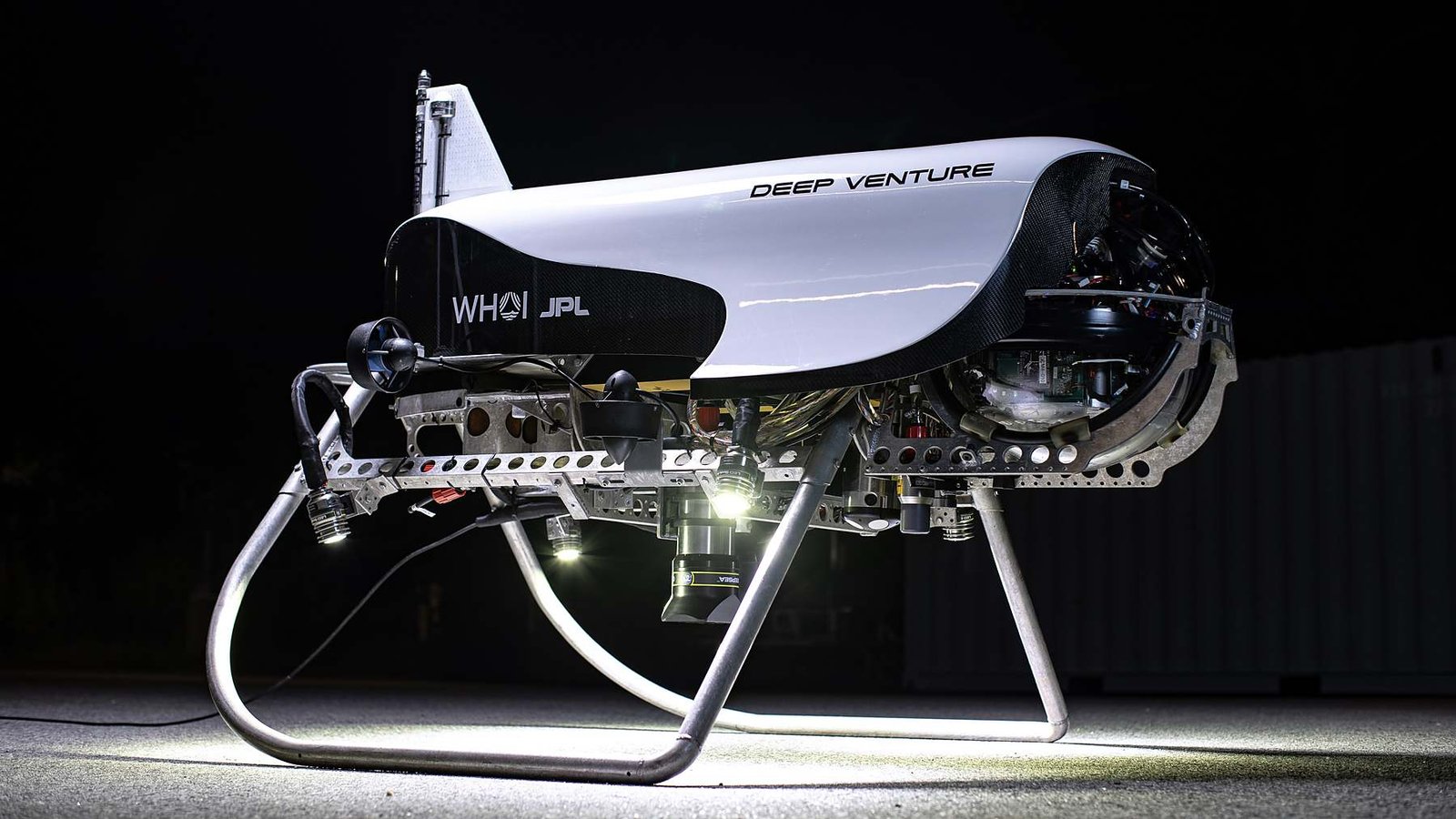
The Woods Hole Oceanographic Institution (WHOI) recently introduced Deep Venture, an autonomous underwater vehicle (AUV) designed to operate at depths of up to 36,000 feet. Developed in collaboration with NASA’s Jet Propulsion Laboratory, the robot represents a significant step in how oceanographers survey the most remote environments on Earth. While crewed submersibles like the iconic Alvin have served as the backbone of deep-sea exploration for decades, they are limited by the scarcity of their flight time and the logistical constraints of carrying human passengers. Deep Venture is designed to augment these missions by serving as an advanced scout, capable of mapping the seafloor and identifying targets before a crewed mission even leaves the surface.
A New Paradigm for Deep-Sea Exploration
For many years, the Alvin submarine has carried researchers to the depths of the ocean to conduct manual observations. However, with a capacity limited to only two scientists per dive, every minute spent searching for an interesting site is a minute lost to actual data collection. Deep Venture changes this dynamic. In June, the AUV completed a successful deployment near Bermuda, descending roughly 19,700 feet to gather high-resolution imagery of the seafloor. This mission allowed the Alvin team to identify specific locations of interest, ensuring that human-led dives were productive and focused from the moment they reached the target depth. By automating the search phase of deep-sea expeditions, Deep Venture maximizes the utility of limited resources, including the time and budget required to support manned research platforms.
Technical Capabilities and Design
Deep Venture is engineered for extreme performance in a compact form factor. Weighing approximately 550 pounds and measuring about 6 feet in length, it is remarkably agile compared to larger, specialized underwater vehicles. This smaller physical footprint is a key feature, as it allows the robot to be launched from a wide variety of research vessels that may lack the massive deck space or heavy-duty infrastructure required for traditional, larger AUVs.
Despite its compact size, the vehicle is rated for 36,000 feet, which qualifies as full ocean depth. This rating signifies its ability to withstand the immense pressure of the deepest oceanic trenches. While the specific construction methods—such as the material science behind its pressure-resistant housings—have not been fully detailed by the research team, the vehicle is designed to thrive in the hadal zone. Inspired by the morphology of the chimera, or “ghost shark,” the robot utilizes a streamlined shape that hints at efficiency in high-pressure, low-light environments.
Operational Autonomy and Navigation
One of the most significant hurdles in deep-sea robotics is communication. Since radio waves and GPS signals cannot penetrate miles of seawater, vehicles operating at these depths must function with complete autonomy. Deep Venture is programmed before launch and executes its mission without a physical tether, eliminating the need for complex cable management systems.
Once on the seafloor, the AUV performs a variety of complex tasks. It features a modular science bay, which allows for the rapid swapping of chemical and biological sensors, making it adaptable to different research goals across multiple expeditions. Beyond simple observation, the robot excels at photogrammetry. By capturing high-density, overlapping images, the onboard processing systems create precise 3D models of the seafloor. This technology allows researchers to move beyond flat, 2D photos, providing a rotatable, interactive map of the terrain that can be analyzed in fine detail once the data is retrieved.
Logistics and Fleet Deployment
The versatility of Deep Venture extends to its deployment strategy. Designed to be cost-effective and easy to manage, the system can be operated by a small team, significantly lowering the barrier to entry for institutions that do not have access to large-scale specialized research fleets. WHOI has indicated that the goal is not merely to create a one-off machine, but to move toward a model where fleets of these vehicles can work in tandem.
When multiple AUVs operate simultaneously, they can map significantly larger sections of the seafloor than a single unit, providing a macro-level view of an area before zooming in on specific geological or biological points of interest. While the focus remains on scientific discovery, the platform is also well-suited for industrial and commercial applications, such as long-term pollution monitoring, infrastructure inspection for submarine cables, and the imaging of shipwrecks.
Future Prospects for Submersible Robotics
As WHOI looks toward the future, the integration of Deep Venture into standard operational workflows appears likely. The transition from 13 experimental dives conducted in the Gulf of Alaska to the recent successful trials off the coast of Bermuda demonstrates a clear trajectory toward reliable, deep-trench deployment. By separating the high-risk, time-consuming task of initial exploration from the precision-based work of a human-crewed crewed submersible, the team at WHOI is establishing a new standard for how we study the deepest parts of our planet. As the program matures, the continued development of modular sensors and increased battery or processing capacity will likely expand the range of environments where these robots can perform, further unlocking the mysteries of the deep.
Disclaimer: This content is auto-generated for informational purposes only.
Source: Read Original News