







As the U.S. military conflict with Iran enters its sixth month, President Donald Trump has returned to a more familiar battleground: global trade.
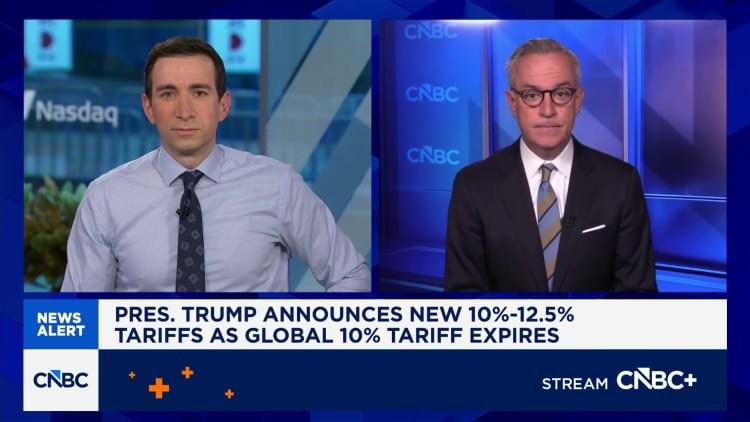
Trump on Friday launched a fresh tariff blitz targeting 60 trading partners, including the European Union, China, the U.K. and Canada. The latest wave of tariffs — which took effect at 12:01 a.m. ET Friday, replacing the stopgap 10% baseline tariff that expired July 24 — range from 10% to 12.5%.
Initial market reaction Friday was muted, with the renewed tariff push largely anticipated by investors, given the approaching expiry of the previous duties. That contrasts with the “shock and awe” approach that underpinned the sweeping “liberation day” levies announced in April 2025, which sent markets plummeting.
However, investors and analysts say the circumstances surrounding the latest tariff push are markedly different this time round, landing amid a more challenging global economic landscape than last year and underpinned by a separate legal framework, potentially risking a lasting drag on markets.

An emboldened White House
“The significance this time around is twofold,” said Emma Moriarty, portfolio manager at CG Asset Management.
“Not only does it show the Trump administration’s commitment to tariffs, but it shows this commitment against a backdrop of a global energy shock and increasing supply chain bottlenecks. They appear content to continue to levy new tariffs even when they exacerbate domestic markets. For markets, the implications should be clear: we have to position for a low growth and high inflation outcome,” Moriarty said.
The measures come as global stock markets continue to grapple with the impact of ongoing hostilities in the Middle East, which have seen oil prices rebound above $100 a barrel last week as hopes of a negotiated ceasefire in the war continue to recede.
“While the outcome won’t come as a complete shock to markets, it is nonetheless another unwelcome source of uncertainty as sentiment is buffeted by the renewed conflict between the U.S. and Iran and concerns about levels of expenditure in the tech sector,” said Russ Mould, investment director at AJ Bell.
The White House administration had been expected to seek an alternative route toward a new round of tariffs following the Supreme Court’s ruling in February that the previous duties were illegal. The new onslaught is being pursued via Section 301 of the Trade Act of 1974, with officials citing alleged forced labor practices as the reason for the new tariffs.
Specifically, countries that have adopted or committed to introducing prohibitions will face a 10% duty, while those that haven’t will be subject to a 12.5% charge, with the levies affecting 99.4% of American imports.
Alan Siow, co-head of EM corporate debt at Ninety One Asset Management, said the White House appears to be adapting to such legal constraints and may be emboldened by limited retaliation and no clear inflation spike.
“These latest tariffs seem to be an evolution of the opening tariff salvos,” Siow said, adding that he expects other countries to respond in a more measured way initially, reserving escalation until the policy’s likely impact becomes clearer.
A permanent drag on markets?
Looking ahead, Martin Jacob, professor of accounting and control at IESE Business School in Barcelona, Spain, said the reintroduction of tariffs hints at the White House’s ambition to preserve import levies as a “lasting feature” of U.S. economic policy.
As the previous temporary measures neared their expiry deadlines, that put pressure on the White House to establish more permanent tariff regimes, Jacob explained. “The latest measures therefore represent more than another short-term negotiating salvo,” he added.
Matthew Ryan, head of market strategy at global financial services firm Ebury, said the durability of the new levies risks a more lasting structural pressure point for markets.
“Following a brief hiatus, the dreaded T-word is back on investors’ lips,” Ryan said. “The move to Section 301 removes the legal vulnerability that allowed the Supreme Court to strike down the previous round of import taxes. With that legal escape hatch now closed, markets may need to start pricing tariffs as a structural drag on global growth rather than a transient risk to be negotiated away.”
Ryan added that attention now turns to this week’s Federal Open Market Committee announcement, with the recent jump in oil prices raising the possibility that the Federal Reserve could hike interest rates later this year. That marks a shift from earlier expectations that it would hold steady through year-end before cutting in 2027, and Ryan expects policymakers to keep the option of a hike open.
Correction: Oil prices rebounded above $100 a barrel last week. An earlier version misstated the time element. The Federal Open Market Committee will make an announcement this week. An earlier version misstated the time element.