









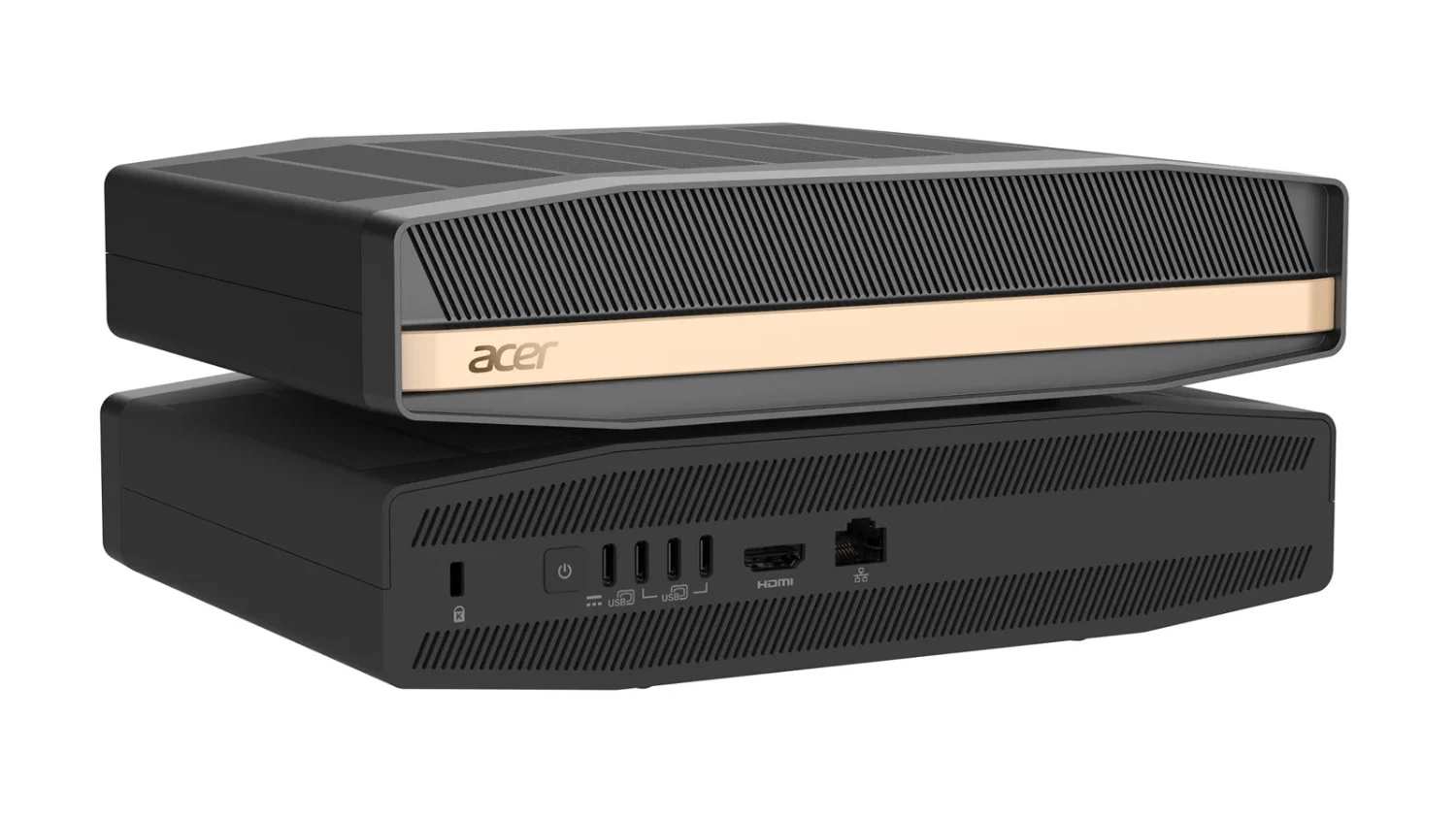
Acer has officially introduced its latest hardware concept, the SFF RTX Spark, at IFA 2026. This compact workstation represents a significant shift for the small form factor (SFF) market, leveraging NVIDIA’s cutting-edge Blackwell GPU architecture and the Grace CPU to create a high-performance system aimed at AI-heavy tasks, professional content creation, and high-fidelity gaming.
A Technical Overview of the RTX Spark Platform
The core of the RTX Spark is its integration of NVIDIA’s Blackwell graphics architecture paired with the Grace CPU. This combination is designed to provide substantial computational efficiency, specifically within a constrained, compact chassis. The system delivers up to 6,144 CUDA cores and an impressive 1 petaflop of FP4 AI compute. By utilizing the Grace-Blackwell pairing, the machine achieves a high level of throughput that was previously reserved for data center hardware or bulky, multi-GPU workstation towers.
The most notable feature of this system is the 128GB of unified memory. Unlike traditional desktop configurations where memory is partitioned into dedicated VRAM for the graphics card and system RAM for the CPU, the unified memory architecture allows both the Grace CPU and the Blackwell GPU to access the same memory pool. This eliminates the latency involved in copying data across the PCIe bus, a bottleneck that frequently slows down complex machine learning training cycles and large-scale rendering operations.
Optimizing for Local AI Workloads
The shift toward local AI processing is a primary driver behind the development of the RTX Spark. As demand for privacy, reduced latency, and lower operational costs grows, developers and enterprise users are moving away from dependency on cloud-based AI infrastructure. The RTX Spark is built to facilitate this transition by providing the hardware overhead necessary to handle complex Large Language Models (LLMs) and local inference tasks that require significant memory bandwidth and capacity.
By providing 128GB of high-speed memory, the machine enables users to run local AI models that would typically overflow the VRAM of standard consumer-grade graphics cards. This makes the system a practical solution for developers who need to fine-tune models or researchers who require a dedicated local machine capable of managing massive datasets without needing to provision cloud instances.
Design and Form Factor Considerations
Acer’s presentation of the RTX Spark at IFA 2026 highlights the potential for high-density computing in a desktop footprint similar to other premium compact workstations, such as the Mac Studio. The “design concept” label suggests that while the internal hardware architecture is finalized, the external chassis and thermal management systems are still subject to refinement.
Thermal management will be a significant challenge for the RTX Spark, given the density of the Blackwell and Grace silicon. Packing a petaflop of compute power into a small box requires efficient heat dissipation to prevent thermal throttling, which can degrade performance during sustained high-load tasks. Acer has yet to provide specific details regarding the cooling solution, though it is expected that the company will utilize specialized vapor chambers or advanced fan configurations to handle the thermal output of the high-end components.
Targeting Developers and Creators
While the system is powerful enough to handle modern gaming, its primary target audience comprises professionals, developers, and digital artists. The combination of the Grace CPU and Blackwell GPU is particularly effective for workflows that combine 3D rendering with AI-enhanced post-processing. Content creators who use software suites that integrate AI denoising, neural upscaling, or automated object tracking will benefit significantly from the unified memory architecture, as these tasks often require rapid interaction between the CPU and GPU.
The platform is explicitly designed to support NVIDIA’s suite of CUDA and RTX technologies. This ensures that the workstation is ready for use within the existing professional software ecosystem, allowing developers to utilize standard tools and libraries immediately upon deployment.
Market Positioning and Future Outlook
Acer’s move to reveal the RTX Spark as a conceptual product serves as a strategic way to measure industry interest before committing to full-scale mass production. The company has not yet released information concerning the retail price, specific storage capacities, or the expected release date.
Given the pedigree of the internal hardware, the RTX Spark will likely enter the market at a premium price point. The inclusion of Blackwell-series silicon and large-capacity unified memory puts the system in direct competition with high-end workstations designed for enterprise professionals. While Acer has remained quiet on the official timeline, the public response to this compact workstation will determine whether this becomes the foundation for a new tier of high-performance, AI-capable machines in the consumer and professional markets. As the industry continues to prioritize local AI, the RTX Spark offers a glimpse into a future where compact workstations can handle tasks that were once the sole domain of massive server clusters.
Disclaimer: This content is auto-generated for informational purposes only.
Source: Read Original News