



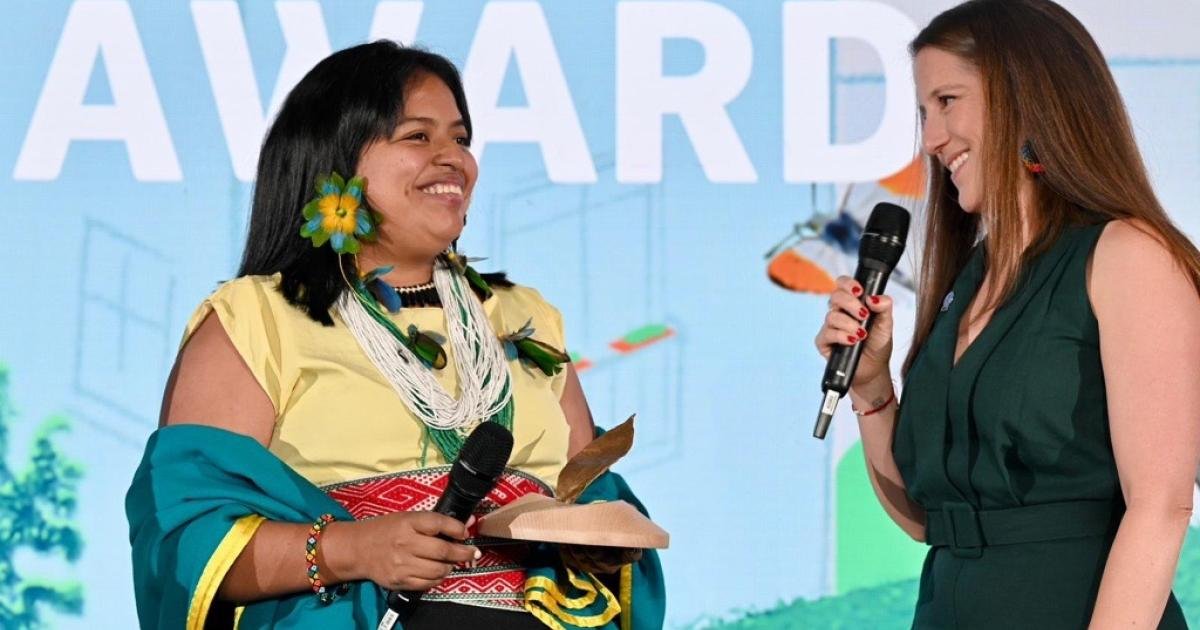
The European Commission is proud to announce the Amazonia Indigenous Women’s Fellowship (AIWF) programme as the official winner of the 2026 #ForOurPlanet Prize.
Following a rigorous evaluation process, the AIWF programme secured the top honour for its inspiring work, which stood out for its recognition that Indigenous women are not just passive victims of climate change, but primary drivers of the solution.
By trusting their deep-rooted and traditional knowledge over top-down corporate structures, the programme has helped place the future of the Amazon back into the hands of its most effective guardians.
The annual competition, which this year focused on nature restoration and bringing nature back to life, drew 370 high-calibre submissions from across the world. The award highlights AIWF’s outstanding commitment to strengthening the leadership of Indigenous women to protect the Amazon rainforest and secure climate stability.
“This recognition is important because it demonstrates and vindicates the rights of Mother Nature and the work of Indigenous women and communities in the Amazon.
It increases the political influence needed to position our voices at the centre of global discussions regarding the importance of safeguarding and defending territorial and cultural rights from the negative impacts of climate change.”
Paola Chindoy, Kamëntsá Indigenous Fellow & President of the Association of Indigenous Women
Long-term, on the ground protection
A key factor in the AIWF programme’s victory is how it has addressed challenges in rainforest protection. By circumventing traditional, slow-moving international bureaucracies and channelling money straight into the hands of local actors who understand regional needs much better, the programme has shown how things can be done.
This includes the transfer of €1.36 million in direct grants exclusively to Indigenous women-led conservation fronts since 2021, as well as supporting more than 115 projects and directly benefiting over 4,200 people.
The #ForOurPlanet judges praised the submission for demonstrating that protecting the human rights and sovereignty of Indigenous women is one of the most effective ways to physically protect the rainforest.
Instead of fostering short-term charity dependence, the programme leaves behind an active, permanent network of self-sufficient female leaders who can continue managing the Amazon for generations.
Recognising other outstanding finalists
The competition was close, with a narrow margin separating the top entries. The European Commission also honours the exceptional contributions of the second and third-placed finalists:
2nd: Trees Under the Microscope – an Armenian hands-on eco-education project that uses outdoor microscopy workshops to connect displaced and vulnerable children with the cellular biology of trees, fostering a lifelong, science-based commitment to protecting local biodiversity.
3rd: 360.come – a Portuguese environmental education program in Guimarães that engages over 2,000 preschool children in hands-on sustainable practices, using school organic gardens and compost bins to teach the principles of circular economy, waste reduction, and regenerative food systems from an early age.
The prize was awarded during a ceremony at EU Green Week 2026 in Brussels on Thursday (4 June), which focused on investing in a nature-positive economy.
Background
The #ForOurPlanet campaign is a joint initiative of DG ENV and the EEAS, which encourages citizens and communities around the world to take simple, practical actions to protect and restore nature.
For the second consecutive year, the campaign has partnered with the European Training Foundation’s Green Skills Award to create a dedicated #ForOurPlanet special award, which recognises outstanding initiatives in nature restoration and preservation from around the world.
The selection of the finalists of the #ForOurPlanet category was carried out by a jury panel from DG ENV and the EEAS.
The winner was selected from the 11 finalists featured on the #ForOurPlanet campaign website through a combined voting process, with the final result based equally on public online voting (50%) and a jury vote (50%).