





India’s archers have returned from the Asian Games in Aichi-Nagoya not merely with a glittering haul of nine medals, but with a statement of intent that has sent shockwaves through the global archery fraternity. With five gold, two silver, and two bronze medals secured, the Indian contingent has effectively rewritten the history books, shattered the long-standing hegemony of South Korean archery, and punched critical tickets to the 2028 Los Angeles Olympic Games.
For a squad that arrived in Aichi-Nagoya facing skepticism regarding its tactical readiness and the youth of its lineup, the performance was a masterclass in poise and precision. By the time the final arrow was released, the team had transformed doubt into a blueprint for future success.
‘We proved exactly what they’re made of’
The tactical approach taken by the coaching staff was defined by a shift in focus—moving away from public medal predictions and toward a rigorous, process-driven execution. Dave Cousins, India’s compound coach, credited the triumph to a significantly improved support system that allowed athletes to thrive under pressure.
“When the training is right, the preparation is right, and the ecosystem is right, these are the results you get,” Cousins noted. “We are exceptionally happy to clinch the first-ever compound archery spot for the Olympic Games. That is a massive milestone for us.”
The compound squad, featuring relatively untested talent, was the spearhead of this momentum. Sahil Jadhav and Chikitha Taniparthu, the dynamic duo of the compound mixed team, delivered a gold-medal performance that secured a precious Olympic quota. For Jadhav, the victory was the culmination of relentless repetition. “There wasn’t pressure as such because we had practiced specifically for these situations,” he remarked. “It was all about execution, and we delivered.”
The momentum carried over to the women’s compound side, where Taniparthu, joined by veterans Jyothi Surekha Vennam and Prithika Pradeep, delivered a world-record-equaling score in their 238-234 victory over China. The depth of the squad was further underscored by the men’s team, including Ganesh Mani Ratnam Thirumuru and Kushal Dalal, who claimed gold to cement India’s dominance in the discipline.
‘We thought that we would do it, and we did’
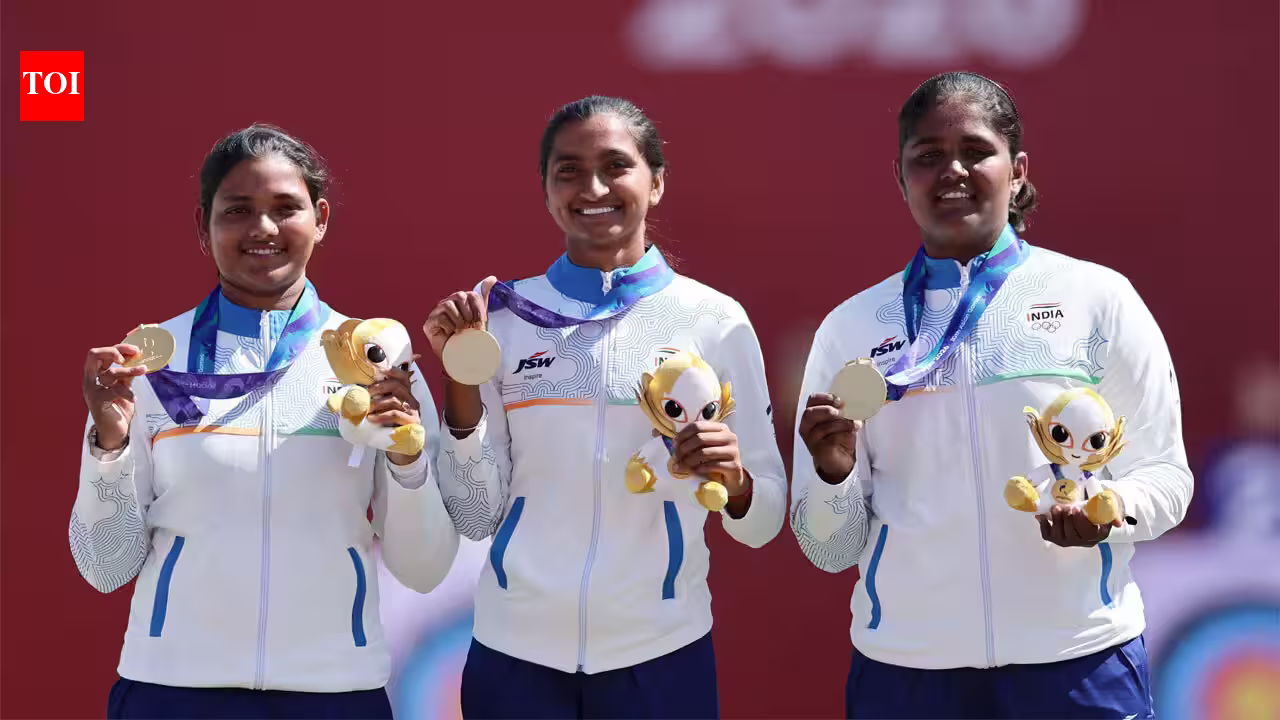
While the compound archers were dominating, the recurve team was busy pulling off one of the greatest upsets in modern archery history. The Indian women’s recurve team achieved what many deemed impossible: they toppled the 10-time Olympic champions from South Korea, winning 5-3 to secure a historic gold.
Kirti Sharma, a key member of the victorious trio, admitted the psychological hurdle of facing the Korean giants was significant. “There was pressure because that team always took gold, but we thought that we would do it, and we did,” Sharma said.
Seventeen-year-old Kumkum Mohod emerged as the breakout star of the tournament. Not only did she anchor the women’s team to victory, but she also secured individual gold and an Olympic quota for India. Her approach to the pressure of the final against South Korea’s Oh Yejin was remarkably mature: “I completely enjoyed my shooting. I held onto my feeling, just shot my arrows, and didn’t look at who was ahead.” Mohod’s advice to her peers remains simple and grounded: “Stay disciplined, do your best, and don’t get carried away.”
Bigger target: LA 2028
The success was not limited to the gold-medalists. The men’s recurve squad added valuable silverware to the tally, with Dhiraj Bommadevara claiming silver in both the mixed and men’s team events. Neeraj Chauhan and debutant Yashdeep Bhoge also contributed to the silver-medal-winning effort, highlighting the depth of the new-look Indian side.
Bommadevara was quick to credit the administrative and governmental support that has professionalized the sport in India. “Earlier, there was hardly any support. But if it weren’t for this government, I wouldn’t be standing here today,” he said.
As the athletes look toward the future, the horizon is clearly marked by the Los Angeles 2028 Olympic Games. The success in Aichi-Nagoya has done more than just boost morale; it has created a new, higher benchmark for what Indian archery can achieve.
With the South Korean dominance finally breached and a robust pipeline of talent delivering results under the most intense conditions, the Indian archery program has effectively exited its “developing” phase. For this group of athletes, the Asian Games gold medals are no longer the finish line—they are the starting blocks for an Olympic cycle that promises to be the most competitive in the nation’s history. The targets have been set, the quotas are in hand, and the world is officially on notice.
Disclaimer: This content is auto-generated for informational purposes only.
Source: Read Original News