









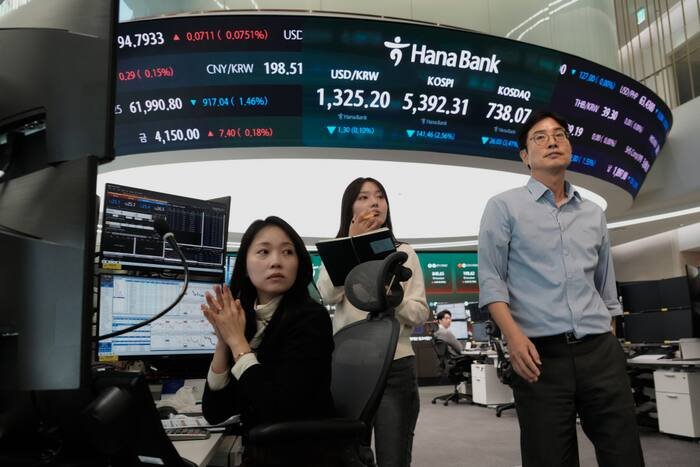
Asian markets traded with caution on Monday as investors recalibrated their expectations for the week ahead, balancing fears of persistent inflation with a high-stakes earnings season for the technology sector. While U.S. stock futures showed modest signs of recovery, the broader Asian landscape remained largely subdued following a difficult close for Wall Street last week.
The regional market performance was mixed: Tokyo’s Nikkei 225 dipped 0.1%, and Seoul’s Kospi retreated by 1.1%. Australia’s S&P/ASX 200 also saw a minor decline, while Hong Kong’s Hang Seng managed a slight gain. This tepid sentiment follows a week where major U.S. indices, including the S&P 500 and the Dow Jones Industrial Average, logged consecutive weekly losses, fueled by concerns over interest rates and geopolitical instability.
## The “Prove It” Moment for AI Giants
The tech industry finds itself at a critical juncture. Despite broader market turbulence, AI-centric companies such as Microsoft, Intel, Micron Technology, and Advanced Micro Devices have shown resilience, logging gains in recent sessions. However, investor enthusiasm is increasingly being tempered by the heavy financial burden of these AI initiatives.
As corporations continue to pour billions into infrastructure and high-performance computing, the market is no longer satisfied with speculative potential. Financial analysts are demanding tangible evidence that these capital-intensive projects will evolve into profitable, sustainable business models rather than serving as mere “capex furnaces.”
“This week is less about broad conviction and more about proof,” said Stephen Innes of SPI Asset Management. “Big Tech now has to show that the spending binge still deserves the market’s faith.”
This week’s earnings calendar is dominated by heavyweights including Microsoft, Amazon, and Alphabet, Google’s parent company. The performance of these firms will likely dictate the short-term trajectory for the tech sector, as investors scrutinize their balance sheets for signs that the aggressive investment in artificial intelligence is beginning to yield measurable returns.
## Macroeconomic Headwinds and Energy Concerns
Beyond the boardroom, the global economy is grappling with significant pressure from the energy sector and central bank policy. Oil prices, which soared to four-year highs last week due to geopolitical tensions involving Iran, saw a minor correction on Monday, with Brent crude dipping to approximately $110 per barrel. Still, the impact of these elevated costs continues to weigh heavily on consumer sentiment and input prices for businesses.
Adding to the complexity is the persistent inflation narrative. With U.S. inflation currently tracking well above the Federal Reserve’s 2% target, all eyes are on the upcoming personal consumption expenditures (PCE) index. This metric is widely expected to show inflation hovering near 3.7%, reinforcing the rationale for the Federal Reserve’s hawkish stance. While most analysts anticipate that the central bank will keep rates steady at their meeting this week, the possibility of a rate hike in December remains a point of contention that could trigger further market volatility.
## Navigating a High-Interest Environment
The challenge for the tech sector is compounded by rising interest rates, which make the cost of borrowing—essential for funding large-scale AI research and data center expansion—significantly more expensive. Companies that have relied on debt to fuel their growth are now facing increased scrutiny as the cost of capital climbs.
While some firms, like American Express, have reported robust profits, they are not immune to the cooling economic climate, as evidenced by recent workforce reductions. As the market moves deeper into the week, the combination of Big Tech earnings and critical U.S. economic data will likely serve as a litmus test for whether the current rally in innovation-focused stocks can survive a period of tightening monetary policy and global economic strain.
Disclaimer: This content is auto-generated for informational purposes only.
Source: Read Original News