









Asian Markets Stumble as AI-Driven Optimism Collides with Economic Headwinds
Asian financial markets opened in a defensive posture on Tuesday, as regional investors grappled with persistent uncertainty regarding global energy prices and rising interest rates. The cautious mood followed a divergent performance on Wall Street, where a concentrated surge in artificial intelligence stocks masked broader instability within the U.S. economy.
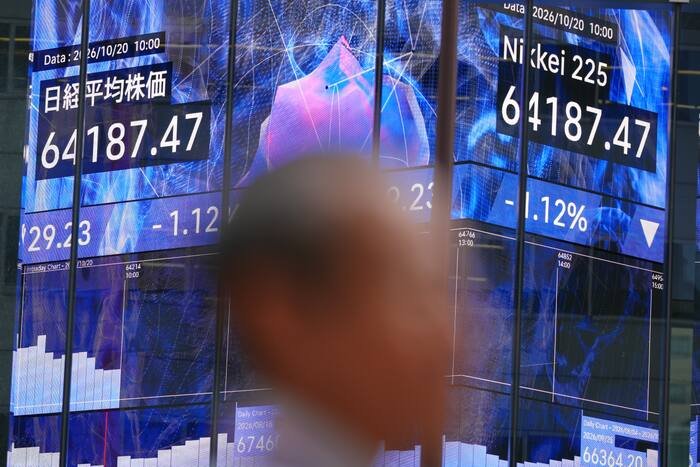
In early trading, major benchmarks across the Pacific rim faced downward pressure. Japan’s Nikkei 225 index shed 0.6%, while Australia’s S&P/ASX 200 retreated 0.8%. South Korea’s Kospi faced a steeper decline of 2.8%, and Hong Kong’s Hang Seng index fell nearly 1%. Meanwhile, China’s Shanghai Composite remained relatively stagnant, reflecting a wait-and-see approach as the market prepares for a critical cycle of corporate earnings reports.
The AI Divergence: Wall Street’s Mixed Signals
The contrast between tech-heavy indices and traditional market sectors highlights the current fragility of the U.S. equity landscape. While the Nasdaq composite rallied by 1.1%—buoyed by intense investor appetite for AI-related enterprise—the Dow Jones Industrial Average suffered a slight dip of 0.1%.
Nvidia continues to dictate the momentum of the broader market. As the highest-valued entity on Wall Street, even minor fluctuations in its stock price have an outsized impact on the S&P 500. The company saw a 1.4% gain on Monday, providing the necessary lift to push the S&P 500 up 0.4% despite a weak finish to the previous week.
Elsewhere in the tech sector, SpaceX saw a 1.3% rise. The company, which governs the xAI initiative, remains in the spotlight following founder Elon Musk’s recent commitment to distribute shares to American youth next year. Despite these high-profile gains, analysts warn that the underlying market remains vulnerable. A significant portion of the recent capital expenditure fueling the AI and data center boom is being financed through debt, making the industry particularly sensitive to the current interest rate environment.
Bond Yields and Energy Volatility
The enthusiasm for AI is currently battling a harsh reality in the bond market. Treasury yields have climbed to multi-year highs, with the 10-year Treasury yield reaching 5.14%. As borrowing costs rise, the sustainability of debt-fueled tech expansion remains a primary concern for institutional investors.
Compounding this pressure is the energy sector. Crude oil prices remained elevated, with U.S. benchmark oil hovering at $103.50 a barrel and Brent crude near $109.47. The sustained premium is largely driven by geopolitical instability, specifically concerns surrounding the ongoing war with Iran. Market analysts suggest that until the conflict stabilizes and production channels normalize, oil prices are unlikely to see a meaningful retreat, keeping inflationary pressures front and center for global economies.
Investor Caution Ahead of Earnings Season
As investors look beyond the AI rally, the primary focus is shifting toward upcoming earnings calls. Markets are currently in a delicate state of transition, balancing the promise of AI-led productivity against the weight of elevated Treasury yields and energy costs.
In the currency markets, the U.S. dollar saw marginal movement, slipping slightly against the Japanese yen to 158.45, while the euro remained steady at $1.1225. As these macroeconomic variables align, participants are increasingly looking for concrete financial results from major corporations to justify current valuations. For now, the narrative remains one of caution, with market sentiment appearing susceptible to any new signals regarding the intersection of high-interest rates and sector-specific growth.
Disclaimer: This content is auto-generated for informational purposes only.
Source: Read Original News