








Black truffles aren’t native to Australia, but since the first oaks and hazelnuts were planted in the 1990s, the local industry has flourished, becoming the largest producer outside Europe.
Now, scientists have identified the environmental factors which appear to have contributed to that success.
Many types of fungi produce truffles, a fruiting body that grows underground. But a handful of species, including French black (or Périgord) truffles from Europe, are considered gourmet delicacies, highly prized for their earthy bouquet and rich, savoury notes.
They were introduced relatively recently, with the first host trees planted in Tasmania in 1995, the first black truffles harvested in 1999, and Australia’s first exports in 2007.
Since then it would be fair to say the local industry has mushroomed. In under three decades, Australia has become the fourth-largest producer of black truffles globally, after Spain, France and Italy.
There are now more than 400 truffle orchards – and half a million host trees, mainly oaks and hazels – spread across every state and territory except the Northern Territory, according to the Australian Truffle Growers Association.
Scientists from Michigan State University, curious whether environmental factors could have played a role in this success, analysed truffles and soils from 24 orchards across France, Spain, Italy and Australia.
Associate prof Gregory Bonito, a mycologist and author of the study, said understanding truffles was a “tricky proposition” because much of what happens occurs underground.
“You grow a tree like an apple, you can see the flower and then the fruits, but below ground it’s a different story, because it’s harder to follow,” he said.
That’s why the research, published in Applied and Environmental Microbiology, involved collecting spoonfuls of soil, and analysing various characteristics including the diversity of fungi and bacteria present, along with sampling the truffle’s microbiome.
The results suggested that one reason black truffles have thrived in Australia was reduced competition from similar types of fungi.
DNA sequencing identified 4,415 genetically distinct types of fungi hidden in Australian soils, compared to 6,575 in soils from Europe. Australian truffle orchards had 75% fewer species of mycorrhizal fungi, the type that produces truffles, giving black truffles more of a monopoly.
The findings were already being pored over by local growers.
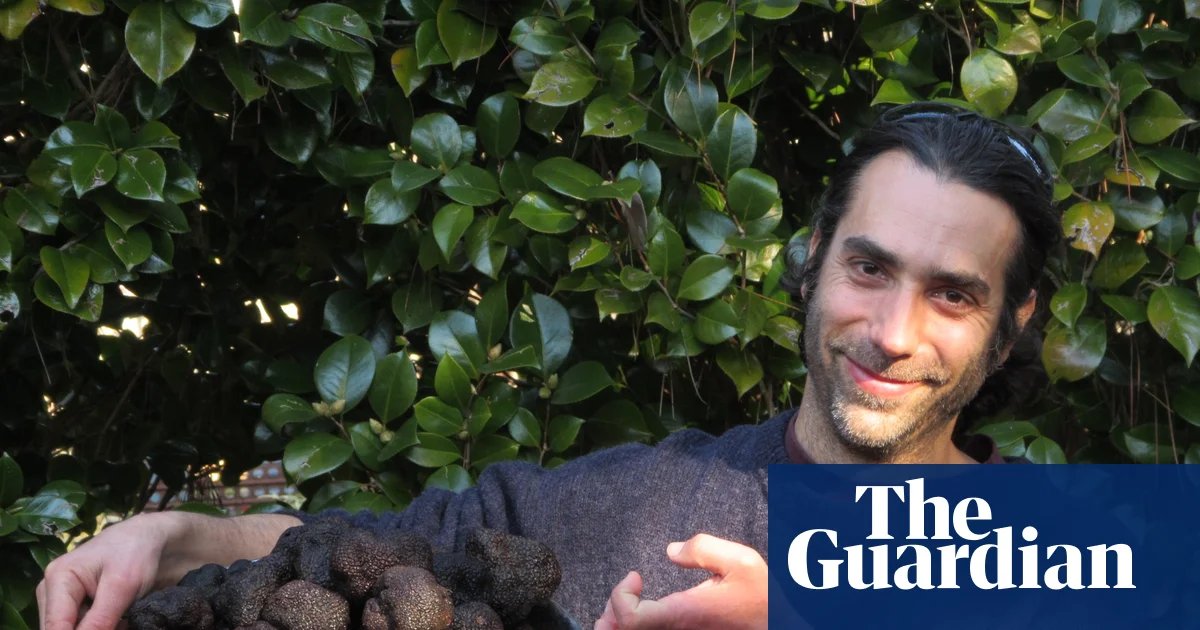
Stuart Dunbar of Yarra Valley Truffles, about an hour’s drive east of Melbourne, holds the record for the largest cultivated truffle – a 1.5kg beauty.
Having planted his trees in 2006, the first fruits arrived about four years later.
The best time to harvest was mid-winter, heading into spring, he said, just as acorns and hazelnuts were beginning to germinate and sprout.
But a successful crop depended on so many factors, he said. They included environmental conditions like temperature, soil structure and water, plenty of “elbow grease” and expert timing.
“A truffle’s goal in life is pretty much like a fruit,” he said. “A truffle wants to be eaten, primarily by a pig, dug up and eaten when its spores are perfectly ripe and it gets spread through the forest.”
An early experience highlighted the perils of harvesting too early. “It was a 124-gram truffle. It formed alongside the root of an oak, with a bit of a groove where it was wrapped around the root. And I got to smell it – wonderful – took it up to the kitchen, went to cut it and it shattered.”
Super light and fluffy soils were crucial for producing healthy, round truffles, Dunbar said, and the fungi themselves played a role in creating the right conditions, drawing calcium and lime from the soil to create pockets of alkalinity.
Dr Gian Benucci, co-author of the paper, said truffles played an important biological role for their host tree partners above the ground.
“While truffles are celebrated at the table, in the forest they are the true architects of tree health. They act as the backstage crew of a high-end kitchen: doing the gruelling work of nutrient transport and environmental staging so the canopy can thrive. It is a sophisticated biological bargain; the truffles provide the foundation for growth, in exchange for just a small portion of precious photosynthetic carbon.”
Biology was the backdrop of Australia’s trufficulture success, Bonito said, but there were likely many other important factors including climate, good truffle stock, research and development and an “innovative and industrious” attitude.
Perhaps one surprising finding from the study was that the microbiome of black truffles – bacteria thought to contribute to their famed aroma – remained strikingly similar across Australia and Europe. “Which is fascinating, because the soil is completely different,” he said.
The researchers didn’t always get to taste the produce. But when Bonito was collecting samples at Peter Marshall’s Australian truffle farm, he said the family would send him home with some every day.
“We would cook them up with eggs, and put it on bread” or “eat them fresh”. They were even invited to a family dinner “with as much truffle as you want, to put on your pasta”.