







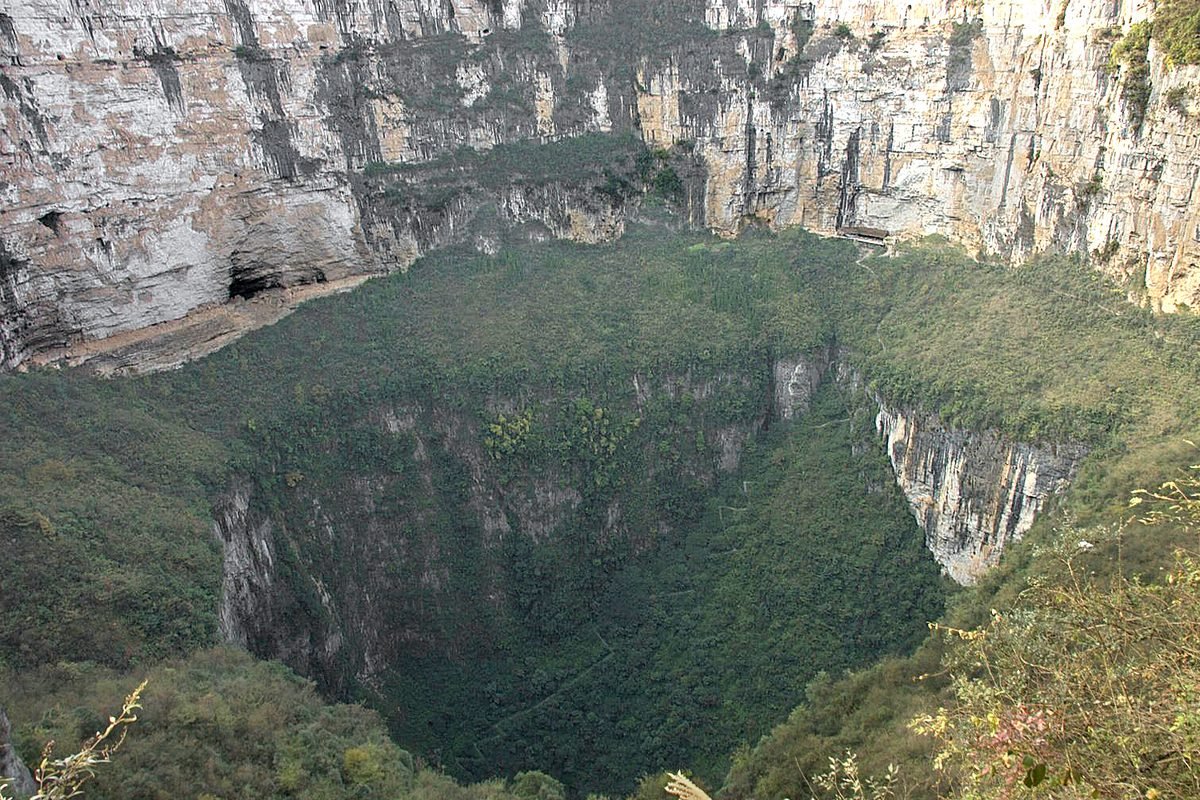
Looking down on it from above, the world’s deepest sinkhole, Xiaozhai Tiankeng, looks as though someone used an enormous apple corer to gauge a chunk out of the earth’s core. Steep sides give way to a deep, dark abyss, shaded in mist and mystery.
In China’s Chongqing Municipality, locals have known about the sinkhole for centuries. Xiaozhai is the name of a local abandoned village, whilst Tiankeng means Heavenly Pit, the local term for sinkhole.
With a depth of 626 metres and a width of 527 metres, the enormous hole is twice as long as the Eiffel Tower and one a half times wider than London’s O2 Arena. With a volume of around 120,000,000 cubic metres, it could hold the equivalent of 40,000 Olympic-sized swimming pools or about 500 Hindenburg-class zeppelins.
Sinkholes are deep holes in the ground that form when surface layers collapse into underground voids. They can appear gradually or suddenly, and are often caused by heavy rain, flooding, or human activities, such as building and mining.
In the case of the Xiaozhai Tiankeng, forces from above and below ground shaped its formation. Over tens of thousands of years, rain water seeped into the region’s porous limestone bedrock, widening crevices and leading to erosion. At the same time, a powerful underground river was hollowing out a network of subterranean caves and caverns. Then, at some point the surface gave way and the sinkhole appeared.
This may have happened in stages. The Xiaozhai Tiankeng has a unique double structure. Framed by vertical cliffs, a larger, upper crater tapers down to a smaller, lower one. This suggests that the sinkhole may have formed in two discrete events.
No one knows exactly when this happened, but in the time that has elapsed, a mature, subtropical ecosystem has formed inside the sinkhole. The environment even has its own cool, moisture-laden microclimate. The rare clouded leopard has been spotted here, and more than a 1,200 plant species have been recorded, including the ancient Ginkgo tree, ferns and mosses.
Although there is comparatively little daylight for the plants that grow at the bottom of the sinkhole, life still finds a way. A 2024 study published in the Chinese Journal of Plant Ecology found that plants in the region’s sinkholes have adapted to their extreme environment by adjusting their nutrient levels. They have lower carbon contents than plants growing at the surface, and high levels of other elements, such as nitrogen and phosphorous.
All of this makes the plants and animals that live inside the Xiaozhai Tiankeng precious and potentially unique, so whilst the overall structure is physically impressive, it’s the flora and fauna that really steal the show.