





Plans for Cheddar Reservoir 2 Face Further Delays as Costs Projected to Top £1 Billion
By Harry Mottram
Despite the ongoing challenges posed by regional drought conditions and the implementation of hosepipe bans, West Country Water and Environment (WCWE) has confirmed that plans for the construction of Cheddar Reservoir 2 will not be fast-tracked.
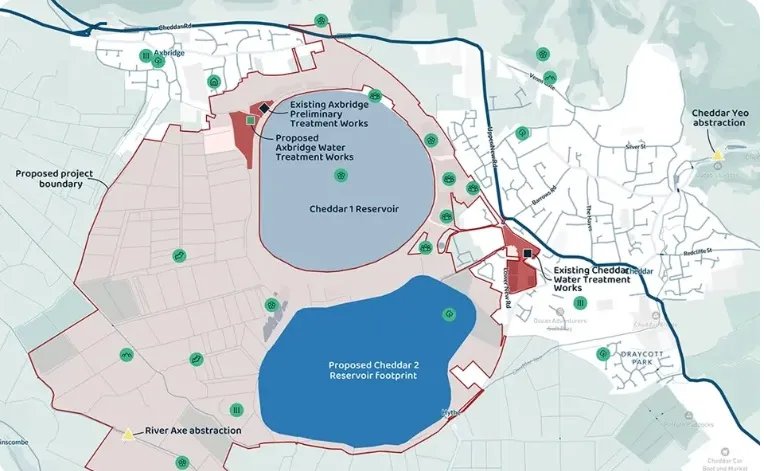
The project, which seeks to expand water storage capacity and establish a critical pipeline to Devon, is currently not expected to be fully operational until 2035. This timeline comes as no surprise to local observers, as the scheme faces a perfect storm of uncertainty, including soaring infrastructure costs, fluctuating interest rates, and the broader economic fallout from the Iran-USA conflict. Furthermore, the industry is navigating a period of significant regulatory scrutiny, with the new Labour Government expressing a keen interest in potential structural reforms to the nation’s water utilities.
Navigating the ‘RAPID’ Regulatory Process
The development is currently being managed under the umbrella of WCWE, representing South West Water’s plans for Bristol Water. Addressing the possibility of accelerating the timeline, a WCWE spokesperson noted that the project is bound by the “RAPID” framework—the Regulators’ Alliance for Progressing Infrastructure Development.
“Major infrastructure projects such as Cheddar Two must progress through established regulatory, environmental, and planning processes,” the spokesperson stated. “This ensures they deliver environmental benefits, protect customers’ interests, and represent good value for money.”
While public consultations are currently underway, additional rounds are expected to take place before the end of the year and into 2025. The current roadmap indicates that planning applications will be submitted to Somerset and Devon councils next year, with initial construction scheduled to commence in 2028.
Engineering and Economic Hurdles
The path to completion is fraught with both logistical and financial obstacles. Beyond the administrative requirements, the proposed pipeline to Devon presents massive engineering challenges. The route must navigate complex terrains, including tunneling under the River Parrett and the Bridgwater to Taunton Canal, as well as crossing numerous major roadways.
Financial projections have also shifted drastically. While early estimates sat at roughly £750 million, current industry forecasts suggest that the total cost of the reservoir and its accompanying infrastructure could exceed £1 billion.
The project’s history is equally turbulent. In 2016, Bristol Water abandoned an earlier iteration of the plan due to prohibitive costs, following a decision by the regulator, OFWAT, that suggested shareholders—rather than customers—should bear the financial burden. The utility was later acquired in 2021 by the Devon-based Pennon Group for $563 million.
A Future-Proofing Strategy
Despite the delays, stakeholders maintain that the project remains essential for regional resilience. WCWE continues to emphasize a multi-faceted approach to the water crisis, incorporating smart meter roll-outs, aggressive leakage reduction targets, and water-efficiency programmes alongside the Cheddar Reservoir 2 development.
While Water Minister Emma Hardy visited the site in March 2025 to express government backing for the project’s funding and momentum, the reality of global economic pressures has tempered expectations. For now, the region must rely on existing infrastructure, such as the original Cheddar Reservoir—completed in 1939—while waiting for the slow, methodical gears of the planning system to grind toward a 2035 finish line.