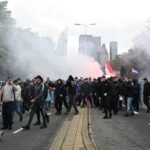







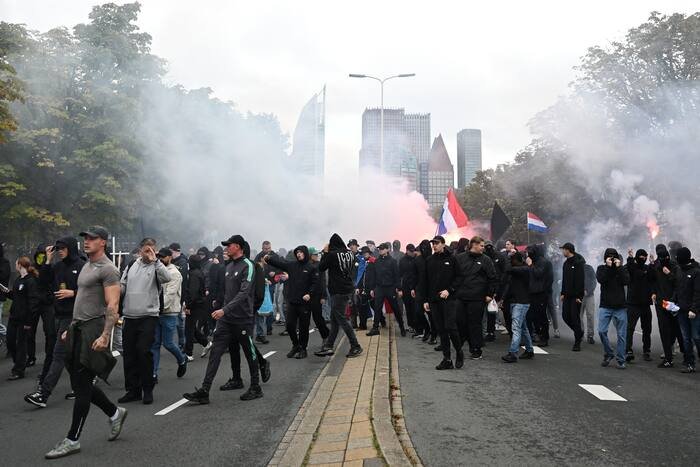
THE HAGUE – Dutch riot police moved in to disperse several hundred far-right protesters in The Hague on Saturday after a planned demonstration against immigration and asylum policies spiraled into chaos, forcing local authorities to declare the march illegal and order an immediate dispersal.
The unrest began at the Malieveld, a large park in the heart of the city often used for political demonstrations. What started as a rally quickly deteriorated as tensions flared between protesters and law enforcement. According to police reports, the situation turned violent when groups of demonstrators began hurling fireworks and other projectiles at officers tasked with maintaining order.
Justice Minister David van Weel expressed outrage at the conduct of the participants, labeling the behavior as “disgusting.” In a stern message posted to X, Van Weel condemned reports of demonstrators performing Nazi salutes and chanting antisemitic slogans. He praised the police response, writing, “Thanks to all the police officers who are once again standing up for our democratic rule of law.”
As the situation escalated, the municipality of The Hague took the rare step of banning the march entirely. Authorities ordered the crowd to disperse, citing public safety concerns and the breakdown of peaceful assembly. While police managed to regain control of the area by late afternoon, the confrontation resulted in several arrests. The exact number of detainees remains under investigation as authorities continue to review footage of the clashes.
The violence cast a dark shadow over the city, echoing previous episodes of civil unrest. Saturday’s riots occurred almost exactly one year after a similar right-wing demonstration in The Hague devolved into anarchy. During that earlier protest, black-clad demonstrators clashed with police, setting a patrol car on fire and targeting the headquarters of the centrist D66 party. The party’s leader, Rob Jetten, who now serves as the Dutch prime minister, was a focal point of the protesters’ anger during that event.
Observers suggest the recurring nature of these violent protests reflects a deepening divide in Dutch society over the government’s approach to immigration and asylum. While the right to protest remains a protected cornerstone of the Netherlands’ democratic system, officials warned that the line between protected speech and criminal activity was definitively crossed on Saturday.
As the city began the process of cleaning up, local law enforcement remained on high alert, with officials promising a “firm” legal response to those responsible for the destruction and hate speech. The events have triggered a wider conversation among Dutch lawmakers regarding the limits of protest and the rising influence of fringe extremist groups in the public square.
Copyright 2026 The Associated Press. All rights reserved. This material may not be published, broadcast, rewritten or redistributed without permission.
Disclaimer: This content is auto-generated for informational purposes only.
Source: Read Original News