








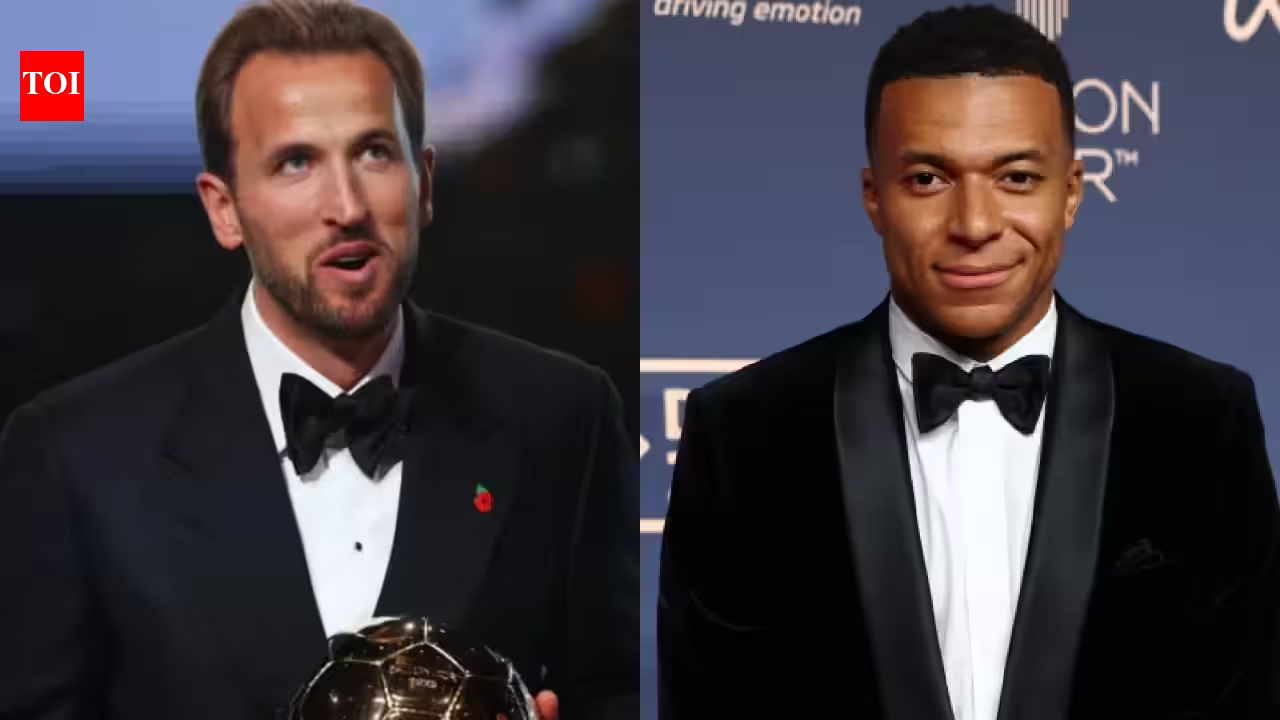
Harry Kane’s historic coronation as the 2026 Ballon d’Or winner was far more than a simple victory lap; it was the culmination of one of the most razor-thin margins in the history of the prestigious award. As the official voting figures from the London Palladium ceremony finally emerge, they reveal that the England captain faced a ferocious challenge from Kylian Mbappé, edging out the French superstar by a mere 28 points.
The final tally saw Kane secure 1,055 points from the 100-member panel of international journalists, while Mbappé followed closely with 1,027. This slim separation underscores the intensity of the debate among voters, who were tasked with measuring Kane’s phenomenal 73-goal campaign for Bayern Munich and England against Mbappé’s own blistering individual excellence throughout the 2025-26 season.
Kane edges Mbappé after a closely fought vote
The nuance of the voting process highlights how divided the electorate was. Kane earned the top spot on 40 of the 100 submitted ballots, a significant achievement, but Mbappé remained firmly in the race, garnering 23 first-place votes of his own. These figures solidify Kane’s status as the first Englishman to claim the trophy since Michael Owen in 2001, rewarding a season that saw him capture a domestic Treble with Bayern and steer the Three Lions to a third-place finish at the World Cup.
For Mbappé, the result marks a bittersweet near-miss. In a landscape of elite football often defined by wide gaps, the 28-point delta is notably smaller than the 41-point margin that separated Rodri and Vinícius Júnior in 2024. It serves as a reminder that in the modern game, the difference between football immortality and second place often comes down to the opinion of a single journalist in a far-flung corner of the globe.
Where Kane’s victory ranks among the closest decisions
While the 28-point gap is historically tight, it stops just short of the extreme photo finishes of yesteryear. The closest contest in the modern era remains the 2019 race, where Lionel Messi beat Virgil van Dijk by a heart-stopping seven points. Looking further back, the annals of the game feature even more narrow margins; both the 1996 and 1966 awards were decided by a solitary point, though those contests utilized significantly smaller voting panels.
The 2026 format, which empowers 100 journalists to rank their top 10 players, provides a much broader data set, making a 28-point difference a remarkably significant indicator of the current parity at the very pinnacle of global football.
How the 2026 Ballon d’Or voting system worked
Under the current regulations, introduced in 2022, the men’s award is decided by journalists representing the top 100 nations in the FIFA rankings. Each voter allocates points in a 15, 12, 10, 8, 7, 5, 4, 3, 2, 1 distribution. With 1,500 points as the theoretical maximum, Kane’s total of 1,055 represents a commanding, yet clearly contested, mandate of more than two-thirds of the available points.
The top 10 reveal a notable drop-off after the leading duo. Lamine Yamal took the third position with 881 points, followed by Rodri on 726 and Lionel Messi on 612. The data suggests that while the race for the top spot was a two-horse affair, the subsequent tiers of elite talent—featuring stars like Khvicha Kvaratskhelia and Erling Haaland—remained firmly locked in their own battle for European supremacy.
Putellas wins the women’s award, but the lower places are exceptionally tight
The women’s Ballon d’Or, decided by a 50-journalist panel, saw a more decisive finish at the summit, yet proved to be a masterclass in tension lower down the table. Alexia Putellas claimed her third Ballon d’Or, finishing with 618 points out of a maximum 750—a dominant showing that underscored her influence for both Barcelona and the London City Lionesses. Ewa Pajor trailed in second with 532 points.
However, the middle of the pack provided the most dramatic theatre of the evening. Third and fourth place were separated by a microscopic two-point margin, with Bunny Shaw (334) narrowly overcoming Melchie Dumornay (332).
Perhaps the most fascinating aspect of the night was the dead heat for sixth and seventh place. Both Caroline Graham Hansen and Pernille Harder finished with 220 points. Because total points could not separate them, the organizers invoked the tie-breaking rule—the number of first-place votes—to determine the final order, with Graham Hansen securing the sixth spot. A similar drama unfolded between Claudia Pina and Alessia Russo, who both finished with 155 points, further emphasizing that at the highest level of the game, every single vote cast carries the weight of history.
Disclaimer: This content is auto-generated for informational purposes only.
Source: Read Original News