








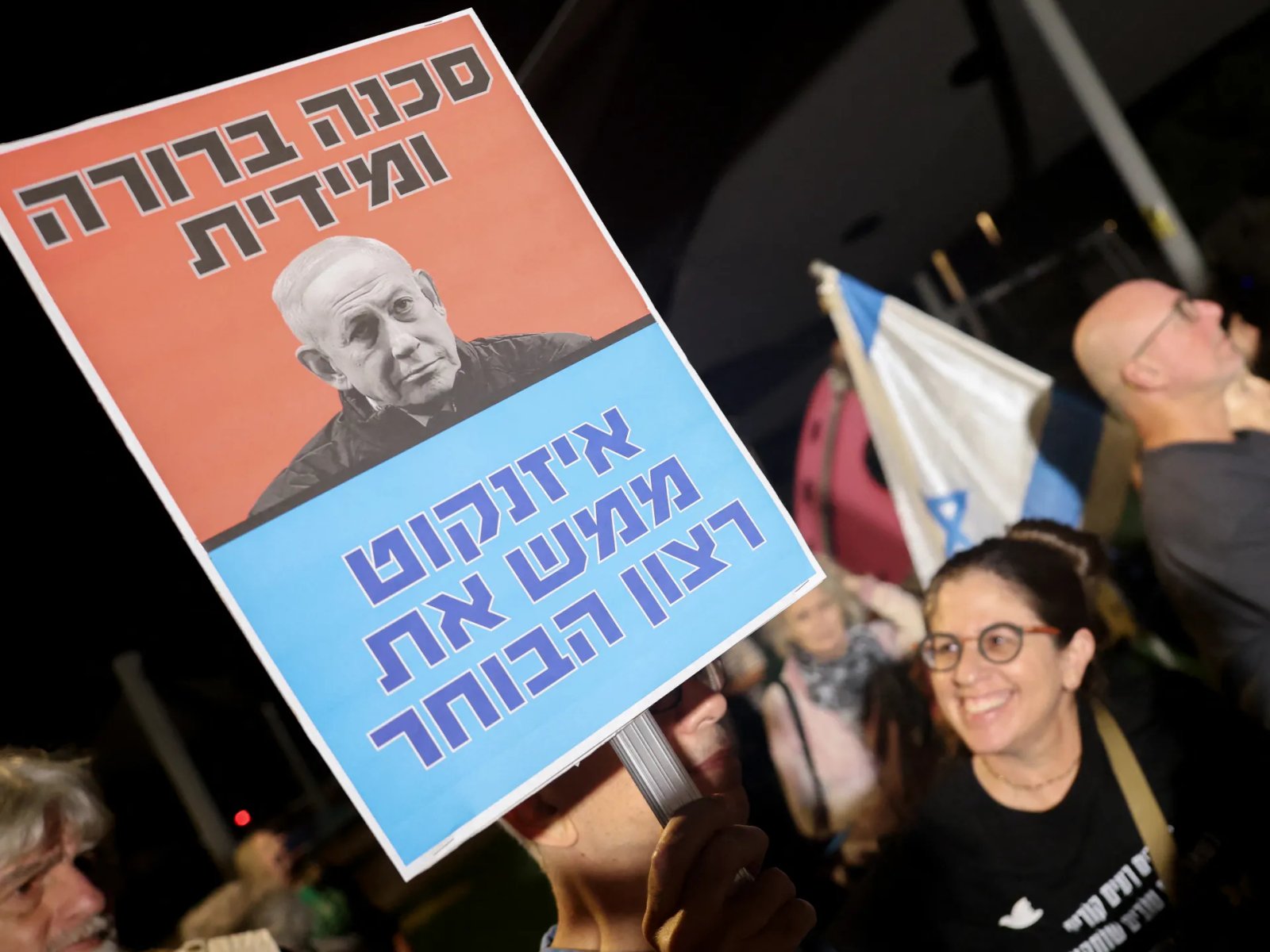
Israel is facing a profound political impasse as final election results confirm that no clear winner has emerged from the October 27 vote. Despite a robust 77.9 percent voter turnout, the Central Elections Committee confirmed on Friday that neither Prime Minister Benjamin Netanyahu’s bloc nor the opposition grouping led by Gadi Eisenkot has secured the 61-seat majority required to form a government in the 120-member Knesset.
The finalized count, bolstered by the inclusion of over 500,000 “double envelope” ballots from soldiers and diplomats, leaves Netanyahu’s bloc with 53 seats, while Eisenkot’s opposition coalition holds 48. The remaining 19 seats are held by the United Arab List (Ra’am) and the Joint List, representing Palestinian citizens of Israel.
The deadlock centers on a deep ideological divide regarding the legitimacy of these Arab-led parties. Both major Jewish-Israeli political blocs have explicitly ruled out formal partnerships with them. Netanyahu has been particularly vocal, condemning the potential for an Arab-supported government and accusing his rivals of “stealing” the election. Conversely, Gadi Eisenkot has set stringent requirements for potential partners, demanding adherence to the definition of Israel as a “Jewish and democratic state”—a framework that remains a point of contention for many Arab representatives.
Political analyst Ahmed Najar noted that while Arab-led parties have shown a willingness to engage to prevent another Netanyahu term, they face systemic exclusion. “The election produced 67 seats outside Netanyahu’s bloc, but Israel’s political system continues to behave as though 19 of those seats do not fully count,” Najar said. “Palestinian citizens are permitted to vote, but when their votes become decisive, their political legitimacy is immediately questioned.”
The path forward remains fraught with uncertainty. President Isaac Herzog is expected to initiate formal consultations to determine which candidate holds the best chance of forming a coalition. If assigned candidates fail to secure a government within the mandated 28-day window—which may be extended—the country could face the prospect of a repeat election, a scenario many analysts believe Netanyahu may prefer in hopes of improving his bloc’s numbers.
For many, the stalemate highlights a fundamental crisis in Israeli governance. While some suggest a potential “confidence-and-supply” agreement—where Arab parties could support an Eisenkot-led government from the outside in exchange for policy commitments—skepticism remains high. Hard-right figures like Avigdor Lieberman have already rejected any “Bibi or Tibi” coalition, further narrowing the options for a stable government.
As political maneuvering continues behind closed doors, observers argue that the focus remains primarily on the survival of specific leaderships rather than the broader Palestinian experience. For Palestinians in the occupied West Bank and Gaza, the election is viewed less as a choice between peace and conflict, and more as a struggle over who will preside over the status quo of occupation and systemic inequality.
Disclaimer: This content is auto-generated for informational purposes only.
Source: Read Original News