








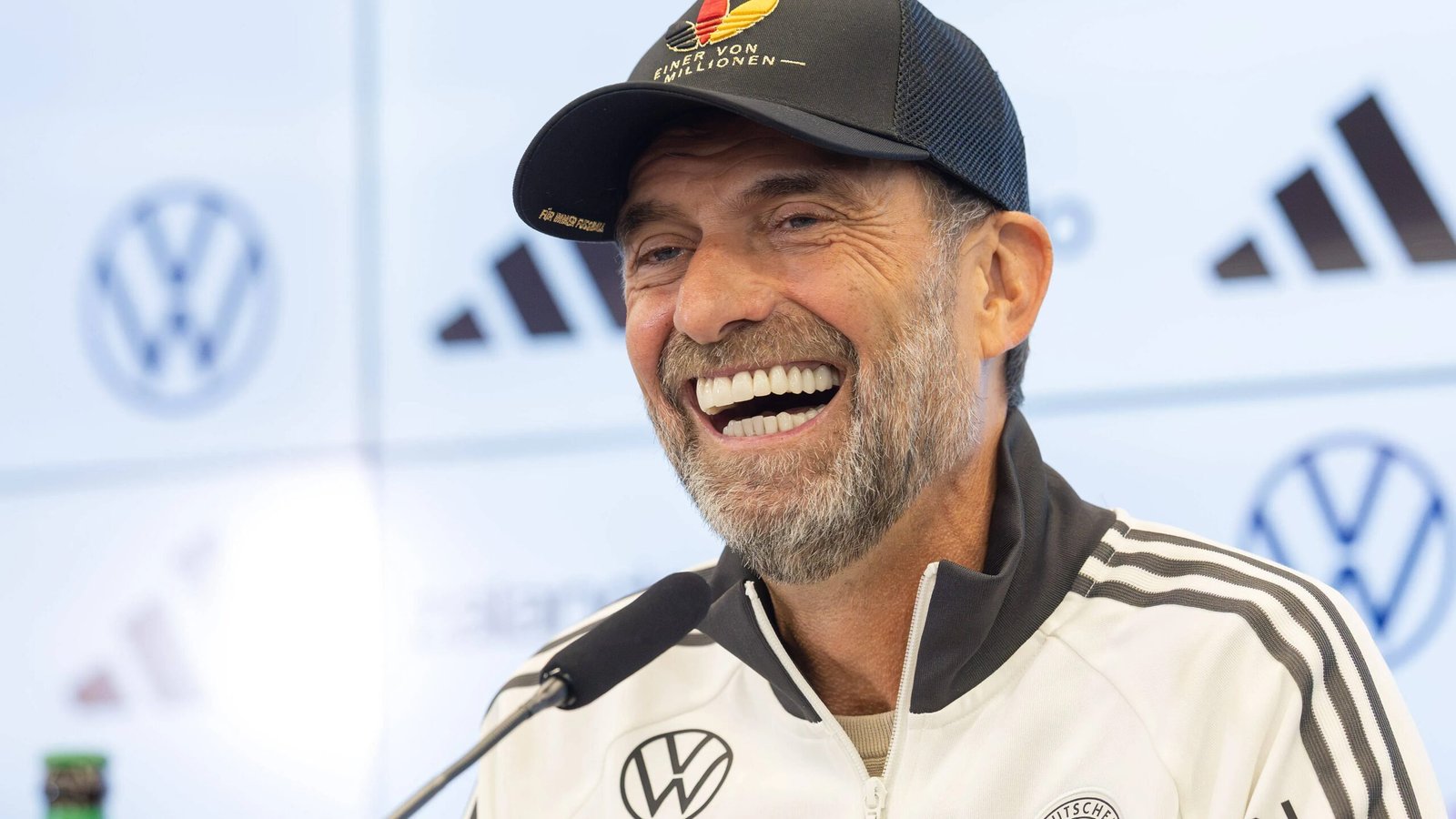
In a wide-reaching press conference that signaled a definitive shift in German football, new national coach Jürgen Klopp has wasted no time in drawing a line under the Julian Nagelsmann era. Unveiling an expansive 44-man squad for the upcoming Nations League campaign, Klopp delivered a masterclass in change, emphasizing personal connection, tactical clarity, and a message that the door is open for every German footballer.
The squad announcement was punctuated by a moment of levity that briefly threatened to dominate the headlines. When asked to name successful club coaches who transitioned to the national team, Klopp momentarily forgot Julian Nagelsmann, only to realize the implication of his slip. “Write the story you want to write,” he told reporters with a wry smile, before pivoting to offer respectful praise for his predecessor. Yet, the substance of his words quickly moved toward a firm rejection of the status quo that had plagued the DFB in recent months.
The most significant tactical pivot concerns the role of Joshua Kimmich. While Nagelsmann frequently deployed the Bayern Munich stalwart as a right-back, often citing a lack of depth in the position, Klopp was blunt in his assessment. “Not in a single conversation that I had with my coaching colleagues was he listed as a right-back,” Klopp stated. “We see him as a midfielder.” Kimmich remains the captain, but he will operate in the heart of the engine room, with Klopp dismissing the notion that the right-back position is a crisis, specifically pointing to debutant Philipp Treu and VfB Stuttgart’s Josha Vagnoman as viable, overlooked solutions.
Klopp’s squad selection is a radical departure from his predecessor’s preferences. The list features 16 debutants—including Celtic’s Mika Baur—and notably excludes several Nagelsmann favorites. The trio of Deniz Undav, Angelo Stiller, and Jamie Leweling have been omitted entirely in favor of a new wave of talent, a decision that underscores Klopp’s desire for a truly clean slate.
The most striking difference, however, is philosophical. Klopp revealed he spent the last four weeks traveling extensively, visiting training grounds and engaging in face-to-face conversations with players. “I saw them, had them physically in front of me,” Klopp explained. “The difference from the picture I had before is quite big.” The remarks served as a thinly veiled critique of the distance maintained by the previous regime, promising a more hands-on, localized approach to player development.
As Germany prepares to face the Netherlands, Greece, and Serbia, the excitement surrounding Klopp’s arrival is palpable. However, the German tactician is well aware that the euphoria of a fresh start is fleeting. In the world of international football, the transition from theory to results remains the final, and most difficult, hurdle.
Disclaimer: This content is auto-generated for informational purposes only.
Source: Read Original News