





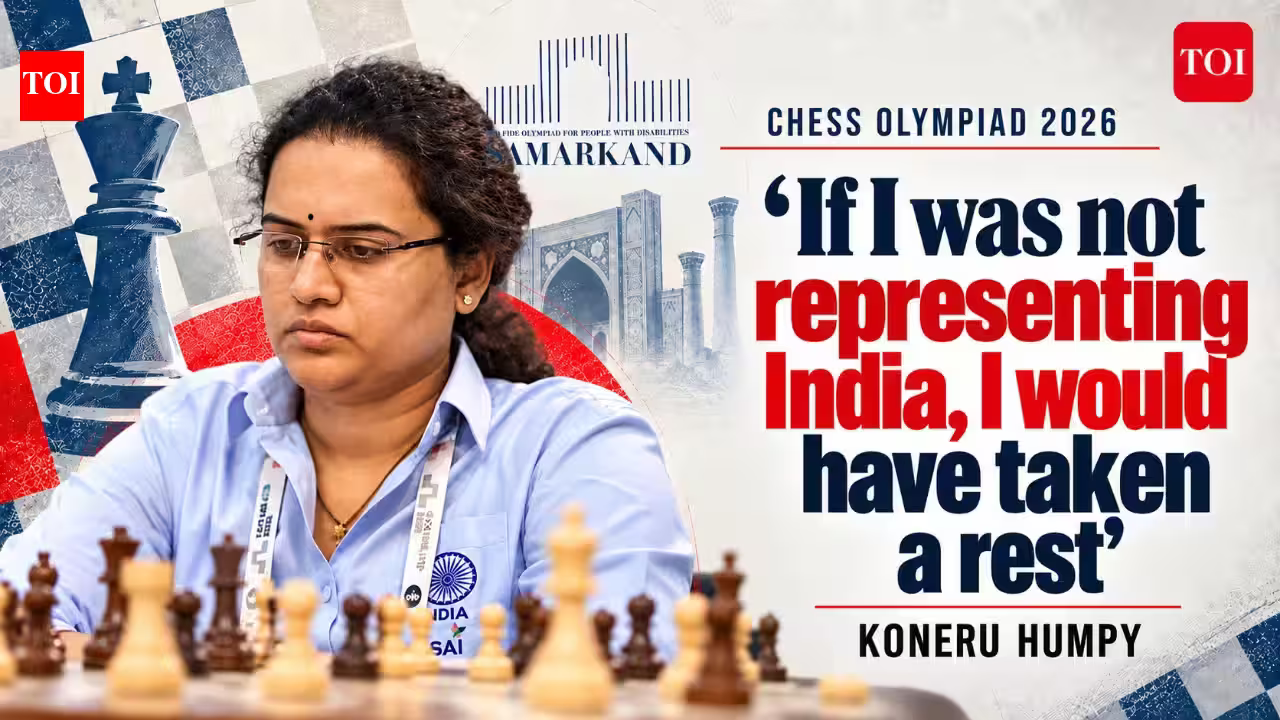
GRIT and resilience defined India’s performance at the 46th Chess Olympiad in Samarkand, Uzbekistan. While the world watched the Indian contingent secure a historic silver medal in the open section and a bronze in the women’s event, a quieter, more grueling battle was unfolding behind the scenes. For Indian Grandmaster Koneru Humpy, the tournament was not merely a test of tactical depth and endgame precision; it was a test of physical endurance, marked by debilitating illness and a relentless schedule.
Playing Through the Pain
The toll of a high-octane professional calendar became evident almost immediately following the tournament’s solitary rest day after Round 6. For Humpy, the Board 1 anchor for the Indian women’s team, the break provided no respite. Instead, it marked the onset of a severe health struggle.
“After the rest day, I completely fell sick. I was having diarrhoea, stomach ache, then I was taking medicines. So it was really tough for me,” Humpy revealed in an exclusive post-tournament interview.
The physical exhaustion was compounded by a taxing two-month lead-up, which included the Global Chess League, the US Cairns Cup, and a major event in France. With only a four-day window at home—much of which was consumed by online training camps—Humpy arrived in Samarkand already operating on a depleted battery.
However, the thought of withdrawal never crossed her mind. For Humpy, the stakes were defined by the tricolor on her sleeve. “Probably if it was not representing India, if it was a private team event, I would have taken a rest and asked the other player to play,” she noted. “But I felt like my presence was very important to hold the top board, and since Vaishali was also not in good shape, I never had the thought of taking a rest.”
The severity of the situation was highlighted by a candid moment captured on camera: the Grandmaster being handed antibiotics by an Indian supporter just before a round, a testament to the lengths she went to simply to remain competitive.
The 25-Move Masterclass
Despite her physical state, Humpy’s performance remained elite. Her crowning achievement came in the final round against Georgia’s Nana Dzagnidze. Facing an opponent she expected to be meticulously prepared, Humpy turned the tables with a clinical display of tactical awareness.
“I was surprised by her opening choice,” Humpy said, reflecting on the match. “She made quite a big mistake, probably she just miscalculated and allowed this sacrifice. It was not working in the previous move, but when I played rook to h3 (18.Rh3), that was the intention.”
Humpy executed a sharp, 25-move victory, securing an individual bronze medal for her efforts. It was a result that underscored her class, as she navigated a complex “mating net” to dismantle Dzagnidze’s resistance. The victory was essential, as it helped stabilize the Indian team’s final push, even as other boards faced fluctuations in form.
A Personal Best Amidst Team Challenges
Reflecting on the campaign, Humpy describes this Olympiad as her strongest personal performance to date. While the women’s team fell short of repeating their previous golden success, Humpy’s individual statistics were a bright spot: she remained unbeaten on the top board, gained rating points, and secured an individual bronze medal.
“If I compare all my Olympiads, probably this is the best one,” she remarked. “Whenever I’ve played the Olympiad before, I’ve lost some rating. This is the first time I’ve gained rating and also won an individual medal.”
However, she remained realistic about the team’s broader challenges. She pointed to the form of teammate Vaishali, whose struggles against Poland and Kazakhstan created a significant handicap for the squad. While the team showcased depth—relying heavily on the consistent play of Divya, Vantika, and Savitha—Humpy admitted the collective result fell below the high expectations established in previous cycles.
The Road Ahead
The life of a professional chess player offers little room for recovery. With the European Club Cup beginning on October 17, Humpy is already looking toward her next commitment. While the international circuit remains unforgiving, she remains committed to taking her career “tournament by tournament.”
When pressed on whether she would feature in the next Olympiad cycle two years from now, Humpy remained cautious but grounded. “I don’t even know whether I’ll be playing very actively after two years,” she admitted with a laugh. “I just take it tournament by tournament.”
For now, the Indian legend returns to the board with her status as one of the game’s most resilient icons firmly cemented. In Samarkand, she proved that while titles are won by intelligence and preparation, they are often earned through the quiet, painful sacrifice of simply showing up when everything else suggests otherwise.
Disclaimer: This content is auto-generated for informational purposes only.
Source: Read Original News