








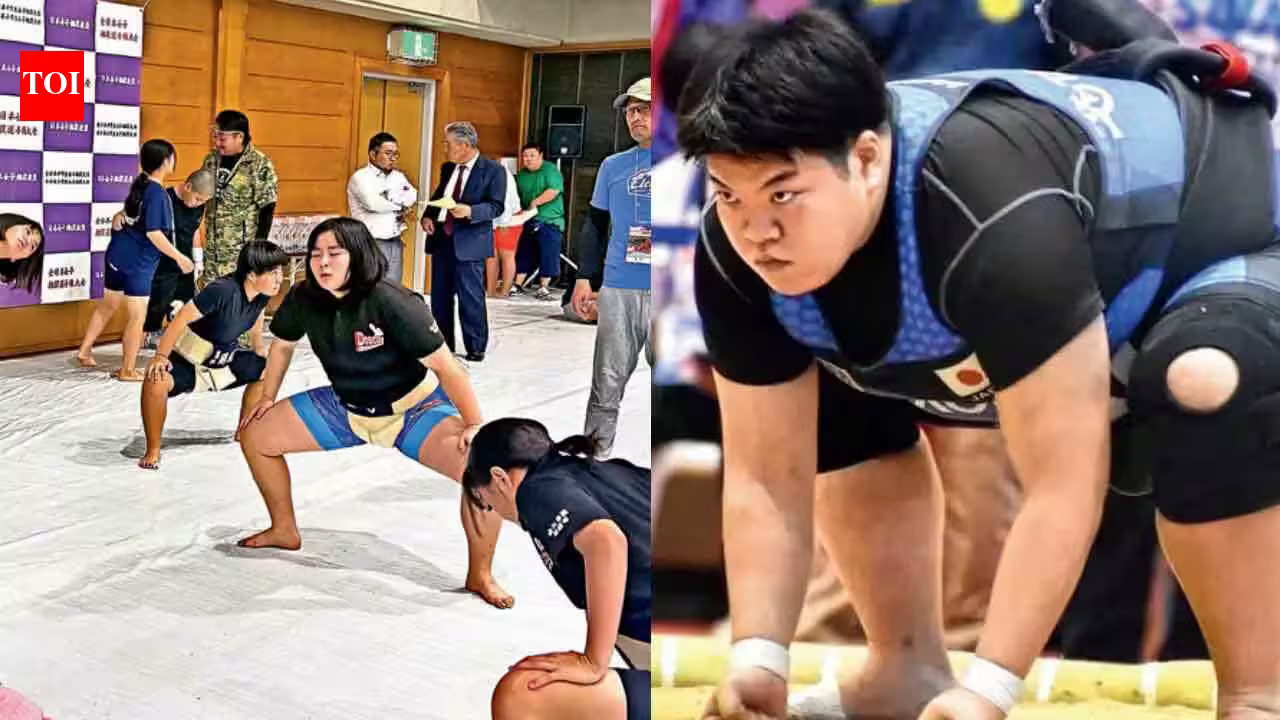
Kyoto—The rain drums rhythmically against the corrugated roof of the Kyoto City Budo Centre, but inside, the atmosphere is electric. More than 100 women and girls are moving with a focus that suggests nothing else in the world exists but the circular space in front of them. They are clad in traditional mawashi belts and singlets, their eyes locked on opponents, their feet driving into the floor with the controlled aggression of elite athletes.
At the heart of the hall sits a raised ring. It looks, moves, and functions exactly like a professional dohyo. Yet, in the eyes of Japan’s rigid sporting establishment, this space does not exist.
### A Sacred Barrier and the Fight for Relevance
Sumo in Japan is more than a sport; it is an institution steeped in Shinto religious tradition. Central to that tradition is the prohibition of women entering the professional dohyo. The rationale, long cited by the Japan Sumo Association (JSA), stems from archaic beliefs that associate menstruation with impurity, a religious stigma that has successfully kept the professional ring a male-only sanctuary for centuries.
Despite this, the women gathered in Kyoto are proving that the sport’s spirit is not tethered to a gendered past. Today, more than 600 women across 70 clubs in Japan are practicing competitive sumo. They are not asking for a permission slip from the JSA; they are building their own infrastructure, brick by brick, club by club.
The resistance they face is not merely silent; it is often institutional and dismissive. Even at the Asian Games, a senior official of the Japan Wrestling Association famously laughed off the prospect of women’s sumo, declaring, “It’s no sport for women.” Such rhetoric persists even at the highest levels of government. Prime Minister Sanae Takaichi, while breaking barriers in her own right, has publicly stated, “I respect tradition. I will not step on the dohyo,” underscoring how deep the reverence for this exclusion runs in the national psyche.
### Reclaiming a Lost History
For these women, the argument that sumo is “for men” is not just sexist—it is historically illiterate. Researchers point out that women participated in sumo as far back as the fifth century. The sport enjoyed waves of popularity throughout the Edo period and into the early 20th century before the moral panics of 1926 saw women’s sumo officially banned.
It took until 1997 for organized women’s sumo to re-emerge from the shadows. Since then, the growth has been steady, though largely unsupported by the nation’s premier governing bodies. Without official recognition from the JSA, the sport survives through the sheer grit of universities, private clubs, and local enthusiasts who refuse to let the tradition die out for their daughters.
### The Modern Trailblazers
Leading the charge is Airi Hisano, a 27-year-old Tokyo native who is widely considered the strongest female sumo wrestler in the country. A polymath of martial arts with black belts in judo and karate, Hisano treats sumo with the same professional intensity as any Olympian.
Balancing her life as an administrative professional and security guard with her rigorous training schedule, Hisano is unfazed by the skepticism that follows her. “Of course people made fun of me because, in rigid gender spaces, acceptance wasn’t easy,” she admits. “But that didn’t bother me.”
Hisano’s presence at the top of the sport is a testament to resilience, but she is the first to admit that individual talent isn’t enough to secure the sport’s future. The talent pipeline is fragile. Mao Ueda, a coach at the Hirakata Sumo Club and a former judoka, notes that the lack of institutional backing creates a “cliff” for female athletes.
“With no recognition, money, or future, most girls drop out after university,” Ueda explains. “We need a structure to change that.”
### The Next Generation’s Dream
For the younger participants, the political and religious nuances matter far less than the visceral pull of the sport. Take 9-year-old Momoka, who trains under the watchful eye of her father, Katsumasa Kawase. Having practiced for two years, she isn’t worried about the Japan Sumo Association’s policies or the history of 1926. She is worried about her stance, her drive, and her technique.
“She wants to become an Olympian,” her father says, watching her warm up.
That dream—Olympic inclusion—is the North Star for the entire movement. Morita, who handles public relations for the all-female Yoko Sumo Club, acknowledges that the greatest hurdle is still basic awareness. “A major challenge is that many people are still unfamiliar with women’s sumo,” she says. “But what keeps the wrestlers going? They continue believing that the sport will eventually be included in the Olympics.”
As the afternoon session in Kyoto concludes, the physical demands of the day are written on the faces of the athletes. They have trained, sweated, and competed, proving that the tradition they are allegedly violating is far less significant than the humanity they are displaying. They are not merely fighting for a place in a ring; they are fighting for the right to define their own legacy in a land that has spent a century telling them to stay on the sidelines. The road to the Olympics is long, but if the energy in this rainy Kyoto hall is any indication, these women are not turning back.
Disclaimer: This content is auto-generated for informational purposes only.
Source: Read Original News